

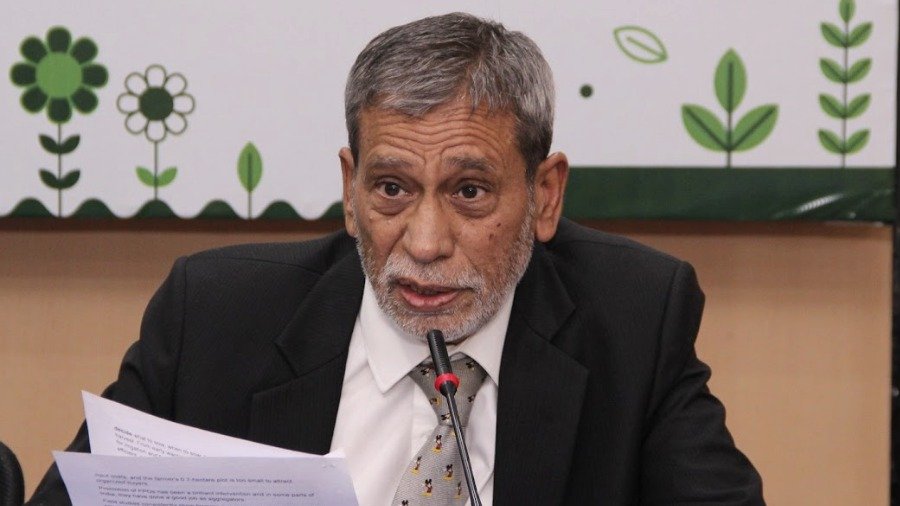
At the 7th Agri Business Conclave and Awards organised by Diplomatist Magazine at TERI School of Advanced Studies on 24th March 2026, Siraj Hussain, former Union Agriculture Secretary, offered a critical perspective on the future of agriculture, placing sustainability, innovation, and climate resilience at the centre of India’s agricultural transformation. His insights highlighted both the promise and the limitations of Artificial Intelligence (AI), while situating agricultural challenges within broader economic, institutional, and geopolitical contexts.
AI in Agriculture: Promise and Paradox
Opening his address with a striking observation, Hussain remarked, “Artificial Intelligence is the flavour of the season. Many of its proponents claim that it can solve all of humanity’s problems.” However, he cautioned against blind optimism by drawing attention to the unintended consequences of AI in other domains, noting that technological advancement without accountability can have grave repercussions.
Turning to agriculture, he acknowledged AI’s transformative potential. With over 140 million farm holdings—mostly small and marginal—India stands to gain significantly. Hussain highlighted that “India’s 140 million farm holdings… could together generate an estimated ₹70,000 crore in annual value if AI-enabled advisories help each farmer save even ₹5,000 a year.”
AI-enabled systems, drawing on data from satellites, drones, sensors, and weather stations, can support decision-making across the agricultural value chain—from sowing to harvesting and marketing. Government initiatives such as Bharat-VISTAAR aim to integrate multilingual AI tools with agricultural databases, enabling hyperlocal advisories even in low-connectivity rural areas.
Structural Constraints Beyond Technology
Despite these advancements, Hussain emphasised that technology alone cannot resolve the deeply entrenched structural challenges in Indian agriculture. He pointed out distortions in the fertiliser subsidy regime, which disproportionately incentivise urea use over balanced nutrients, and highlighted the limitations posed by fragmented landholdings.
“In Bihar, for example, the average landholding is just 0.39 hectares,” he noted, underscoring the difficulty of achieving economies of scale.
Market inefficiencies further exacerbate farmers’ vulnerabilities. Reflecting on his role in launching the National Agriculture Market (e-NAM), Hussain candidly admitted, “I had thought that it would help inter-state trade… Unfortunately, this has not been achieved to any significant strength.” As a result, farmers continue to capture only a fraction—around 30 percent—of consumer prices.
Climate Volatility and the Limits of Digital Solutions
Climate uncertainty remains one of the most formidable challenges. Hussain detailed recent extreme weather events, including unseasonal rains, hailstorms, and temperature fluctuations that have adversely affected wheat and pulse crops across multiple states.
He explained how even AI-driven advisories have limitations in such contexts: “While a harvested crop can be covered… how practical is it for farmers to cover their standing crop?”
This observation underscores a critical gap between technological recommendations and on-ground feasibility. While digital tools may provide early warnings—such as localised SMS alerts to millions of farmers—their utility is constrained by physical and economic realities.
Information vs. Institutional Gaps
A key argument in Hussain’s address was that the core challenges in Indian agriculture are not informational but structural. He emphasised that farmers already possess strong local knowledge systems and make rational decisions within their constraints.
“The binding constraints are economic and institutional, not informational,” he stated, cautioning that “digital advisories that ignore these realities risk generating technically sound but practically useless recommendations.”
He also pointed to the inadequacy of market infrastructure, particularly for perishables, noting that India lacks globally competitive agricultural markets despite significant investments in broader infrastructure such as highways and railways.
The Role of Institutions and Collective Action
Hussain acknowledged the success of Farmer-Producer Organisations (FPOs) as aggregators that can enhance farmers’ bargaining power and market access. However, he stressed that more systemic investment is required to strengthen agricultural infrastructure and ensure equitable benefits from technological advancements.
On crop insurance, he expressed hope that technology would expedite claim settlements, adding that making such data publicly available could enhance transparency and policy learning.
Precision Agriculture: Gains and Questions
As a precursor to AI-driven farming, precision agriculture has demonstrated clear benefits globally, optimising input use and improving yields. However, Hussain raised a critical question about equity and accessibility:
“Do our farmers have resources to invest in sensors for soil tests and other expensive equipment?”
Citing concerns from academic discourse, he noted that while such technologies may reduce subsidies and environmental stress—thereby generating public goods—the direct financial gains for farmers remain uncertain.
Diplomacy, Conflict, and Food Security
In a broader reflection befitting the conclave’s global outlook, Hussain touched upon the intersection of diplomacy and conflict. He lamented the declining effectiveness of diplomacy in preventing wars, warning of their potential implications for global stability and food security.
“It is a tragedy that diplomacy has been failing… One can only hope that the current war… will not finally end in a nuclear catastrophe,” he remarked.
Conclusion: Towards Inclusive and Resilient Agriculture
The future of Indian agriculture lies in a balanced approach—one that integrates technology with institutional reforms, strengthens market linkages, invests in infrastructure, and remains grounded in the lived realities of farmers. He called for a recalibration of policy priorities, ensuring that the benefits of innovation are inclusive, sustainable, and resilient in the face of growing climatic and economic uncertainties.


Leave a Reply