

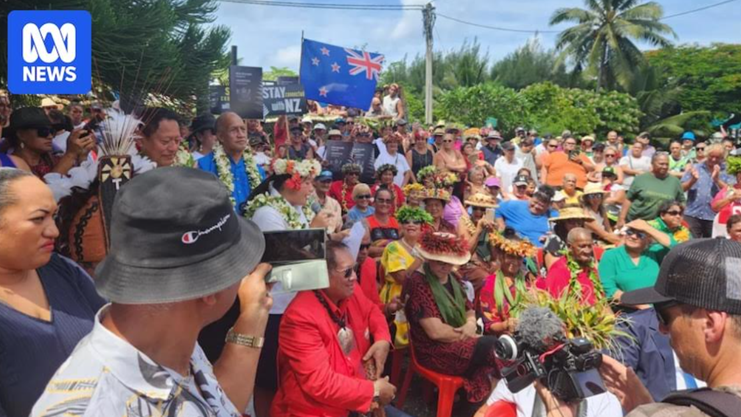
The year 2026 is shaping up to be a significant one in Pacific Islands geopolitics, as both the Cook Islands and New Zealand prepare to face elections amid evolving regional dynamics and increasing strategic competition in the Pacific.
Relations between the Cook Islands and New Zealand, which had experienced considerable strain over the past year, have recently improved. The two nations signed a new defence and security declaration, signalling the easing of a diplomatic row that erupted after the Cook Islands entered into strategic agreements with China.
It may be recalled that the Cook Islands and China signed a Comprehensive Strategic Partnership Agreement in February 2025.
The Cook Islands was a dependent colony of New Zealand from 1901 to 1965, but since then it has functioned as a self-governing nation in “free association” with New Zealand. Its population of approximately 17,000 people holds New Zealand citizenship, and both countries are expected to regularly consult each other on matters related to defence and security.
However, tensions emerged in February 2025 when New Zealand expressed “significant concern” over the lack of transparency surrounding the Cook Islands’ decision to sign a strategic partnership agreement with China covering deep-sea mining, regional cooperation, infrastructure, and economic matters.
The agreement marked the first time that the Cook Islands had entered into a major strategic arrangement with a country outside its traditional partners — New Zealand and Australia. This development raised concerns in Wellington and Canberra over China’s expanding influence in the Pacific Islands region.
Earlier in April 2026, relations between the Cook Islands and New Zealand began to improve following the signing of a declaration requiring both parties to act in good faith and consult one another on defence and security matters.
As noted by New Zealand’s Foreign Affairs Minister, Winston Peters, the two governments had faced a series of “serious disagreements” since late 2024. However, he described the declaration as an effort aimed at “setting a course together for the future” and providing greater clarity regarding the bilateral relationship.
The New Zealand Realm — comprising New Zealand itself, the Cook Islands, Niue, and Tokelau — continues to carry historical and constitutional associations linked to colonial legacies. While the Cook Islands remains part of the Realm, its relationship with New Zealand is officially described as one of “free association,” under which two self-governing states cooperate voluntarily on areas such as defence, external affairs, and citizenship.
Yet, as developments following the China agreements have demonstrated, the “association” aspect of the relationship appears to carry greater weight during periods of geopolitical contestation.
Unlike the Compact of Free Association arrangements between the United States and Pacific states such as Palau, Federated States of Micronesia, and Marshall Islands — which are governed by treaties between sovereign states — the Cook Islands’ constitutional status remains rooted in New Zealand’s 1964 Cook Islands Constitution Act.
As this framework is based on New Zealand legislation, it retains inherited mechanisms of oversight and conventions of consultation with Wellington. While these conventions are not legally binding, they create a continuing structural tension between autonomy and expectation. This tension has become central to the enduring constitutional ambiguity surrounding the Cook Islands’ international engagement and explains why the concept of “consultation” remains politically sensitive.
This constitutional arrangement also explains why both the Cook Islands and Niue operate internationally in many ways like sovereign states, yet do not possess the full constitutional architecture normally associated with complete independence. Both territories enjoy international legal personality: they can sign treaties and participate in specialised international agencies. However, neither is a full member of the United Nations.
The issue is not a lack of international recognition. The Cook Islands established formal diplomatic relations with China in 1997 and with the United States in 2023. Rather, any move toward full UN membership would inevitably raise questions regarding the future nature of their free association with New Zealand, particularly concerning citizenship arrangements and constitutional status.
Relations between China and Wellington have also had spillover effects on relations between Niue and New Zealand. This was reflected in the new Political Declaration signed between Niue and New Zealand on 13 November 2025.
Under Clause 5 of that declaration, Niue is expected to pursue its foreign policy “consistently with its enduring alignment with New Zealand’s fundamental interests” — a formulation that effectively leaves the interpretation of those interests largely in Wellington’s hands.
On a similar front, Wellington has sought comparable assurances from the Cook Islands. New Zealand had provided approximately US$116 million in funding assistance to the Cook Islands between 2022 and 2025, according to official figures, but temporarily halted portions of the funding following the China agreement controversy.
New Zealand Foreign Minister Winston Peters later confirmed that funding support would now resume.
“If anyone understands Polynesian society, cousins fall out now and again,” Peters remarked. “Our job is getting it back.”
In return, New Zealand has reaffirmed its commitment to remain the Cook Islands’ primary defence and security partner. Under Clause 7 of the recently signed declaration, New Zealand pledged to continue providing defence cooperation, security assistance, and capacity-building support to the Cook Islands.
Clause 8 further commits New Zealand to enhancing defence engagement and upholding the responsibilities of the New Zealand Defence Force toward the Cook Islands.
Meanwhile, Clause 10 requires both parties to consult each other in good faith on defence and security matters that may affect the Cook Islands’ interests. Clause 13 additionally provides for regular structured dialogue and the sharing of information on defence and security issues upon request and to the fullest extent possible.
In conclusion, as both the Cook Islands and New Zealand head toward elections this year, it will be particularly interesting to observe how both incumbent governments and opposition parties navigate the evolving strategic realities of the Pacific. The coming months may significantly shape the future direction of the Realm countries and their place within an increasingly contested Indo-Pacific geopolitical landscape.


Leave a Reply