

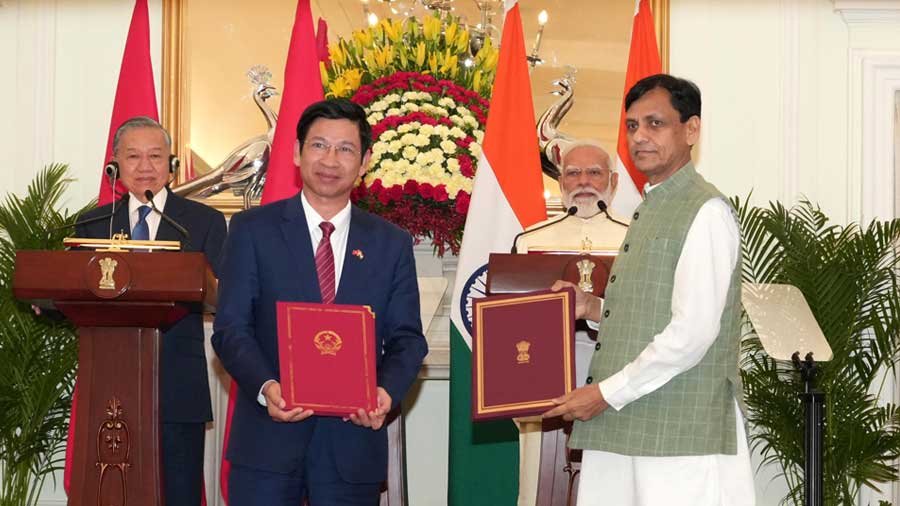
As India and Viet Nam enter a new phase of their partnership, cultural diplomacy is no longer a supporting element of bilateral relations, it has become one of its principal drivers. Heritage conservation, academic collaboration, tourism, aviation connectivity, Yoga, Buddhist exchanges and growing interaction between ordinary citizens have created a relationship that extends far beyond official diplomacy.
While strategic cooperation, defence and trade have emerged as defining pillars of the India–Viet Nam partnership, it is the warmth of people-to-people ties that continues to give the relationship its unique character. Across centuries, the two countries have been connected by the movement of ideas, faith, art and commerce rather than conquest. Today, these civilizational bonds are finding renewed expression through cultural diplomacy, heritage conservation, tourism, education and growing air connectivity, making this dimension of the relationship one of its most dynamic and enduring strengths.
The year 2026 marks not only a decade of the Comprehensive Strategic Partnership but also the beginning of a new cultural roadmap. During the State Visit of General Secretary and President Tô Lâm to India in May 2026, both sides reaffirmed that cultural exchanges and people-to-people contacts remain indispensable to strengthening mutual trust and understanding. The signing of the Viet Nam–India Cultural Exchange Programme (CEP) 2026–2030 provides a structured framework for expanding cooperation in performing arts, museums, archaeology, literature, exhibitions, cultural festivals, academic exchanges and youth engagement over the next five years. More importantly, it signals a shared recognition that diplomacy is strengthened not only by governments, but by sustained interaction between societies.
Few countries share civilizational ties with India as profound as those of Viet Nam. Buddhism has served as a spiritual bridge for nearly two millennia, while the influence of Indian philosophy, Sanskrit, Hindu iconography and maritime trade can still be witnessed in the Cham heritage that flourished across central Viet Nam. Rather than viewing these links as historical artefacts, both governments are consciously investing in preserving and celebrating this shared legacy.
India’s conservation work at the UNESCO World Heritage Site of Mỹ Sơn Sanctuary remains one of the finest examples of cultural diplomacy in action. The Archaeological Survey of India has successfully completed restoration work in Blocks A, H and K and is currently undertaking conservation of Blocks E and F. During the 2026 State Visit, Viet Nam also acknowledged India’s restoration efforts at the historic Nhan Tower, reflecting the high level of confidence placed in Indian archaeological expertise. These projects extend well beyond conservation; they preserve a shared civilizational memory while creating new opportunities for academic collaboration, heritage tourism and cultural research.
Another significant outcome of the visit was the agreement to collaborate on the digitisation and preservation of ancient Cham manuscripts. Many of these invaluable texts, written in Sanskrit, Cham and related scripts, offer rich insights into Southeast Asia’s historical interactions with the Indian subcontinent. Their preservation through modern digital technologies will not only safeguard an important cultural archive but also enable scholars from both countries to undertake collaborative research on language, religion, art and maritime history.
Education is increasingly reinforcing these civilizational links. The decision to establish India Studies Chairs at Vietnamese universities represents an important investment in long-term intellectual engagement. These academic centres are expected to promote research on Indian history, politics, economics, philosophy and contemporary society while encouraging greater scholarly collaboration between universities in both countries. Combined with expanding student exchanges and research partnerships, such initiatives will help cultivate a new generation of scholars with a deeper understanding of each other’s societies.
Equally significant is the growing popularity of Yoga across Viet Nam. What began as a modest cultural initiative has evolved into one of the most visible symbols of India’s soft power. The International Day of Yoga is now celebrated annually across numerous Vietnamese cities and provinces, attracting thousands of participants from diverse age groups. Yoga studios, wellness centres and certified instructors have become increasingly common, reflecting a broader appreciation of holistic health and traditional Indian knowledge systems. During the 2026 discussions, both sides expressed support for closer cooperation between yoga institutions, further expanding this successful dimension of cultural engagement.
Religious tourism is emerging as another promising avenue for strengthening people-to-people ties. Recognising Buddhism as a shared spiritual heritage, the leaders encouraged greater exchanges among monks, pilgrims, scholars and students. India has invited Vietnamese pilgrims to visit the Buddhist Circuit, including Bodh Gaya, Sarnath, Rajgir and Kushinagar, while Vietnamese Buddhist institutions continue to welcome Indian scholars and practitioners. Such exchanges deepen spiritual understanding while generating sustainable tourism and academic cooperation.
Tourism has, in many ways, become the most visible manifestation of this expanding relationship. Viet Nam has rapidly emerged as one of the most sought-after destinations for Indian travellers, offering a compelling blend of cultural heritage, natural beauty, modern infrastructure and competitive pricing. According to official figures, 746,000 Indian tourists visited Viet Nam in 2025, representing an increase of nearly 50 percent over 2024 and almost four times the number recorded before the pandemic in 2019. This remarkable growth places Viet Nam among India’s fastest-growing outbound destinations in Southeast Asia and underscores the increasing familiarity between the two societies.
Several factors explain this tourism boom. Simplified visa procedures, expanding hospitality infrastructure, targeted tourism promotion and a growing preference among Indian travellers for experiential destinations have all contributed to Viet Nam’s rising popularity. Destinations such as Hanoi, Ho Chi Minh City, Da Nang, Ha Long Bay, Ninh Binh, Phu Quoc and Hoi An now feature prominently on Indian travel itineraries, while wedding tourism, MICE travel and family holidays have opened entirely new market segments.
Supporting this remarkable growth has been the rapid expansion of aviation connectivity. From only a handful of weekly services following the pandemic, the two countries are now connected by nearly 90 direct flights every week, linking major Indian cities with Hanoi, Ho Chi Minh City and Da Nang. New routes introduced over the past year have substantially reduced travel time and enhanced accessibility, making short leisure breaks and business travel increasingly convenient. The two governments have welcomed this progress and encouraged their civil aviation authorities to further strengthen air connectivity, recognising that improved mobility is fundamental to expanding tourism, business and educational exchanges.
Complementing these developments, the signing of the MoU on Tourism Cooperation during the May 2026 visit provides an institutional framework for joint destination marketing, sustainable tourism, capacity building and greater collaboration between tourism authorities and the private sector. It reflects a shared ambition to diversify tourism beyond traditional sightseeing by promoting Buddhist circuits, heritage tourism, wellness travel, cruise tourism and cultural festivals.


Leave a Reply