

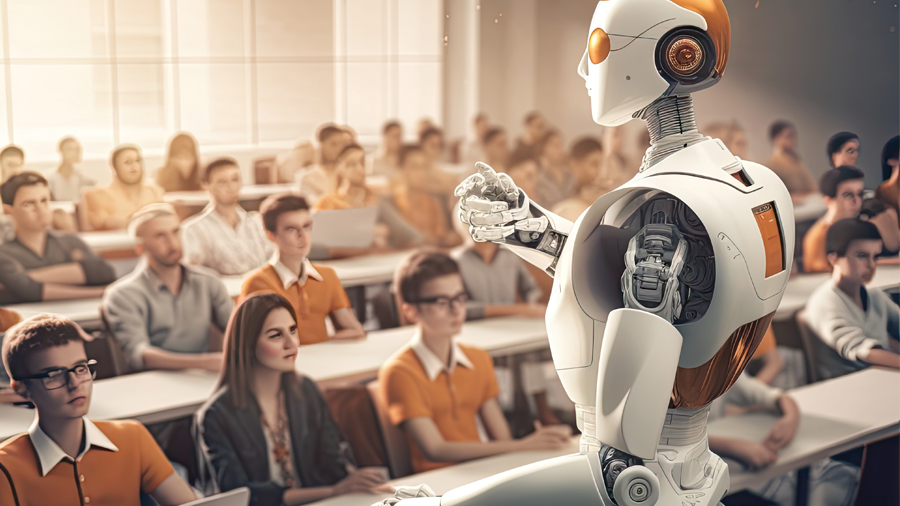
AI is the hottest topic of discussion at most seminars and conferences today, both nationally and internationally. I attended an IIFT seminar on 4 June on ‘Leveraging AI in Management Education.’ Eminent experts spoke, and it was clear that ethics comes first when it comes to decision-making, and AI cannot replace ethics. However, progressive thinkers feel that AI may not be the perfect teacher, but adventurous professors are already experimenting with AI agents to take portions of their classes.
AI’s integration into pedagogy is being pioneered by ISB Hyderabad, and AI has already started assessing students. The day is not far when evaluation will largely be carried out using AI. But what happens if students’ submissions are entirely AI-based? Does AI then assess AI? That remains a tall order!
However, the fact that AI compresses time and enhances productivity is no longer in dispute. Insurance companies, for instance, regularly use AI to assess buyers’ preferences. Drones are being used to capture images of accident sites, enabling insurance companies to make more accurate assessments. It is estimated that nearly 40% of consultants use AI to enhance their businesses. Undoubtedly, AI is a potent force, energising the functioning of company boards, enabling company secretaries to ensure extensive compliance, and facilitating strategic decision-making.
One expert from BIMTech remarked that AI compromises the cognitive abilities of human beings. Another expert, however, mentioned that, with AI’s assistance, we need to overhaul the way we teach and engage with students. He also stressed that agentic AI can build products, develop case studies, enhance learning during internships, and add value to complex projects. IIT Mumbai is examining whether AI can be fruitfully integrated into meaningful research activities. There is no doubt that AI is rewriting literature, learning rapidly, and requires the right craftsmen to exploit its full potential.
At another educational seminar held at the India International Centre (IIC) a day earlier, on 3 June, I saw experts focusing on ‘AI Authorship and the Emerging Creative Ecosystem.’ Several teachers and writers candidly expressed their views on AI’s growing influence. Succinctly, the following important observations emerged from the perspective of learning, teaching, and education:
1 AI can be a dream or a nightmare (what I call the “darling or devil” enigma).
2 Balance is required in the use of AI, as it can be revolutionary. The rapidity of its development is unprecedented. Verification of AI output is necessary, especially for students, who can easily be taken in by its agility and speed of response.
3 If not controlled and regulated carefully, AI can become a Frankenstein. Many believe that AI has no consciousness and is therefore vastly different from human capacity and capability. However, AI has developed the ability to create “authorless horizons,” making it increasingly difficult to distinguish reality from fabrication.
4 Since AI has unimaginable possibilities, it is important to understand how the “cultural halo” may be affected by it. Collaboration between human beings and AI should always remain the first priority. AI can change the dynamics of composition; therefore, original creative thinking should never be compromised.
5 Generative AI can produce text with remarkable ease. It can also “mimic data” available in the public domain and cause enormous problems if it is not carefully regulated and monitored.
6 Critics argue that AI is “an automated aggregator of human expressions rather than a real creator.” They contend that divergent and deeply personal human experiences cannot be captured by AI. While this view may be disputed by many, the fact remains that AI can generate intelligent and highly readable text. However, some critics go further, calling AI a “soulless commodity” that can produce content on a massive scale but can never surpass individual creativity. Some even describe artificial intelligence as “artificial illusion.”
7 In the field of education, students are confronted with a colossal explosion of information. AI alone is capable of handling such a surfeit of data today. The important requirement is the existence of a trustworthy ecosystem. Mindfulness is equally important because we must carefully analyse what to extract from AI and how it can support, rather than replace, our original thinking.
8 Conventional teachers take pride in the fact that their ability to mentor, provide moral guidance, and offer situational advice to individual students can never be replaced by AI. AI is best suited to a one-size-fits-all approach. It cannot truly distinguish the unique needs of every student, particularly those with special learning requirements.
9 A professor from IIT Delhi is a strong proponent of AI and, based on his experience, remarked that AI provides the greatest opportunity for the “democratisation of knowledge creation.” Today, knowledge need not remain confined to the elite. AI facilitates scholarly writing, and language is no longer a barrier. Individuals with strong ideas but weaker academic writing skills or language proficiency can leverage AI to produce meaningful research papers or develop innovative start-ups despite their linguistic limitations.
Ajit Ranade echoes this view by asking whether Indian universities should look upon AI as a “learning partner” or merely as a “cheating device.” However, a McGraw Hill study conducted in the USA offers two stunning revelations. Up to the 5th grade, students generally do not use AI to cheat, and their learning progresses normally. However, cheating becomes noticeably more prevalent from the 6th grade onwards, as students attempt to obtain correct answers quickly. In controlled situations, AI-habituated students perform poorly because they have dulled their minds and are unable to solve problems that they could have tackled before the advent of AI.
It is becoming abundantly clear that AI is like a sharp knife that can cut the finger, but if used wisely, it can help carve out a complete dish. Hence, according to the IIT professor, AI is a great “equaliser of intellectual property,” and its role in granting intellectual freedom must be recognised, developed, and respected.
The data on AI’s penetration into the education sector is telling. Press reports indicate that the demand for AI talent in India is expected to reach 1.2 million by next year. The Salesforce Chief Digital Officer says that AI will be as “essential as electricity” within the next five years. Similarly, Udemy’s Country Manager reports a high demand for courses across the entire AI spectrum, in both the B2B and B2C segments.
It is apparent that younger professionals are entering the AI ecosystem more frequently and are keen to learn real-world implementation and advanced skill-building techniques. Coursera has introduced 2,700 new courses covering AI technology, data analytics, and data leadership. UpGrad is developing Foundation Gen AI literacy courses for B2C learners, particularly four- to six-month programmes in Data Science, AI and ML, and full-stack development. Agentic AI programmes are currently the most sought-after, according to the President of Emeritus.
AI is a favourite tool of Gen Z today. Gen Z will determine how far and how fast AI will be adopted and adapted in everyday life. The fact that even mundane questions are now being put to AI in drawing rooms reflects the momentum it has gained in educating people on the nitty-gritty of everyday life. Questions that were once left unanswered, forgotten, or swept under the carpet are now routinely posed to the many AI alternatives available today. In a trice, answers appear—even for a housewife’s recipes!
The very fact that AI is taking centre stage globally has made some countries, such as Norway, cautious enough to ban its use for primary and middle school students. India is particularly vulnerable to the misuse of AI, and therefore a well-considered regulatory framework must be put in place urgently by MeitY. Any delay could prove disastrous for our economy, especially for our youth. The PMO must intervene and ensure that this process is set in motion sooner rather than later.
The Ministry of Corporate Affairs (MCA) has taken the lead in the use of AI for corporate governance by upgrading its MCA21 V3 platform with AI and machine learning for “data classification, policy analytics, stakeholder feedback processing, and improved corporate filings.” Top management, perforce, must develop a hybrid skill set in which business acumen and digital literacy go hand in hand with AI systems to achieve greater efficiency and effectiveness. AI is consolidating voluminous data from multiple sources into a single dashboard, making fragmented reports redundant and saving both time and money. In short, AI brings “speed and scale, while the human mind provides wisdom and accountability,” with the final decision ultimately resting on human judgment.
The question then is: Does AI provide the right answers? Can it be the perfect teacher? It depends. My experience shows that the more time I spend refining and calibrating the prompt, the better the results. Moreover, with authentication now demanded in every response, AI works harder to scan data across the public domain before producing its answers. Once my creative dish is ready, I ask AI whether anything is amiss or whether there is anything worth adding. Promptly, AI identifies what my logical or creative mind may have overlooked and urges me to make improvements.
My conclusion, therefore, is that AI requires the best commands to produce the best answers. Those who complain about AI should first master prompt engineering! More importantly, AI is no longer merely virtual. The market for humanoid robots is projected to grow nearly twenty-five-fold—from $6 billion today to $165 billion over the next ten years—with estimated shipments of 1.4 million units, according to Goldman Sachs. If a perfect teacher is what we seek, robots may well be taking classes in the not-too-distant future.



Leave a Reply