

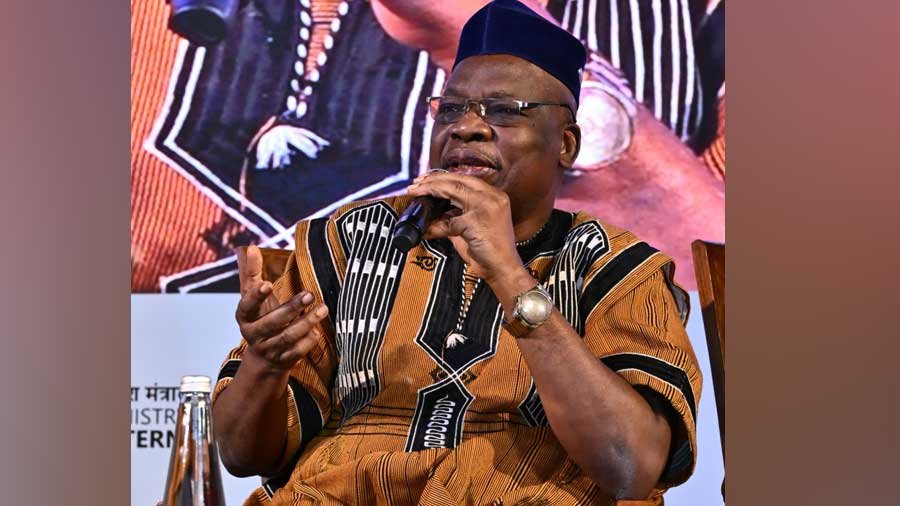
At DAKSHIN Day 2026, H.E. Dr. Désiré Boniface Somé calls for people-centred cooperation focused on poverty reduction, security, education and healthcare.
The Global South must move beyond discussions and translate its shared aspirations into practical initiatives that improve people’s lives, said H.E. Dr. Désiré Boniface Somé, Ambassador of Burkina Faso to India, at DAKSHIN Day 2026 in New Delhi on 17 November.
Speaking during the session on “New Global South Strategic Partnership” at the India Habitat Centre, Ambassador Somé challenged policymakers and institutions to make the idea of the Global South more meaningful to ordinary citizens, particularly young people. He stressed that the concept should not remain confined to academic discussions or diplomatic forums, but should be understood through the tangible benefits it can deliver to communities.
“Global South must move from theory to practice,” he said, underlining the need to explain what the concept means to people and, more importantly, what it can do for countries and their citizens.
He proposed that DAKSHIN and the Research and Information System for Developing Countries (RIS) could serve as an “idea bank” for the Global South by bringing specific themes into focus, including health, agriculture, culture, education and people-to-people connections. Such discussions, he suggested, should lead to practical recommendations and cooperation on the ground.
For Amb Somé, the real measure of South-South cooperation lies in its ability to address persistent development challenges, particularly poverty. He called for concrete collaborative activities rather than an approach centred primarily on conferences and statements. “Global South must go to people, go to ground,” he emphasised, advocating cooperation that produces visible improvements in everyday lives.
He also drew attention to the security challenges confronting parts of Africa, including Burkina Faso and the wider Sahel region. Having faced terrorism-related challenges for over a decade, his country understands the importance of solidarity and cooperation in addressing insecurity. He urged Global South partners to give greater attention to security concerns across the Sahel and Central Africa.
Education and healthcare emerged as two further priorities. Somé called for deeper university-to-university partnerships between India and African countries, including initiatives that could bring Indian higher education institutions closer to students in Africa. He noted that the financial resources required to travel to India for higher education can be a barrier for many young people. Greater institutional collaboration, he suggested, could widen access to learning and strengthen academic ties.
In healthcare, he encouraged partnerships between Indian and African hospitals and clinics, enabling medical expertise and services to become more accessible within African countries. He pointed to the potential of medical cooperation that goes beyond patients travelling abroad for treatment.
Concluding his address, the Ambassador returned to the central idea that cooperation must be judged by its practical outcomes. For him, a meaningful Global South partnership is one that reaches communities, expands opportunities and responds directly to the priorities of people. His message was clear: the next chapter of South-South cooperation must be measured not simply by the conversations it generates, but by the change it delivers.


Leave a Reply