

The discourse surrounding educational technology has fundamentally outgrown the simplistic paradigms of the past decade. For years, the global conversation was monopolised by the mere digitisation of textbooks or the commercial proliferation of proprietary learning applications. The pandemic violently accelerated this trend, forcing a reliance on commercial EdTech that, while necessary, exposed severe structural vulnerabilities: glaring digital divides, the exorbitant costs of vendor lock-in, and the precariousness of student data privacy.
Today, we are witnessing a profound geopolitical and structural shift in pedagogy. As nations grapple with the dual challenges of demographic expansion and economic restructuring, educational technology has transitioned from a supplementary consumer sector into a core pillar of critical infrastructure.
The DPI Paradigm: Private Innovation on Public Rails
The most consequential innovation in modern educational technology is not an artificial intelligence model or a virtual reality headset; it is the conceptual shift toward Digital Public Infrastructure (DPI). Historically, the EdTech market operated in walled gardens. Large technology conglomerates built proprietary platforms, captured user data, and dictated the terms of access. This model inherently marginalised low-income demographics and constrained the ability of governments to shape equitable learning outcomes.
The DPI approach upends this dynamic by treating the foundational layers of digital learning as public goods. Much like a government builds physical highways upon which private logistics companies operate, the state builds the digital rails, identity verification, content registries, and interoperable data protocols, allowing private innovators to build, scale, and monetise their solutions on top.
This collaborative Public-Private Partnership (PPP) moves away from profit-making models to making education more inclusive. By utilising open-source architecture, governments lower the barrier to entry for local startups. A nascent EdTech firm in a developing economy no longer needs to spend millions building a proprietary backend; it can plug directly into the national digital infrastructure and focus entirely on creating culturally relevant, pedagogical innovations. This symbiotic relationship ensures that the state maintains governance and broadens access, while the private sector is incentivised to drive agility, deep tech integration, and specialised content creation. It is a market design that fosters competition based on educational outcomes rather than data monopolisation.
The Indian Blueprint: Policy, Scale, and Inclusivity
To understand the sheer operational scale of this revolution, one must look at India’s strategic deployment of educational DPI. The National Education Policy (NEP) 2020 explicitly recognised that true digital transformation must be architecturally inclusive. This ethos birthed DIKSHA (Digital Infrastructure for Knowledge Sharing), under the PM eVidya initiative.
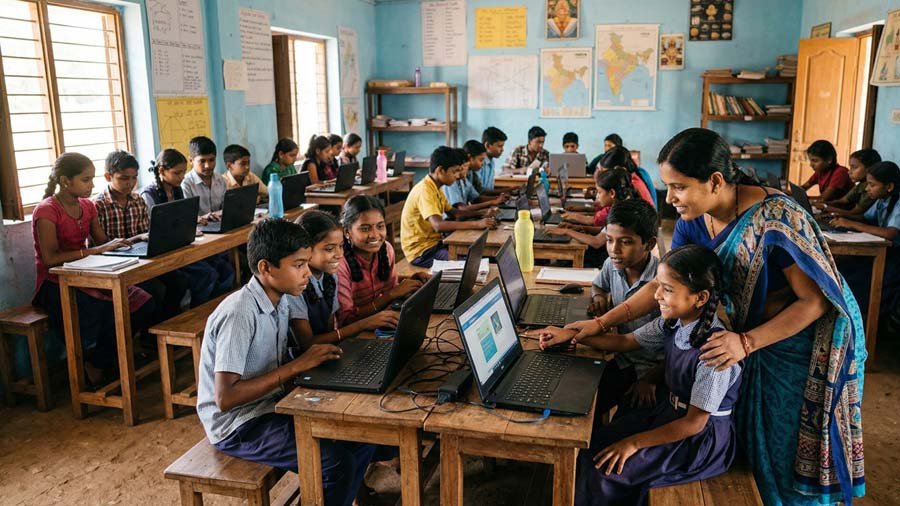
Operating on an open-source technology framework (Sunbird), DIKSHA serves as a foundational ecosystem. It boasts over 180 million course enrollments and is a vital bridge across India’s complex socio-linguistic landscape. Supporting 36 Indian languages, it fundamentally addresses the access paradox that has long plagued digital learning. Acknowledging that there can be connectivity gaps, the platform is designed to also provide offline capabilities. Textbooks are embedded with QR codes that, when scanned, link students to energised digital content that can be downloaded and consumed without a persistent internet connection. This ensures that the benchmark for success is not defined by how many premium devices are deployed in elite urban centres, but by how seamlessly a foundational learning protocol can be accessed by a student in a remote, low-connectivity district. The Indian government’s priority is clear: technology must conform to the realities of the population, not demand that the population conform to the limitations of the technology.
The Governance Imperative: Legal and Ethical Guardrails
However, the deployment of technology at a population scale introduces immense legal and governance challenges. As we transition from simple digital content delivery to sophisticated AI-driven learning environments, the regulatory friction increases exponentially. As public affairs professionals, we observe that the governance of learning is quickly becoming as critical as the technology itself.
The primary friction point is data sovereignty and privacy. When private innovators operate on public rails, the volume of student data generated, ranging from cognitive behavioral patterns to biometric login data, is staggering. Without rigorous legal guardrails, this data is vulnerable to commercial exploitation. Frameworks akin to India’s Digital Personal Data Protection (DPDP) Act are essential to mandate purpose limitation, data minimisation, and the explicit protection of minors. The state must ensure that the data is utilised strictly for pedagogical enhancement.
Furthermore, we are entering the era of algorithmic opacity. As AI is increasingly utilised for adaptive learning and automated student assessment, the risk of encoding societal biases into learning software is high. If an algorithm determines a student’s aptitude or learning trajectory based on historically skewed datasets, it can institutionalise inequality under the guise of technological objectivity. Therefore, next-generation EdTech policy must demand algorithmic transparency. Governments must establish auditing mechanisms to ensure that AI models deployed in classrooms are ethical, explainable, and regularly tested for bias. Innovation cannot outpace the rule of law; regulatory frameworks must evolve synchronously with technological capabilities to protect the fundamental rights of the learner.
EdTech as Soft Power: Tech Diplomacy in the Global South
The success of this sovereign, open-source model has implications that stretch far beyond domestic borders, transforming educational DPI into a potent instrument of tech diplomacy. For the broader Global South, institutional capacity has historically struggled to match the educational demands of booming youth populations.
India’s DPI offers a vital “third way.” By internationalising platforms like, DIKSHA much like the successful global export of the Unified Payments Interface (UPI), India is projecting a unique form of soft power, a diplomacy of empowerment. By exporting open-source architectural frameworks, India allows partner nations in Africa, Southeast Asia, and Latin America to build customised, localised EdTech ecosystems that respect their own digital sovereignty.
This cooperative approach positions India as the architect of a democratic, inclusive global technology order. Offering technical assistance and sharing the blueprints of its educational infrastructure fosters deep geopolitical goodwill and creates a shared, interoperable digital economy among developing nations. It establishes a collaborative alliance where the Global South is no longer merely a consumer of foreign technology, but an active participant in building sovereign, resilient digital futures.
Conclusion
The “EdTech Revolution” is fundamentally a misnomer; what we are experiencing is an infrastructure revolution. By shifting the paradigm from private walled gardens to Digital Public Infrastructure, we are democratising the very foundation of knowledge distribution.
The collaborative PPP model ensures that the agility of private enterprise is harnessed to serve the public good. The Indian experience anchored in the inclusive mandates of the NEP 2020 and the massive scale of DIKSHA, proves that when technology is intentionally designed for the most marginalised, it elevates the entire ecosystem. Yet, this potential can only be secured through stringent legal frameworks that demand data privacy, algorithmic transparency, and ethical AI deployment.
As the world rapidly digitises, the export of these sovereign, open-source models will become a defining feature of 21st-century tech diplomacy. The nations that successfully build, govern, and share equitable digital infrastructure will not only secure the future of their own youth but will shape the diplomatic and economic contours of the global stage for decades to come.



Leave a Reply