

For most of the post-war era, “energy security” meant one thing: enough oil, gas, coal or electricity to keep an economy running. That definition no longer holds. Energy security today begins in a mine, not a power station, the refining plant, the battery factory, or the port. It is a supply-chain problem before it is ever a generation problem, and nowhere is this more consequential than in the relationship between Australia, the world’s pre-eminent resource holder, and India, one of the world’s fastest-growing consumers of clean-energy inputs.
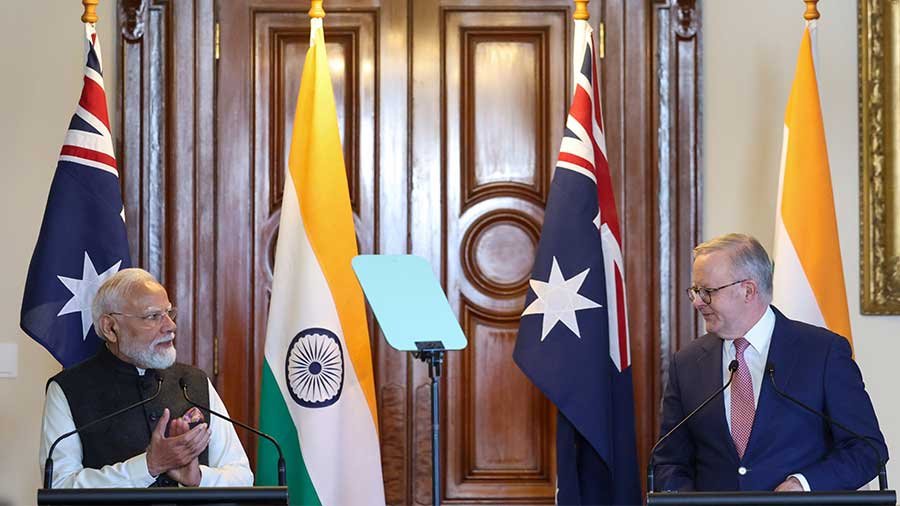
The case for an India–Australia energy corridor is not new in principle. What has changed is the urgency, and the evidence that the two governments are finally treating it as such. The third India–Australia Annual Summit[1], held around Prime Minister Narendra Modi’s visit to Australia in July 2026, moved the relationship from communiqué to construction: the two sides announced a dedicated Critical Minerals Corridor and, notably, formalised long-term offtake agreements from Australian lithium operations — the financial instrument that actually de-risks downstream investment in Indian battery manufacturing. The newly agreed Australia-India Partnership on Cyber, Critical Technologies and Supply Chains (PACTS), alongside the trilateral Australia–Canada–India Technology and Innovation (ACITI) Partnership, extends the co-operation beyond a purely bilateral frame into the kind of trusted-partner network that a China-dependent supply chain has never had.
This shift matters because the strategic backdrop has become considerably sharper. China’s rare earth export restrictions tightened in waves through 2025 and again in early 2026[2], with dual-use controls affecting flows to Japan, which remains the single largest source of supply-chain risk for every economy outside China.
Beijing suspended the most expansive October 2025 measures for a year after a trade truce with Washington, but that suspension expires on 10 November 2026[3]. This is not only a scarcity problem but a leverage problem: China controls roughly 90 percent of global rare earth refining capacity, and it deploys, eases, and threatens the tool as circumstances demand. For India, which still sources a large share of its refined lithium and finished battery components from China, this is not an abstract risk. It is the daily operating reality shaping the country’s clean-energy build-out.
Australia mines close to half the world’s lithium. But it exports most of it raw, without processing. Historically, that raw lithium went to China for refining.
Moving up the value chain has been harder than policy papers suggested. In February 2026, Albemarle decided to idle its Kemerton lithium hydroxide refinery in Western Australia.[4] The plant cost US$1.5 billion. It had opened less than four years earlier. This is a blunt reminder: even with subsidies, they struggle to compete with China’s lower costs.
Lithium prices have been on a wild ride too. Carbonate prices fell more than 80 per cent from their 2022 peak. Then they tripled between June 2025 and February 2026, as China tightened supply discipline. By mid-2026, prices eased again. That happened after CATL’s giant Jianxiawo mine cleared its permits and restarted. A corridor built on the assumption of stable, bankable pricing needs to be designed for exactly this kind of volatility, not surprised by it.
That is precisely why the emphasis on offtake agreements and joint-investment vehicles, rather than spot-market trade, is the right instinct. Predictability, not sentiment, is what makes private capital commit to refining and battery-grade processing plants that take years to build. It is also why India’s parallel strategy, striking critical-mineral partnerships with eleven countries, from Argentina and Zambia to Japan and the United States, should be read not as dilution of the Australian relationship but as insurance against exactly the kind of single-point failure that has already disrupted EV component supply once.
Five things would turn intent into an operating corridor: joint ventures that move lithium and rare earths from raw export into shared refining and battery-material production; parallel investment in green hydrogen and solar manufacturing, pairing Australian research with Indian deployment scale; skills transfer through institutions such as the India-Australia Rooftop Solar Training Academy; advanced manufacturing collaboration, including green steel trials linking CSIRO and Indian research bodies; and, critically, connection to wider regional architecture such as Japan’s capital and hydrogen technology, Singapore’s logistics and finance, and the Quad’s clean-energy diversification programme.
None of this is self-executing. Export-control shocks, price cycles and slow-moving refinery economics will keep testing the partnership’s resolve. But for the first time, the scaffolding – offtake contracts, identified projects, institutional plumbing — exists to bear real weight. The next eighteen months, running up to China’s November 2026 decision point on suspended export controls, will show whether Canberra and New Delhi treat that scaffolding as a corridor or leave it as another set of well-intentioned agreements.
References:
[1] Ministry of External Affairs, Government of India Media Releases; Third India – Australia Annual Summit Joint Statement <Available at> https://www.mea.gov.in/bilateral-documents?dtl/41426/Third_India__Australia_Annual_Summit_Joint_Statement
[2] China’s Rare Earth Campaign Against Japan <Available at> https://www.csis.org/analysis/chinas-rare-earth-campaign-against-japan
[3] China Temporarily Suspends Export Controls on Key Raw Materials, Including Rare Earths, Lithium Batteries, and Diamonds <Available at> https://www.cirs-group.com/en/chemicals/china-temporarily-suspends-export-controls-on-key-raw-materials-including-rare-earths-lithium-batteries-and-diamond
[4] Albemarle Announces Plans to Idle its Kemerton Lithium Hydroxide Processing Plant: Press release <Available at> https://www.albemarle.com/us/en/news/albemarle-announces-plans-to-idle-its-kemerton-lithium-hydroxide-processing-plant-a




Leave a Reply