

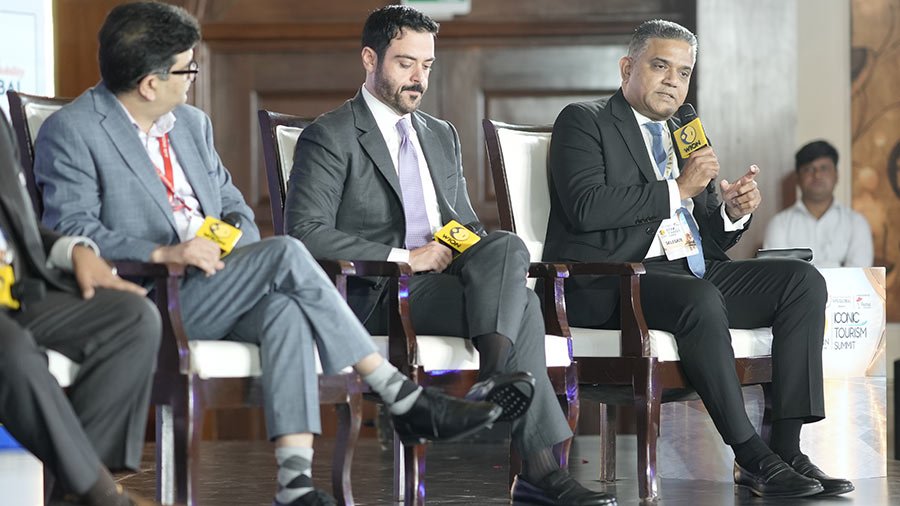
Tourism between India and Sri Lanka has long been shaped by geography, history and cultural familiarity. But according to Kamal Munasinghe, Senior Vice President – Colombo Hotels, Cinnamon Hotels & Resorts and General Manager, Cinnamon Life at City of Dreams Sri Lanka, the next chapter of the relationship should be about building a much more integrated tourism corridor between the two countries.
Speaking at the WION ICONIC Tourism Summit and Awards 2026 in New Delhi, Munasinghe made the case for looking beyond conventional measures of tourist arrivals and thinking instead about how people move between destinations, why they travel and how the two countries can complement one another.
“The India–Sri Lanka tourism corridor must work both ways,” Munasinghe subsequently noted in reflecting on his participation at the summit. “It’s not simply about increasing arrivals, but creating greater movement, stronger connectivity and more reasons to travel between our two countries, for leisure, business, weddings, MICE, entertainment and experiences.”
That idea of a corridor rather than a one-way tourism market, was central to his intervention.
Connectivity is the starting point
For Munasinghe, connectivity is fundamental to tourism growth. But he sees it as more than simply adding flights.
The objective is to make travel between India and Sri Lanka sufficiently easy, frequent and commercially viable to encourage different categories of travellers to move in both directions.
India is an important source market for Sri Lanka, but Indian visitors are not a homogeneous group. Travellers from different Indian cities and states can have different food preferences, cultural expectations, religious practices and travel motivations.
Munasinghe stressed the importance of understanding those distinctions when developing tourism products for India.
As he put it during the summit: “India is not just one India.”
The observation is particularly relevant for a destination such as Sri Lanka, which is geographically close to India but is competing for Indian travellers with a growing range of short-haul international destinations.
Understanding the Indian traveller, therefore, means going beyond broad market statistics.
The Indian traveller is changing
Munasinghe also addressed the changing expectations of today’s traveller.
Travellers are increasingly informed, digitally connected and conscious of the value they receive for their money. They research destinations extensively before travelling and increasingly document their experiences on social media.
During the discussion, he emphasised two particularly important considerations: value and experience.
“Number one is your quality and what you’re paying for, what you’re getting in your return,” he said.
The second, he suggested, is the desire to document and share the journey.
“People want to document that,” Munasinghe observed, referring to travellers sharing where they are going and what they are experiencing through platforms such as Instagram and Snapchat.
For hospitality businesses, this means the product can no longer be limited to a room and basic services. The destination, hotel, restaurants, entertainment, design and surrounding experiences all become part of the traveller’s decision-making process.
From destination to regional journey
One of Munasinghe’s more interesting ideas was to move away from thinking about destinations in isolation.
In his view, India, Sri Lanka and the Maldives can potentially complement one another rather than simply compete for the same traveller.
He subsequently described the opportunity as one of thinking beyond individual destinations and exploring how India, Sri Lanka and the Maldives can work together for the global traveller.
This approach reflects a familiar pattern in European tourism, where travellers commonly combine several countries within one holiday.
For South Asia, Munasinghe sees potential in creating similar multi-destination itineraries.
An international traveller could, for example, combine India’s cultural and heritage attractions with Sri Lanka’s beaches, wildlife and city experiences, before extending the journey to the Maldives.
For Indian travellers, the concept could work differently, a holiday in India could potentially be extended with a short Sri Lankan or Maldivian experience.
The proposition is therefore not necessarily about dividing a finite pool of tourists. It is about expanding the overall regional tourism offering.
India as both market and partner
Munasinghe’s comments also point to an important distinction: Sri Lanka does not simply view India as a source of tourists.
India is also a partner in building the regional tourism ecosystem.
Business travel, weddings, MICE, entertainment, healthcare, education and leisure can all contribute to movement between the two countries.
This is particularly relevant to Colombo, where the development of large-scale integrated hospitality and entertainment infrastructure is creating new possibilities for regional travellers.
Cinnamon Life at City of Dreams Sri Lanka was conceived as an integrated destination bringing together accommodation, dining, entertainment, retail, wellness and business facilities. Munasinghe has described its vision as going beyond a conventional hotel and helping position Colombo as a destination in its own right.
The property has also become part of Colombo’s wider ambition to attract international events, conferences, destination weddings and entertainment.
Building the human connection
Munasinghe also spoke about an element of tourism development that is sometimes overlooked: people working within the tourism industry need to understand one another’s markets.
His comments highlighted the importance of staff exposure and cross-market learning.
Cinnamon, he explained, has worked on exposing employees to different markets and hospitality environments, allowing teams to understand how tourism operates in different destinations.
This is important because building a tourism corridor requires more than flights and hotel rooms.
A strong corridor also needs people who understand the traveller on the other side.
For India and Sri Lanka, that can mean understanding differences in cuisine, cultural practices, religious requirements, family structures and travel behaviour.
Munasinghe’s argument is essentially that connectivity between countries has to be matched by cultural and professional connectivity between their tourism industries.
Colombo’s opportunity
The evolution of Colombo is central to this proposition.
For many international visitors, Colombo has traditionally functioned as an entry point to Sri Lanka before they move towards beaches, wildlife, tea country or heritage destinations.
Munasinghe believes the city increasingly has the ingredients to become a destination in its own right.
His current role at Cinnamon Life places him at the centre of that transformation. Cinnamon Life at City of Dreams has been positioned as a large integrated hospitality and lifestyle destination, bringing accommodation, entertainment, dining, retail and events together.
That model also supports the development of MICE tourism, destination weddings and entertainment-led travel, segments that can attract higher-value visitors and encourage longer stays.
Recent reporting on Munasinghe’s work at Cinnamon Life has similarly highlighted Colombo’s opportunity to grow its international MICE profile, with the property offering more than 160,000 square feet of flexible event space.
For Indian travellers, this opens up a particularly interesting segment: weddings, corporate events, incentives, conferences and celebrations that can bring groups of travellers rather than individual tourists.
The power of regional tourism
Munasinghe’s broader proposition is ultimately about thinking of South Asia as a connected tourism region.
The region already possesses many of the ingredients required: cultural diversity, short geographical distances, strong diaspora connections, multiple tourism products and growing air connectivity.
What has been less developed is the idea of packaging those assets collectively.
For the global traveller, a multi-country South Asian itinerary could offer a combination of experiences that no single destination can provide.
For the tourism industry, it could create opportunities for airlines, hotels, tour operators, cruise companies, MICE organisers and destination management companies to collaborate rather than operate entirely within national boundaries.
A corridor, not just a market
Munasinghe’s message at the WION summit ultimately comes down to a shift in perspective.
India should not be viewed merely as a market from which Sri Lanka seeks more arrivals. Nor should Sri Lanka be viewed simply as another destination competing for Indian outbound travellers.
The opportunity is to build a two-way tourism corridor, one that supports leisure, business, weddings, MICE, entertainment and experiences, while strengthening the movement of people between the two countries.
That requires connectivity, but also cultural understanding. It requires compelling destinations, but also trained people. And it requires individual countries to think beyond their own borders and consider how neighbouring destinations can complement one another.
For Munasinghe, the future is therefore less about asking “How many Indian tourists can Sri Lanka attract?” and more about asking “How much more travel can India and Sri Lanka create together?”
That distinction could prove important as South Asian tourism becomes increasingly interconnected and as travellers begin to see the region not as a collection of separate destinations, but as a network of experiences.


Leave a Reply