

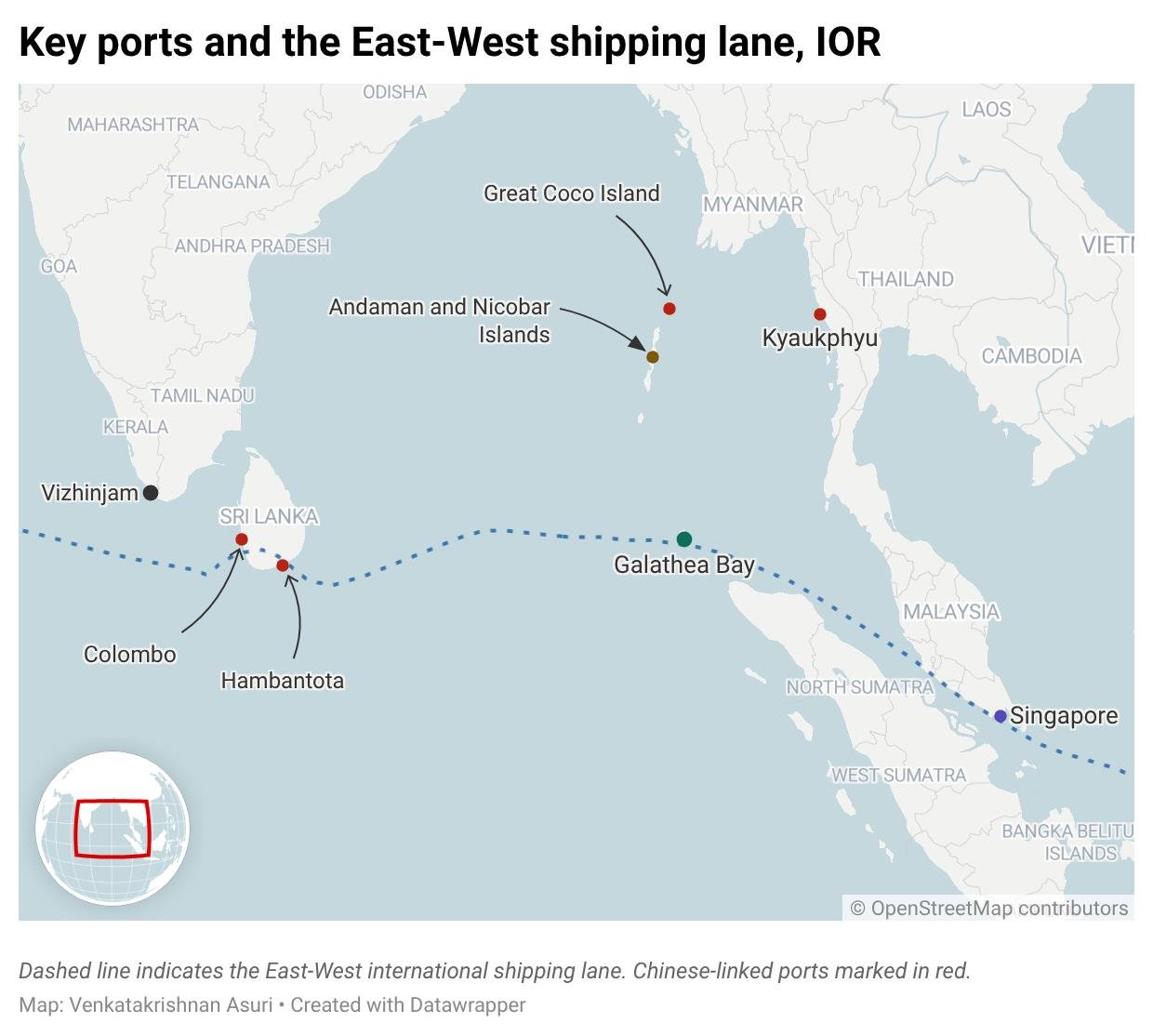
For nearly five decades after independence, India has treated the Andaman and Nicobar Islands primarily as its remote eastern frontier, rather than a strategic asset. This posture of benign neglect is no longer sustainable strategically and economically. It is in this regard that the Great Nicobar Project (GNP) is extremely consequential, consisting of an international transshipment terminal at Galathea Bay, a greenfield airport, a township and a 450 MVA hybrid power plant. The rationale for the GNP rests on the evolving strategic environment in the Indian Ocean and the exponentially increased costs of further delays.
China’s shifting maritime doctrine
The first reason remains China’s strategy in the Indian Ocean Region (IOR), which, under President Xi Jinping, has changed both in scale and character. This shift is consistent with China’s naval doctrine, which has evolved from coastal defence to one of “far seas protection”, with Beijing aiming to secure its interests beyond its immediate periphery. The Observer Research Foundation’s (ORF) assessment argues that Beijing’s objective has shifted from an episodic projection of power to the gradual construction of architecture pertaining to intelligence, surveillance and reconnaissance (ISR). Around 80 per cent of the 64 Chinese research and survey vessels active in the IOR are believed to have organisational links to the People’s Liberation Army (PLA). These vessels routinely deactivate their automatic identification systems, making any assessment of Chinese maritime activity in the region incomplete. In October 2025, Myanmar denied the presence of Chinese naval facilities on the Coco Islands while declining India’s request for an independent inspection visit.
The growing opacity surrounding Chinese maritime activity in the IOR poses a broader challenge for New Delhi. Over the past decade, India has developed a network of logistics and access arrangements, in what is described informally as the Necklace of Diamonds, including facilities at Duqm, Sabang, Changi and Assumption Island. However, time has shown that each of these depends upon the political disposition of partner governments, with political developments in the Maldives in 2023, Myanmar’s refusal of access in 2025 and political uncertainty in Sri Lanka. Great Nicobar is unique as it occupies considerable strategic significance entirely under Indian sovereignty.
The transshipment dependency
The economic considerations reinforce the strategic ones. Nearly 75 per cent of India’s transshipment cargo currently flows through foreign ports, primarily Colombo, Singapore and Port Klang. Colombo accounts for the largest share, with nearly 47 per cent of its container throughput attributed to Indian trade. The Colombo International Container Terminal, the port’s principal deep-water facility, is operated by China Merchants Port Holdings under a long-term arrangement. This indirectly strengthens China’s position commercially in a region critically important to India. Galathea Bay’s natural depth of over 20 metres and its proximity to the East-West shipping lane provide India with an excellent opportunity to internalise a large share of its transshipment requirements within its own territory. The planned capacity of 14.2 million TEUs does not need to displace Colombo or Singapore, for it only needs to capture a sufficient share of Indian cargo to reduce India’s dependence on foreign facilities. While one may argue that the Vizhinjam port is an alternative, Great Nicobar serves multiple functions by also anchoring India’s presence in both the Bay of Bengal and the IOR.
Sustaining forward presence
At its core, the project requires a corresponding civilian infrastructure base if New Delhi is to sustain a forward presence in the region. The Andaman and Nicobar Command, established in 2001 as India’s first tri-service command, has remained constrained by inadequate infrastructure for two decades. While the approval of ₹5,650 crore for military infrastructure in 2019 marked a new capacity-building effort, it also reflected years of underinvestment and neglect. Similarly, the runway extension at INS Baaz, first proposed in 2012, is only now approaching completion. These long-standing constraints are addressed by the GNP, with a permanent township to create the demographic and logistical foundations needed for sustained presence, the former of which China lacks. A deep-water port alongside an expanded airport adds significantly to India’s presence in one of the most important junctions of the Indo-Pacific, with monitoring of the Six Degree Channel and maritime traffic approaching the Strait of Malacca.
Environmental safeguards
While environmental concerns associated with the project need to be considered, they do not alter its rationale. Forest diversion accounts for around 1.82 per cent of the total forest cover of the Andaman and Nicobar Islands. In parallel, 65.99 sq km within the project area has been retained as green zones, and 97.30 sq km have been identified for compensatory afforestation. The phased nature of the project, with Phase I extending from 2025 to 2035, provides scope for periodic review and adjustment. Taken together, these provisions provide a degree of mitigation for the project’s potential social and environmental impacts.
The cost of inaction
The rising costs of further delay cannot be ignored; China’s deep-sea port at Kyaukphyu in Myanmar, valued at US$7.3 billion, resumed active construction in 2024. Once operational, it will provide Beijing with a strategic foothold in the Bay of Bengal, connected to Yunnan through energy and transport corridors. Viewed in this context, the Great Nicobar Project should not be seen merely as an infrastructure initiative but as a long-term investment to consolidate India’s foothold in the IOR. As competition in the Indo-Pacific intensifies, the rationale for India to fully utilise one of its most consequential maritime assets will only grow stronger.



Leave a Reply