

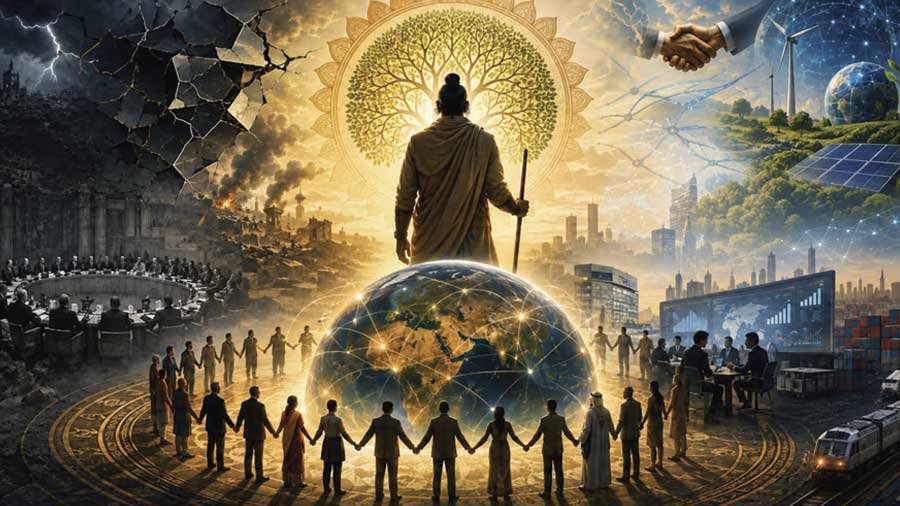
The contemporary global landscape is undergoing a profound structural shift. Beneath the surface of technological convergence lies a stark reality: the world is fragmenting, but India is connecting. Decades of hyper-globalisation are yielding to protectionism, supply-chain nationalism, and zero-sum geopolitical rivalries. The international community increasingly treats global politics, trade, and business as arenas for total dominance—a mindset where one nation’s rise or one corporation’s profit necessitates another’s absolute defeat.
Yet, as the fractures widen, a radical counter intuitive truth emerges from traditional Indian knowledge systems: unshakeable stability and true leadership stem not from absolute ownership, but from detached stewardship. At a time when international institutions are paralysed by systemic distrust, India’s civilizational ethos offers a timeless philosophical framework capable of healing a divided world: The Chowkidar (Caretaker) Mindset. By shifting global paradigms from possession to stewardship, traditional Indian wisdom provides a practical blueprint to restructure modern politics, trade, and enterprise.
Modern geopolitics is trapped in an ownership paradigm. Nations view borders, resources, and institutional vetoes as permanent possessions to be aggressively defended. This structural anxiety mirrors the ancient Puranic narrative of the god Indra, who, driven by envy and the fear of losing his celestial crown, used manipulation to strip the virtuous Bhakt Prahlad of his entire kingdom. Indra’s modern counterparts are the global powers that paralyse international bodies like the United Nations, weaponising their positions to protect their own “crowns” at the expense of collective human welfare.
The Indian response to this systemic insecurity is the concept of Sthitapragya (the sage of steady wisdom), as articulated by Sri Krishna in the Bhagavad Gita (Chapter 2, Verse 56):
“One whose mind remains undisturbed amidst misery, who does not crave pleasure, and who is completely free from attachment, fear, and anger, is called a sage of steady wisdom.”
When applied to global governance, Sthitapragya transforms into a foreign policy of strategic equanimity and multi-alignment. India’s contemporary diplomatic stance—acting as a Vishwa Mitra (Friend to the World)—epitomises this mindset. By decoupling leadership from the existential fear of losing status, world leaders gain the psychological armour required to make ethical, long-term decisions rather than knee-jerk protectionist choices.
When prime ministers, presidents, and diplomats operate as temporary watchmen (chowkidars) of global peace rather than permanent rulers, diplomacy ceases to be a zero-sum game. It enables nations to remain steady during diplomatic storms, fostering a collaborative international environment where cross-border crises—such as pandemics and systemic instability—can be managed transparently.
India’s recent multilateral milestones demonstrate how this philosophy is put into action. During its G20 Presidency, India reshaped the global narrative by championing the inclusion of the African Union and placing the developmental challenges of the Global South at the very centre of the global agenda. Instead of pursuing narrow strategic dominance, India acted as a bridge, utilising its Digital Public Infrastructure (DPI)—including open-source financial and identity systems like the India Stack—as a universal public good. This inclusive blueprint proved that technological innovation should not be a tool for corporate or national monopolies, but a shared vehicle for economic empowerment across developing nations.
Building on this legacy, the BRICS 2026 Summit hosted at Bharat Mandapam in New Delhi serves as the next major chapter where India shapes the future of the Global South. Operating under the chairmanship theme “Building for Resilience, Innovation, Cooperation and Sustainability,” India is introducing a people-centric, “Humanity First” approach to a rapidly expanding 11-member bloc. By promoting cross-border collaborations in digital finance, energy security, and local currency trade, India’s leadership in BRICS 2026 seeks to dismantle old paradigms of severe geopolitical competition and cultural disharmony. It provides an alternative pathway where emerging economies cooperate transparently to solve collective crises without creating new axes of dominance.
The fragmentation of global trade is deeply intertwined with the climate crisis. For centuries, the dominant economic paradigm has viewed the natural world and global markets through a lens of exploitation. Nations and trading blocs scramble to lock down finite natural resources, viewing them as property to monetise and exhaust. This reckless consumption has triggered severe ecological degradation and deep economic friction.
The antidote to this existential crisis lies in the opening verse of the Isha Upanishad:
“All this—whatever exists in this changing universe—is pervaded by the Divine. Therefore, enjoy it by renouncing the sense of possessiveness. Do not covet the wealth of anyone else, for nothing truly belongs to you.”
This foundational text establishes the principle of Aparigraha (non-possession). Coupled with ancient teachings that advocate for the peaceful coexistence of all species and the timeless philosophy of “live and let live,” Indian thought demands a complete overhaul of resource management. True harmony is achieved when humanity realises it belongs to a grander ecosystem, encapsulating the core civilizational ethos of Vasudhaiva Kutumbakam (One Earth, One Family, One Future). Such holistic knowledge solves the modern global issues of severe competition and ecological damage by anchoring trade in respect for all creation.
Paradigm Shift in Trade and Resource Management
| Dimension | Old Paradigm: Ownership | New Paradigm: Traditional Indian Stewardship |
| Core Philosophy | Possession: “This resource belongs to my nation, and I must exploit it for strategic leverage.” | Stewardship (Aparigraha): “I am a temporary caretaker. I own nothing; I protect everything.” |
| View of Nature | Exploitation: Natural ecosystems are static assets to be fully monetised, extracted, and exhausted. | Trusteeship: Earth’s vital resources are held in trust for future generations, honouring all biological species. |
| Trade Outcome | Protectionism & Crisis: Resource hoarding, aggressive supply chain warfare, and severe climate depletion. | Sustainability & Peace: Shared transparent supply chains, carbon neutrality, and mutually balanced global ecosystems. |
By adopting this mindset, India connects a fragmented trading world through strategic initiatives like the International Solar Alliance (ISA) and the Global Biofuels Alliance. These frameworks are intentionally designed not as instruments of economic dominance, but as collaborative platforms rooted in environmental stewardship, accelerating global carbon neutrality while protecting finite ecosystems.
In the corporate arena, the singular focus on short-term shareholder profit has widened the chasm of economic inequality, leading to deep social fragmentation. The traditional corporate framework conditions executives to measure success purely through a zero-sum lens: victories are tallied by rivals outrun, market share seized, and personal wealth accumulated.
Traditional Indian knowledge systems offer a radical alternative: Servant Leadership powered by the Corporate Mindset of Trusteeship, a concept deeply championed by Mahatma Gandhi. Under this model, corporate leaders do not view themselves as absolute rulers of their domains; they are temporary custodians. Grounded in the absolute mandate of Ahimsa Paramo Dharma (Non-violence is the highest duty), true business success shifts away from aggressive market exploitation and cutthroat dominance that fractures societies, moving instead toward a systemic culture of care, cultural harmony, and deep corporate empathy.
A powerful modern parallel is found in the journey of Rajat Gupta, the former Global Managing Director of McKinsey & Company. After a dramatic fall from grace and subsequent imprisonment, Gupta turned to the Bhagavad Gita to cultivate the very indifference mastered by ancient sages. He realised that society could label him a visionary builder or a corporate culprit, but his true identity was entirely detached from the world’s shifting verdicts.
This psychological freedom is highly transformative for corporate governance. When business leaders decouple their ego from the “crown” of corporate titles, the fear of failure or loss vanishes. The core formula for modern business operations becomes:
Power − Attachment = Selfless Service (The Chowkidar Mindset)
Businesses operating under this banner pivot from maximising short-term exploitation to delivering long-term societal value. They actively align with the universal prayer Sarve Bhavantu Sukhinah (May all beings be happy), reinvesting heavily in fair wages, inclusive healthcare, vocational education, and community resilience, effectively bridging the economic and cultural gaps that fracture modern societies.
As the forces of fragmentation threaten to tear the geopolitical and economic fabric of the 21st century, the world desperately requires a stabilising philosophy. The traditional Indian knowledge system proves that absolute triumph is not about obliterating opposition; it is about maintaining a serene, purposeful commitment to collective welfare under adverse conditions.
India is actively connecting this fragmented world by reminding global actors of a vital psychological and spiritual law: when you operate with detached stewardship, your leadership becomes impenetrable armour. By embracing the Chowkidar Mindset through platforms like the G20 legacy and the upcoming BRICS 2026 framework, global politics moves from conflict to collaboration, trade shifts from exploitation to sustainability, and business transitions from greed to trusteeship. In an era of profound division, traditional Indian wisdom provides the exact connective tissue the global order needs to secure a peaceful and sustainable future for all species.



Leave a Reply