

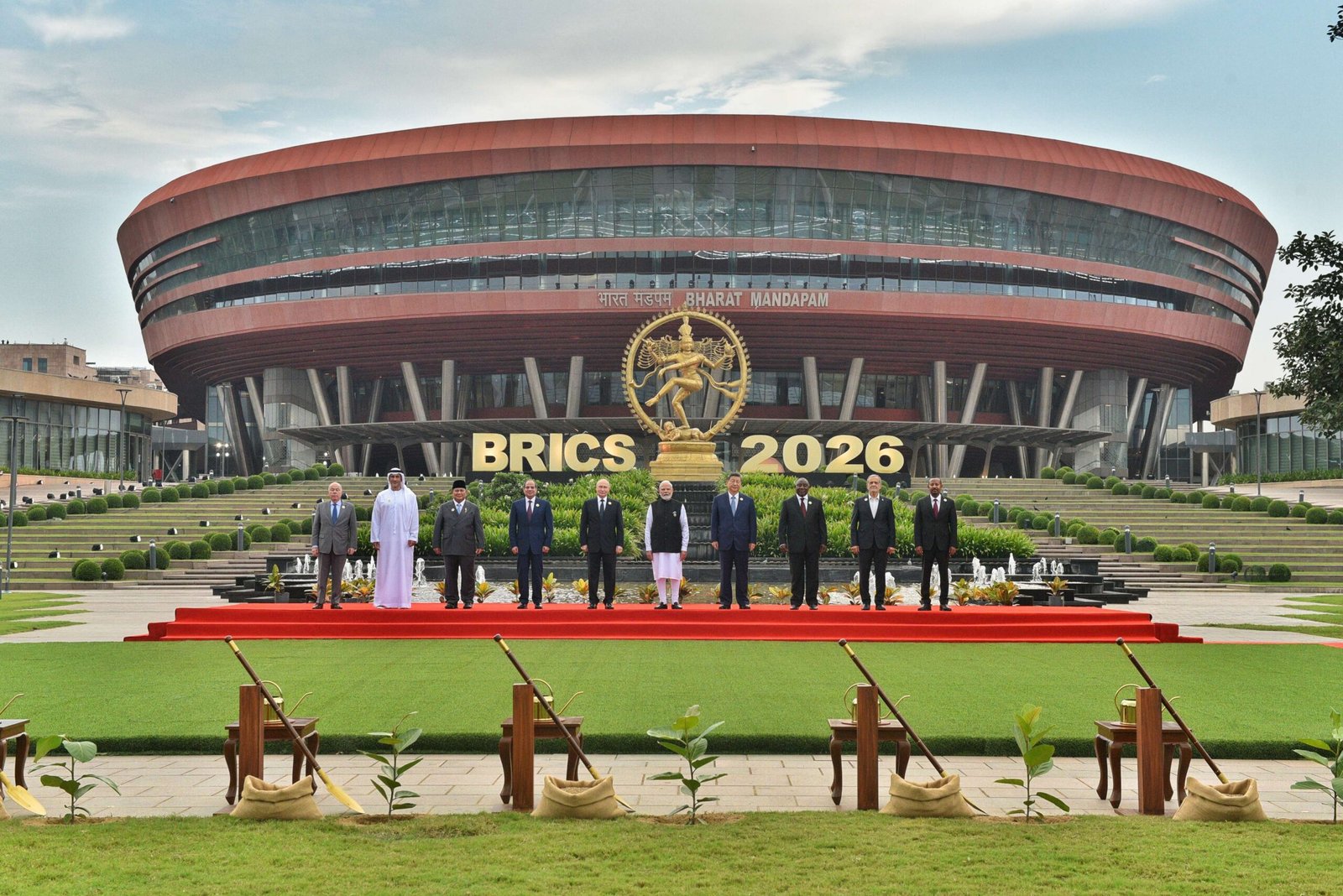
The recent conclusion of the 18th BRICS Summit has reaffirmed India’s position in the international system, along with the importance given to Global South countries.
PM Modi said BRICS has reached a “coming of age” moment after two decades of growth, urging member nations to transform the bloc’s unity and consensus into tangible outcomes on the global stage.
Addressing the BRICS Summit 2026, he said the grouping had built a distinct global identity by respecting diverse viewpoints, advancing through consensus, and seeking progress by taking all nations along rather than opposing any.
“Today, BRICS, too, has reached a moment of ‘coming of age’. Over the past two decades, BRICS has established a distinct identity on the global stage. We respect each other’s perspectives and move forward through consensus. We strive to advance not by opposing anyone, but by taking everyone along. Now is the time for us to translate our unity and consensus within BRICS into tangible results on the global stage,” PM Modi said.
India’s BRICS presidency has given New Delhi something better than a successful summit. It has given the country room to move for its diplomatic mission.
The summit wrapped up in the capital with all 11 members signing off on a 140-paragraph declaration. That alone was an achievement.
The grouping, known to agree on almost nothing, met in the middle of a war in the Middle East, while Russia and Ukraine are still fighting, trade disputes are piling up, and sanctions are reshaping how countries do business with each other. And yet, they agreed on a declaration which buttresses India’s importance in the international system.
The real question is what New Delhi does next with the goodwill it just built. It has to prove that a stronger seat at the BRICS table doesn’t come at the cost of its relationships with Washington and Brussels, challenging the supremacy of the Eurocentric world.
Now the goal will be to build strategic autonomy with sharper edges. India isn’t pulling away from the West, but it is trying to get strong enough to reduce its reliance on the West in an effort to
The obvious victory for India during the summit was to get 11 countries, with wildly different interests, to sign one document.
For instance, Iran and the United Arab Emirates (UAE) were both in the room, on opposite sides of a region at war with itself. According to a Reuters report, their presence alone nearly derailed consensus. The final text called for restraint and dialogue and avoided anything that would have blown up the talks.
It’s understood that BRICS is an intergovernmental organisation comprising nine countries: Brazil, Russia, India, China, South Africa, Iran, Egypt, Ethiopia, and the United Arab Emirates, while IBSA is a unique forum bringing together India, Brazil, and South Africa. These two organisations present different and sometimes conflicting approaches to the international system. A major obstacle to permanent cooperation within BRICS is the lack of similarity among its member countries.
Brazil is a regional power in South America, Russia is a great power in Eurasia, India is a great power in the Asia-Pacific, China is a rising superpower, and South Africa is a regional power in Africa, at best. What these countries have in common is their dissatisfaction with the current international order, which is dominated by Western powers, particularly the United States. Even in India, which views China as its primary threat, there is significant domestic opposition to the values promoted by the West and the United States, even in the second decade of the 21st century.
However, it remains uncertain whether these countries can form a cohesive alternative to the international system. Each of them continues to rely on the United States to balance against threats within their respective regions—a strategy that has historically worked in Washington’s favour since the late 19th century. Brazil seeks American support in its regional struggle for hegemony against Argentina. Russia finds it difficult to accept China’s growing influence in Central Asia and the Middle East, as does India in South and Southeast Asia. Similarly, South Africa’s position in Africa is threatened by China’s growing presence on the continent, with the latter’s disregard for human rights also being a point of contention for both Brazil and South Africa.
There is also a risk that BRICS could evolve into a platform primarily promoting China’s foreign policy, just as Moscow uses a variety of interregional cooperative bodies to further its own goals. If this occurs, the legitimacy of the organisation could be jeopardised, and the remaining members may need to reconsider their involvement. Brazil, on the other hand, has the potential to become a global player.
In conclusion, it’s understood that BRICS has attained a stature, along with India, in the international system.


Leave a Reply