

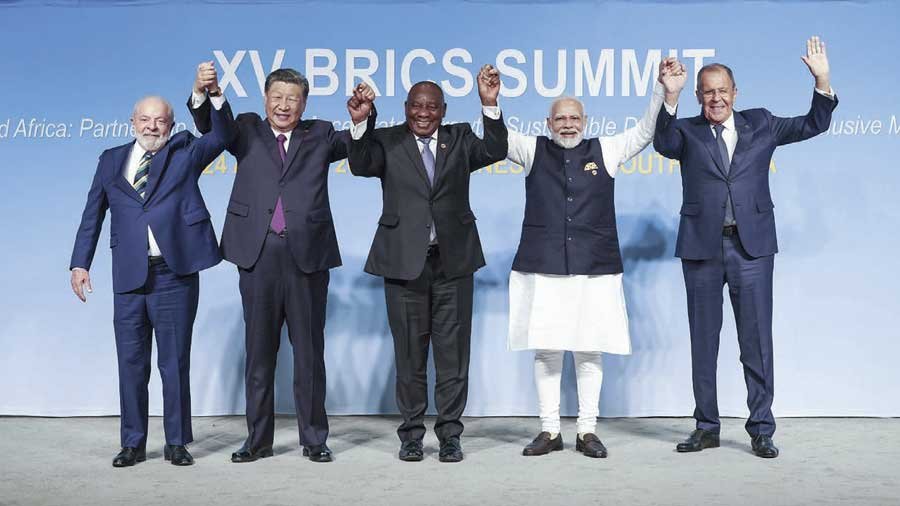
In just over a decade, BRICS has grown from five founding members to 11 countries representing roughly 45% of humanity. By 2030, the bloc is expected to account for more than half of global GDP[1].
With the 18th BRICS Summit approaching, the bloc is increasingly a key platform for countries of the Global South seeking a greater voice in trade, climate finance, technology governance and the reform of global institutions. But if BRICS wants to build a more representative world order, it must first make its own foreign-policy tables more representative.
According to the Anwar Gargash Diplomatic Academy’s 2025 Women in Diplomacy index, women hold just 22.5% of ambassadorial and permanent-representative posts worldwide[2]. In Asia, that falls to 13%; across BRICS, it is just 14%. The contrast within the bloc is striking. South Africa had women in 42% of its ambassadorial posts in 2025, while India had just 11 women serving as Ambassadors, High Commissioners or Permanent Representatives out of 954 officers as of December 2025, even though women have made up nearly 40% of new Foreign Service recruits in each of the last two years. Some of India’s gap is undoubtedly a pipeline problem.
Career diplomacy runs on a 20-to-30-year clock, so today’s senior ranks partly reflect who entered the service decades ago. But the pipeline cannot become an alibi for doing nothing today. South Africa offers the more important lesson: representation can be accelerated when political leaders make it a deliberate institutional goal. The African National Congress (ANC) adopted voluntary gender quotas and eventually raised them to 50%, helping transform women’s representation in South Africa’s political institutions[3]. The point is not that a political-party quota automatically produces women ambassadors. It is that governments do not have to wait a generation for representation to change. Comparative research on legislatures and bureaucracies consistently finds that who sits in decision-making institutions influences which risks make it onto the agenda, not because women have some innate disposition toward “softer” issues, but because different people bring different priorities and lived realities into the room.
Brazil offers a case in point. Marina Silva, Brazil’s Environment and Climate Change Minister from 2023 to 2026, grew up in Acre, in the Amazon, in a family of rubber tappers. That experience shaped a worldview in which the forest was never separate from Brazil’s economy or security. As she put it, “Brazil is an agricultural power because it is a rainforest power.” During her tenure, that perspective helped push the Amazon, deforestation and biodiversity from the margins of environmental policy into the centre of Brazil’s economic and international agenda[4]. The Amazon is not simply an environmental issue: it touches sovereignty, trade, natural resources, food security and Brazil’s leverage in global climate diplomacy. One woman’s tenure does not prove a pattern. But it shows why representation matters: who sits at the table can change what the table sees as strategic. That is precisely the question BRICS foreign ministries should be asking, especially as issues once dismissed as “soft” increasingly shape economic, technological and diplomatic power.
The digital divide makes the same point on a bloc-wide scale. Globally, 77% of men use the internet compared with 71% of women, according to the 2025 data by ITU; in low- and middle-income countries specifically, women are 14% less likely than men to use mobile internet, leaving about 235 million fewer women online[5]. For a bloc like BRICS, this gap is also a geopolitical issue. BRICS represents a large share of the world’s internet users and seeks greater influence over the digital economy. Access to the digital economy varies widely among BRICS members. In 2022, more than 85% of adults in Russia and China made or received digital payments. The figure was 81% in South Africa, 77% in Brazil, and only 35% in India[6]. These differences reflect gaps in infrastructure and access to banking, not gender alone. But they also show why women technologists and negotiators need a seat at the table. Without their perspectives, digital inclusion policies may fail to address the barriers women face. None of this means women automatically produce better foreign policy, or that they should be boxed into “soft” portfolios like gender and development while men handle security and trade. Women negotiate defence pacts and lead strategic partnerships in exactly the same rooms men do. The argument is simpler than that: a foreign-policy establishment built almost entirely by one half of society will keep missing what the other half sees first digital exclusion, climate vulnerability, the economics of care work until it stops being an afterthought and starts being who’s actually in the room.
India’s 2026 BRICS Chairship provides an important test of this commitment. The BRICS Women Ministerial Meeting, held in Kochi, Kerala, on 8–9 July 2026, brought ministers together to advance women-led development as part of India’s official BRICS agenda[7]. This is a significant step forward. However, a dedicated women’s forum is not the same as ensuring gender parity in the broader negotiating and decision-making processes of the bloc. South Africa has demonstrated that a Global South country can make substantial progress towards greater gender representation. The question for the rest of BRICS, including India, is how to translate commitments to women’s empowerment into greater representation within the institutions where the bloc’s priorities and policies are shaped.
When leaders gather in New Delhi on September 12–13 for the 18th BRICS Summit, it will be important to watch not only what is announced, but also who participates in shaping those decisions. This will be a useful test of whether India’s BRICS Chairship treats representation as a stated commitment or as a practice embedded in decision-making. BRICS seeks to present itself as a voice for the Global South. That claim is stronger when the bloc’s own institutions reflect the diversity they seek to represent. The Global South cannot call for greater representation in global governance while leaving women underrepresented in its own decision-making spaces.
References:
[1] TV BRICS, “BRICS are expected to contribute more than 50% of global GDP by 2030,” 6 April 2023. Available at: https://tvbrics.com/en/news/brics-contributes-more-to-world-gdp-than-g7/
[2]Anwar Gargash Diplomatic Academy (AGDA), 2025 Women in Diplomacy Index, 8 December 2025. Available at: https://www.agda.ac.ae/research/publications-multimedia-events/publication-details/2025-women-in-diplomacy-index
[3] Deutsche Welle (DW), Ana Muñoz Padrós, “More women sit in African parliaments but equality eludes,” 16 March 2026. Available at: https://www.dw.com/en/more-women-sit-in-african-parliaments-but-equality-eludes/a-76291235
[4] WWF-Brazil, “Marina Silva as Brazil’s Environmental Minister shows commitment to retake a leading role in the socio-environmental agenda,” 29 December 2022. Available at: https://www.wwf.org.br/en/?84540/Marina-Silva-as-Brazils-Environmental-Minister-shows-commitment-to-retake-a-leading-role-in-the-socio-environmental-agenda
[5] International Telecommunication Union (ITU), Facts and Figures 2025: The Gender Digital Divide, 15 October 2025. Available at: https://www.itu.int/itu-d/reports/statistics/2025/10/15/ff25-the-gender-digital-divide/
[6] International Trade Centre (ITC), BRICS Digital Economy Report 2022, Geneva, December 2022. ITC Document No. TFPB-22-58.E. Available at: https://www.intracen.org/sites/default/files/media/ file/media_file/2022/12/19/itc_brics_digital_economy_report_2022.pdf
[7] Press Information Bureau (PIB), Ministry of Women and Child Development, Government of India, “India to Host BRICS Women Ministerial Meeting in Kochi from 8-9 July 2026,” 7 July 2026. Available at: https://www.pib.gov.in/PressReleasePage.aspx?PRID=2281868®=48&lang=1



Leave a Reply