

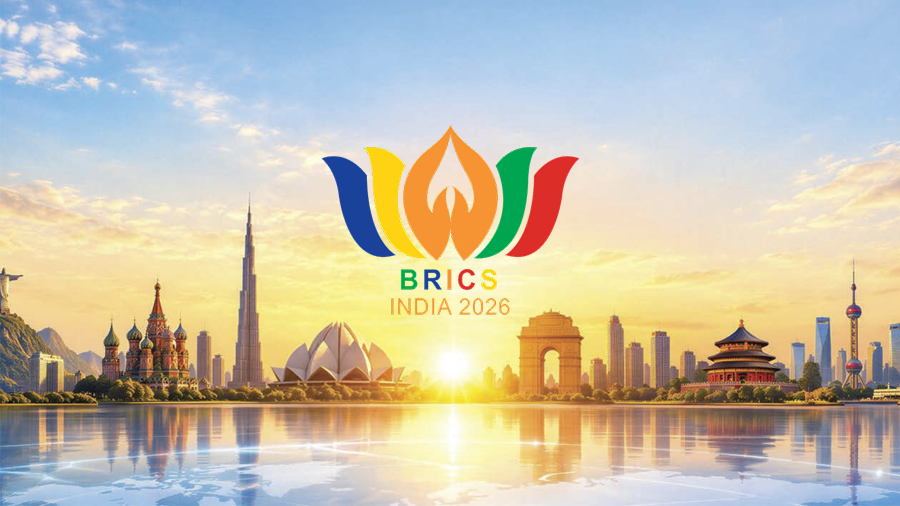
The actual challenge of India’s 2026 BRICS Presidency won’t be about the depth of the declaration or how many initiatives are launched from New Delhi. It will be whether India can play a significant role in making BRICS a more “effective forum” to solve the issues that are most relevant to the Global South, like development finance, economic resilience, climate change, energy security and more representation in the global order. This is a great opportunity for India to play its role as the Voice of the Global South by setting the agenda, establishing coalitions and proving that a more representative international order can be a more functional one as well.
Since the inception of the term, BRICS has come a long way from that initial bloc of emerging economies, Brazil, Russia, India and China. With South Africa on board and the expansion of the grouping in 2024, BRICS has emerged as an important platform for a group of countries which are looking to have greater say in a world system in which the institutions remain rooted in the power dynamics of the twentieth century. BRICS is not a formal bloc, nor does it have a common economic or foreign policy stance. It is composed of members with very diverse political systems, development paths and strategic interests. However, BRICS provides a forum for collaboration among nations and states that do not always agree.
The New Development Bank is a good example of the potential of BRICS. The NDB was established by the BRICS countries to fund sustainable development and infrastructure, not to replace the World Bank or other Bretton Woods institutions. Its other contribution is to widen financing options for developing countries, to build up South-South financial cooperation, and to raise the importance of local currencies in development finance. Infrastructure finance, especially in transport and energy, has been a major part of its portfolio, with India and China representing a big portion of these projects.
This is a significant policy opportunity for India. Instead of positioning the NDB as a rival to the Western financial system, New Delhi can help make the NDB a better complement to the traditional development finance channels. The challenge of development in the Global South is not a lack of institutions, but a lack of affordable, long-term and suitably structured capital. The NDB will be able to play a pivotal role if it is able to increase lending in local currencies, enhance project preparation and, most importantly, bring in private finance in addition to public development finance. Instead of posing the question of whether BRICS can replace the current financial order, it is better to ask whether it can make the latter more plural, competitive and responsive to the needs of the developing countries.
BRICS’ relevance is even more evident in the context of climate change. The grouping encompasses more than 40% of the world’s population and more than 40% of global emissions of greenhouse gases. The members of this group must therefore not consider climate policy as a minor topic. This is where the experience of India can be relevant. India’s challenge is, like many developing nations, to increase energy supply quickly to drive industrialisation and improve living standards without increasing the carbon footprint of the economy. Its goal to become net-zero by 2070 and the pace of renewable energy deployment show that development and decarbonisation are not conflicting goals. However, India’s ongoing reliance on coal makes it more relevant to the case of developing countries than a model that would call for an instant elimination of fossil fuel consumption.
In this context, India may be able to leverage BRICS to promote a Global South perspective on the energy transition, which goes beyond emissions reduction, focusing on affordability, access to energy, technology transfer, industrial policy, and job creation. A just transition cannot be a one-size-fits-all approach, and must not presume that developing countries can follow the same pace of transition as advanced ones. It must acknowledge the responsibility differences between countries, per capita emissions, fiscal capacity and development needs.
This is becoming even more relevant if climate policy becomes increasingly linked to trade. The EU’s Carbon Border Adjustment Mechanism and other climate-related trade measures have raised significant concerns from developing economies, as they can affect the competitiveness of exports from developing countries. These concerns have been echoed by BRICS. India thus has a chance to break the cycle of the “climate ambition versus development rights” battle. The better question is how developing countries can decarbonise without being shut out of the global markets.
India’s potential influence, however, extends beyond climate and finance. Perhaps the most interesting strategic advantage it has is that it is able to act in different regional economic and political blocs. New Delhi belongs to both BRICS and is also a key ally of the United States, Europe, Japan and other economies in the Indo-Pacific region. This strategic autonomy policy enables India to interact with rival power centres without siding with any one power.
The Global South is not a single political block and Africa, Asia, Latin America and the Middle East are not all equal in terms of their priorities. Therefore, the credibility of India will be more dependent on supporting regional forums, like the BRICS, to represent the interests of the Global South countries than on just speaking their voice. India’s active role in international climate diplomacy can be a very helpful model for its broader BRICS diplomacy.
It is therefore not the moment for India to create a new vision for a post-Western world. India’s more useful contribution would be on the implementation of practical ways of cooperation that BRICS can deliver, like development finance that reaches projects without delay, more use of local currencies (where economically viable), digital payment connectivity, resilient supply chains, affordable clean energy technology, and stronger mechanisms for technology transfer.
In the end, the impact of India in BRICS will be judged on “implementation”, not the “number of initiatives”. Without projects, a declaration on sustainable development will have no value. Climate justice is meaningless without affordable technology and capital for developing countries. But calls for a more representative global order will not become a reality unless BRICS can prove that their institutions can achieve better results.
Therefore, the opportunity is now with India to write a new chapter for the Global South, but not alone. As a pragmatic leader, possessing both strategic autonomy and diplomatic influence, along with development experience, India can provide practical solutions to both the Global South and the Global North.
If India can bring BRICS from geopolitical symbolism to the performance of its institutions, it can turn the group from a voice of dissent against the status quo to a more influential forum at a global level.



Leave a Reply