

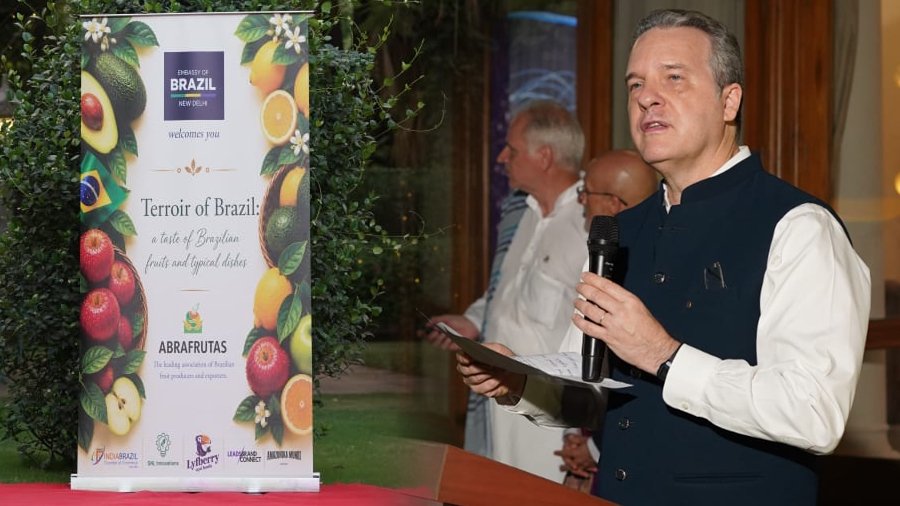
The Embassy of Brazil in New Delhi, in collaboration with Abrafrutas, the Brazilian Association of Fruit and Derivative Producers and Exporters, hosted an engaging evening reception titled “Brazil Terroir: Fruits and Flavours of Brazil” on 26 May 2026 at the Embassy of Brazil in New Delhi. The event brought together importers, industry representatives, members of the hospitality sector, and distinguished guests to celebrate Brazil’s rich agricultural diversity and explore new avenues of cooperation between Brazil and India in the field of agri-trade and food processing.
Hosted by H.E. Kenneth Félix Haczynski da Nóbrega, Ambassador of Brazil to India, alongside Mr. Jorge Luiz Raimundo de Souza of Abrafrutas, the evening offered guests an immersive experience into Brazil’s fruit industry through curated tasting counters, live product displays, networking sessions, and presentations on sustainability, logistics, and future export opportunities.
The venue was transformed into a vibrant showcase of Brazilian flavours, with interactive live counters serving tropical fruit-based beverages, juices, and culinary preparations. Guests explored a variety of Brazilian fruit products while engaging directly with exporters and representatives from the Brazilian fruit industry.
Opening the evening, H.E. Kenneth Félix Haczynski da Nóbrega highlighted the growing importance of agriculture as a pillar of India–Brazil relations. He noted that agriculture has become one of the strongest drivers of bilateral cooperation between the two countries.
“Today we have yet another trade and investment event at the embassy. This time we are focusing on promoting trade and investment ties in the field of agriculture between Brazil and India, more specifically, positioning Brazil in a high-potential market for fresh fruits and value-added fruit products,” he remarked.
He further recalled that agriculture featured prominently during recent high-level engagements between the two countries, including Prime Minister Narendra Modi’s visit to Brazil in 2025 and subsequent bilateral exchanges involving President Luiz Inácio Lula da Silva.
“Agriculture has become one of the big pillars of our bilateral relations,” he observed, while citing collaboration in areas such as animal genomics, food security, and agricultural technology as examples of expanding cooperation.
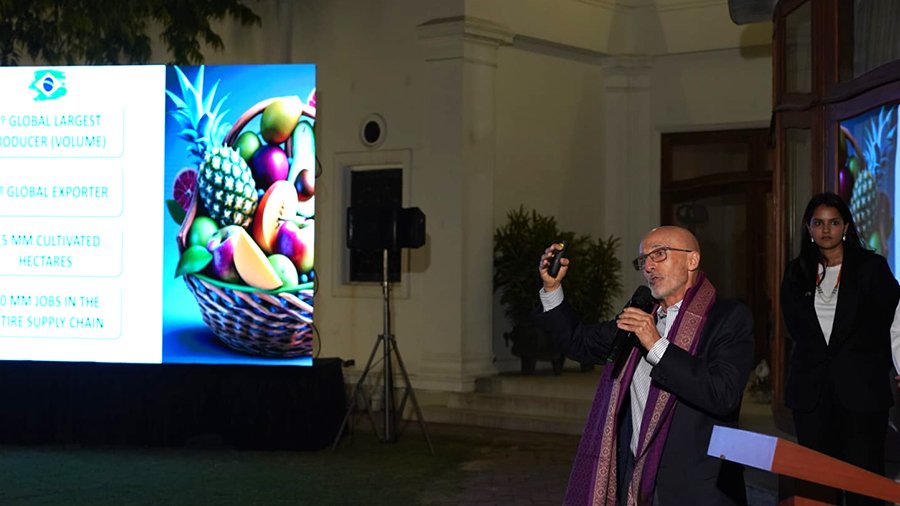
The highlight of the evening was the detailed presentation delivered by Mr. Jorge Luiz Raimundo de Souza, Project Manager, Frutas do Brasil, who provided an overview of Brazil’s fruit industry and its growing engagement with international markets, including India.
Describing the structure of Brazil’s fruit economy, he noted that the sector is largely driven by small and medium-sized growers and generates significant employment across rural communities.
“We cultivate around 2.5 million hectares and generate more than five million jobs. The fruit industry is one of the most important employment-generating sectors within Brazilian agriculture,” he said.
Brazil is currently the world’s third-largest fruit producer, behind China and India, though Mr. Souza acknowledged that the country seeks to improve its global export ranking through stronger international partnerships and market diversification.
One of Brazil’s major advantages, he explained, lies in its ability to produce fruits throughout the year due to favourable climatic conditions.
“Brazil is able to supply international markets year-round while other producers face seasonal limitations. This gives us important commercial opportunities,” he stated.
A recurring theme throughout the evening was sustainability. Mr. Souza highlighted Brazil’s increasing emphasis on environmentally responsible farming practices, including water conservation, renewable energy use, and biological alternatives to pesticides.
“Sustainability is extremely important for us. The management of water resources is as important as producing the fruit itself,” he remarked.
He also noted that many Brazilian fruit-processing facilities are now powered through renewable energy sources such as solar and wind energy.
“The majority of our packing houses are now self-sufficient in energy through solar power,” he said.
Addressing climate concerns and sustainable agriculture, he added that fruit cultivation can contribute positively to carbon absorption and environmental preservation.
“Fruit trees absorb significantly more carbon than the emissions generated during production. This is something we are very proud of,” he observed.
The Brazilian delegation also discussed future opportunities for exports to India. While Brazil already exports apples to the Indian market, discussions are underway regarding the export of avocados and limes. Logistics, however, remain a major challenge.
“It is not easy transporting fresh fruits from Brazil to India by sea while maintaining the quality standards consumers expect. But we are working hard to find solutions,” Mr. Souza explained.
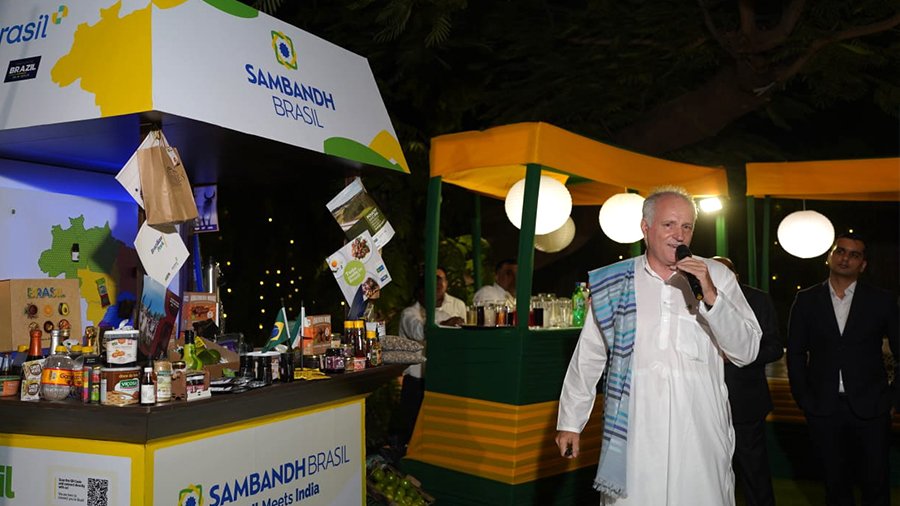
The evening also featured remarks by Mr. Roberto Carlos Razera Papa, Agricultural Attaché at the Embassy of Brazil in New Delhi, who spoke warmly about the similarities between India and Brazil and the potential for deeper agricultural cooperation.
“I really feel like an Indian citizen because this country welcomed me so warmly,” he said, adding, “Brazil and India complement each other. We are like twin nations.”
Drawing a personal analogy, he added humorously: “I am a father of twins, and now I am working for twin nations.”
Mr. Papa also shared his vision of establishing agricultural distribution and communication centres across Indian states to facilitate stronger Brazil–India trade connectivity and direct engagement between businesses and institutions.
“If you do not have connection, you have no communication. Here is our connection,” he said while presenting a digital initiative designed to strengthen interaction between Indian stakeholders and Brazilian agricultural institutions.
The reception reflected Brazil’s growing efforts to position itself as a key agricultural and food partner for India while simultaneously deepening trade diversification beyond traditional commodities. It also highlighted the broader strategic convergence between India and Brazil within the Global South, particularly in areas of food security, sustainable agriculture, green technologies, and resilient supply chains.
The evening concluded with networking interactions, live culinary experiences, and tasting sessions celebrating Brazil’s rich agricultural heritage, leaving guests with both a flavourful and insightful introduction to one of the world’s leading fruit-producing nations.


Leave a Reply