

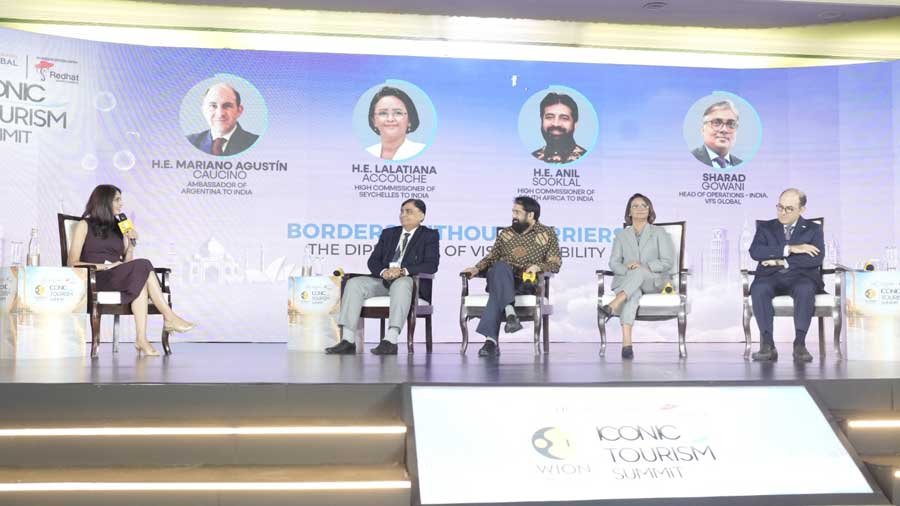
At the WION Iconic Tourism Summit, diplomats and mobility-sector experts examined how easier visas, stronger air links, digitalisation and people-to-people exchanges can turn travel into a bridge between nations, without compromising security.
Borders may define nations, but they increasingly do not have to define human connection. At the WION Iconic Tourism Summit, the session “Borders Without Barriers: The Diplomacy of Visas and Mobility” brought together H.E. Mariano Agustín Caucino, Ambassador of Argentina to India; H.E. Lalatiana Accouche, High Commissioner of Seychelles to India; H.E. Prof. Anil Sooklal, High Commissioner of South Africa to India; and Sharad Gowani, Head of Operations – India, VFS Global.
Moderated by Molly Gambhir, the conversation moved beyond the mechanics of visas to a larger question: how can countries make international movement easier while preserving the security, integrity and trust that underpin modern mobility? WION described the session as an exploration of how visa facilitation and seamless travel can strengthen tourism, business, education and diplomatic ties.
Lalatiana Accouche: “We are not only neighbours; we are like sisters and family”
For H.E. Lalatiana Accouche, mobility is inseparable from the deepening relationship between India and Seychelles. The timing is particularly significant: 2026 marks 50 years of diplomatic relations between the two countries, alongside Seychelles’ 50th anniversary of independence. India and Seychelles have been using the milestone year to expand cooperation across areas including maritime security, education, hospitality, digitalisation and people-to-people ties.
Speaking about the next phase of the relationship, H.E. Accouche stressed that the objective should be to strengthen links not merely between governments but between people, through tourism, education, culture and other forms of mobility.
“The links, the mobility of people, not only tourism, education, cultural, any areas where we are welcome to more strengthened relationships,” she said.
Her remarks also placed tourism within the wider Indian Ocean relationship. Seychelles and India have increasingly worked together on maritime security and capacity building, with the Indian Ocean providing both the geographical setting and a shared strategic interest.
H.E. Accouche emphasised that cooperation at sea is particularly important for island nations. India’s support has included assistance to Seychelles in maritime capacity building and security, while both countries have continued to discuss ways of keeping the Indian Ocean safe.
The message was ultimately one of partnership rather than proximity alone. “We are not only neighbours, but we are like sisters and family,” she said, capturing the people-first character she sees at the heart of the bilateral relationship.
The relationship has gained fresh momentum in 2026. During Prime Minister Narendra Modi’s state visit to Seychelles in June, the two countries unveiled a commemorative logo for 50 years of diplomatic relations and agreed to intensify cooperation in areas including tourism, direct air connectivity and other people-centric initiatives.
Amb Mariano Agustín Caucino: “We are opening as much as possible”
For Argentina’s Ambassador Mariano Agustín Caucino, the most tangible expression of tourism diplomacy is often the removal of unnecessary barriers.
He stressed that Argentina respects the sovereign right of every country to determine its own immigration policy. At the same time, he argued that Argentina is seeking to make entry easier for Indian travellers.
“We respect the sovereign decision of countries that decide what to do with their own immigration policy,” Amb Caucino said. “But in the case of Argentina, we are opening as much as possible in order to attract more tourists.”
He pointed to a significant policy change introduced in 2025: Indian passport holders with eligible valid US visas can enter Argentina for tourism without obtaining a separate Argentine visa. Argentina’s official consular guidance confirms that Indian citizens holding specified valid US visa categories can enter for tourism for up to 90 days without an Argentine visa.
For the Ambassador, such measures are not merely administrative conveniences. They can influence whether a long-haul destination becomes realistically accessible to a traveller.
He also highlighted air connectivity as an equally important part of the equation. Restoring or expanding direct connections, or improving connections through major hubs such as Madrid, could significantly reduce the friction involved in travelling between India and South America.
“Concrete measures” were needed to promote tourism, he argued, with aviation and visa facilitation working together rather than separately.
His message was clear: if countries want more visitors, they have to make the journey to their destination easier.
H.E. Anil Sooklal: “We are in a Global South Tourism Moment”
H.E. Anil Sooklal widened the conversation beyond individual bilateral relationships. For him, the next phase of global tourism must also challenge the way destinations from the Global South are represented and connected.
“We are in a Global South tourism moment,” he argued, referring to the growing importance of cooperation among developing economies and the role of countries such as India and South Africa in that process.
India and South Africa already have deep historical and people-to-people links. South Africa is home to a large population of Indian origin, while the two countries have developed a substantial diplomatic relationship through forums including BRICS.
Yet H.E. Sooklal argued that connectivity remains a major gap.
“We need to have direct connectivity,” he said, noting that India and South Africa currently do not have a direct passenger service. Current aviation data confirms that there are no direct Mumbai–Johannesburg flights, with travellers generally connecting through hubs including Nairobi, Addis Ababa, Mauritius, Doha or Dubai. The Johannesburg–Mumbai route has been identified as an important underserved opportunity, with both governments and industry stakeholders discussing the possibility of restoring direct services.
Visa facilitation, he added, was another part of the equation.
But his vision went beyond tourism alone. Sooklal called for greater educational and cultural mobility, particularly among young people.
“We want to see more South African students come and study in India,” he said, recalling the historical flow of South African students to India during apartheid. He advocated exploring special visa categories and easier pathways for students and researchers in both directions.
“We want to see more Indian students going to African universities, including South Africa,” he added.
For H.E. Sooklal, youth mobility is ultimately about strengthening the relationship at a deeper level. “The youth should be at the centre of that relationship,” he said.
Sharad Gowani: “Security and accessibility need to go hand in hand”
For Sharad Gowani of VFS Global, the central challenge is one that sits at the heart of the entire visa ecosystem: making travel easier without weakening security.
“The traveller wants things instantly,” Gowani said, describing the expectations of today’s increasingly digital traveller. From visa applications to tracking and document submission, travellers increasingly expect speed, transparency and flexibility.
But faster does not mean less secure.
“Security and accessibility need to go hand in hand,” he said.
That balance is particularly important because VFS Global operates as an administrative and technology-services partner to governments and diplomatic missions; visa decisions remain with the relevant authorities. Today, VFS Global says it serves 69 client governments and operates more than 3,900 application centres in 165 countries, having processed more than 514 million transactions since its establishment in 2001.
Gowani described a system in which security begins at the point of application and continues through document handling, biometrics, logistics and passport return. He also pointed to the rapid digitalisation of the process.
The direction of travel, he suggested, is towards increasingly remote and technology-enabled services. Digital applications are already reducing the need for physical visits in some processes, while biometrics and other identity technologies continue to evolve.
“The hardware is already there. The technology needs to be connected,” he said, pointing to the possibility of further digitalisation in the years ahead.
But technology, he stressed, must serve a larger objective: ensuring that legitimate travellers who have the required documentation can move through the system efficiently, while maintaining the safeguards governments require.
That balance, convenience without compromising integrity, may ultimately determine what the next generation of international mobility looks like.


Leave a Reply