

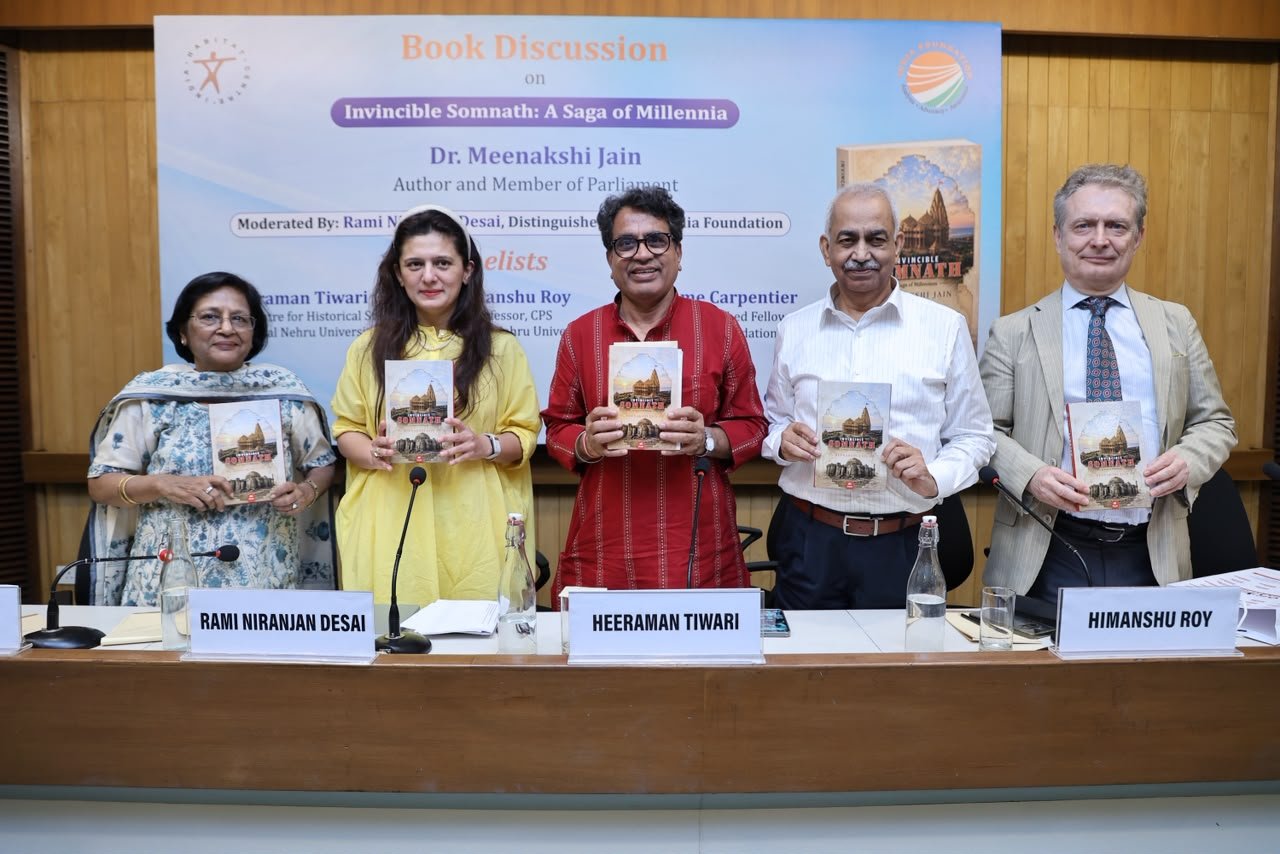
India Foundation organised a book discussion on Invincible Somnath: A Saga of Millennia, authored by Dr. Meenakshi Jain, Member of Parliament, on 7 October 2026 at Gulmohar Hall, India Habitat Centre. The discussion brought together scholars and academics to examine the historical, cultural and civilisational significance of Somnath and the themes explored in the book. The session was moderated by Rami Niranjan Desai, Distinguished Fellow, India Foundation, with Prof. Heeraman Tiwari, Prof. Himanshu Roy and Côme Carpentier, Distinguished Fellow, India Foundation, participating as panellists.
In his opening remarks, the moderator highlighted the significance of Somnath within the sacred geography of Saurashtra and emphasised the importance of preserving civilisational memory. He noted that Dr. Jain’s research draws upon a wide range of sources, including religious texts, inscriptions, archives, archaeology, and foreign and Persian accounts. The book traces the history of Somnath from its early history to the reconstruction of the temple in independent India.
Dr. Meenakshi Jain, while discussing her book, focused on the distinction between viewing a sacred site merely through the chronology of its construction and destruction and understanding it as part of a living civilisational memory. She explained the traditions associated with Somnath, including its association with Soma and Lord Shiva, and emphasised the role of ordinary people in preserving the continuity of Indian civilisation. Her discussion traced the successive temples of Somnath, the destruction associated with Mahmud of Ghazni, subsequent efforts at reconstruction, and the temple’s continued importance as a site of pilgrimage.
A significant part of the discussion examined the reconstruction of Somnath after Independence. Dr. Jain highlighted the roles of Sardar Vallabhbhai Patel and K. M. Munshi in the reconstruction process and discussed the debates surrounding the rebuilding of the temple. She presented Somnath as an example of the resilience of civilisational traditions and concluded by reflecting on the gradual revival of important sacred sites in post-independence India.
Prof. Heeraman Tiwari appreciated the book for bringing archival, archaeological and inscriptional evidence into discussions of Indian history. He described the repeated destruction and reconstruction of Somnath as an important aspect of its historical significance and emphasised the continuity of the site across ancient, medieval and modern periods.
Prof. Himanshu Roy focused particularly on the reconstruction of Somnath after 1947. Drawing upon the book’s discussion of Sardar Patel, Mahatma Gandhi and Jawaharlal Nehru, he examined the political and institutional debates surrounding the rebuilding of the temple.
Côme Carpentier placed Somnath within the wider political and historical context of Saurashtra. He discussed the succession of dynasties, the fragmented political structure of medieval India and the motivations behind invasions, while also drawing attention to the cultural connections surrounding the concept of Soma.
The discussion concluded by highlighting Invincible Somnath as an exploration of history, memory, reconstruction and civilisational continuity. The event provided an opportunity to reflect on how historical sources and sacred traditions together contribute to understanding the enduring significance of Somnath in India’s civilisational narrative.


Leave a Reply