

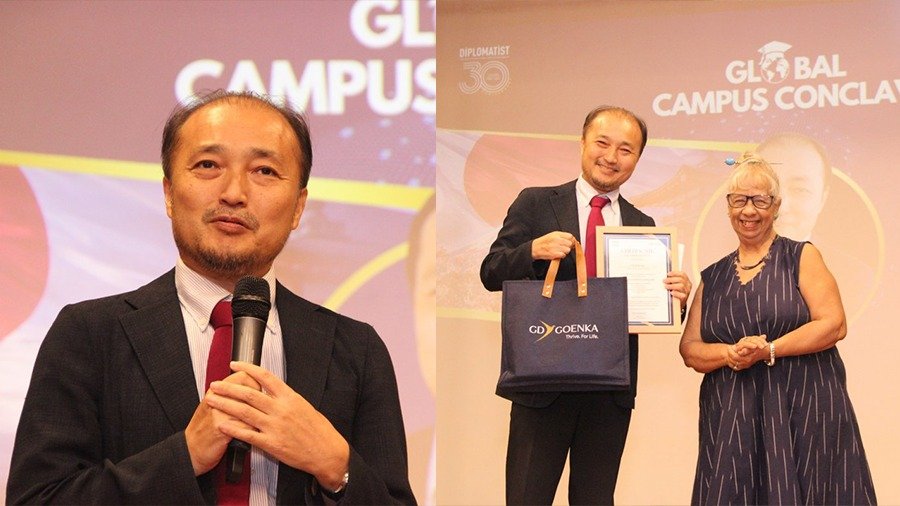
At the Global Campus Conclave, Mr. Koji Sato, Director General, The Japan Foundation, New Delhi, offered a refreshing perspective on education and global learning, placing cultural exchange and human experience at the centre of the conversation.
He began with an unexpected cultural moment. After greeting the audience with a warm “Namaskar” and “Konnichiwa”, Sato surprised everyone by breaking into the popular Bollywood song Tujhe Dekha To Yeh Jaana Sanam. The audience responded with enthusiastic applause and visible surprise, before he added another playful reference to Yeh Dosti Hum Nahin Todenge. With a smile, he joked, “If you ask me to continue, I have plenty of songs!”
The spontaneous opening perfectly captured the essence of his message: culture is not something to be simply studied or displayed; it is something to be experienced and shared.
Drawing from his own journey, Sato recalled his first visit to India as a university student, long before smartphones and the internet. He travelled by train, got lost, met strangers and experienced a world very different from the one he knew in Japan.
“What changed my life was not a textbook. It was an encounter with another culture, people.”
That experience eventually shaped his career in international cultural exchange. For Sato, cultural diplomacy is not simply about showcasing a country’s art, literature or traditions.
“The essence of culture exchange is not the export of culture. It is the encounter between people.”
His reflections became particularly relevant in the age of artificial intelligence. While acknowledging AI’s enormous potential to expand access to knowledge and transform education, Sato drew a crucial distinction between information and experience.
“AI can give us information, but it cannot give us experience.”
AI can explain India or Japan, he noted, but it cannot recreate the feeling of walking through an unfamiliar city, entering a temple, meeting a stranger or discovering a culture through direct human interaction.
“Knowledge and experience are not the same thing. Information and understanding are not the same thing.”
Sato urged young people to think beyond technological capability and consider the kind of society technology should help create.
“Technology should not diminish our humanity. It should strengthen it.”
His message to students was simple: travel, explore, meet people who are different from you and remain curious about cultures beyond your own.
“Do not let algorithms decide the boundaries of your world. See the world with your own eyes.”
He concluded with a powerful reminder that, despite the rapid advances of technology, some experiences remain uniquely human:
“AI can help us understand the world, but it cannot experience the world for us. That part remains our responsibility.”
Sato’s address ultimately offered a simple yet timely message: the future should not be about choosing between technology and humanity, but about ensuring that technological progress continues to serve human curiosity, empathy and connection.
His final hope was that India and Japan would continue to learn from one another while building a future that is “not only more advanced, but also more human.”


Leave a Reply