

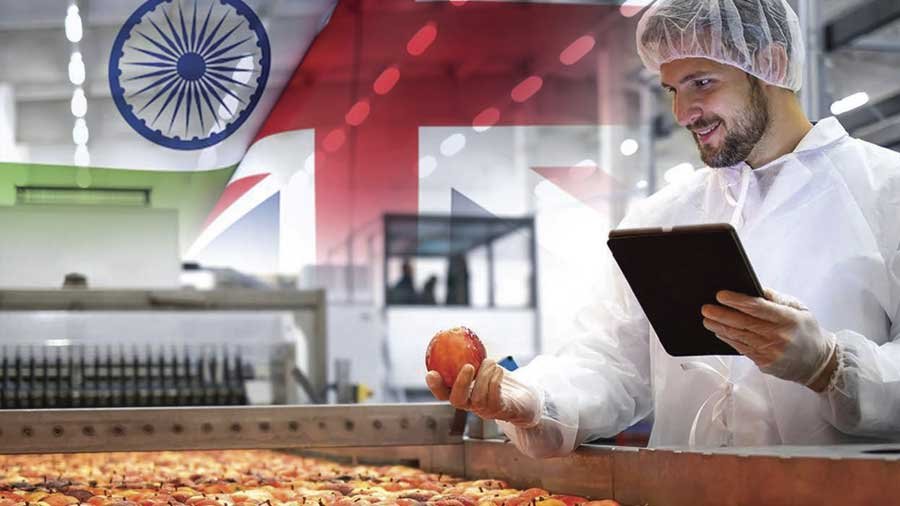
CETA has opened the tariff gate. The larger prize will go to businesses that convert access into UK-ready products, compliant capacity, dependable supply chains and durable commercial partnerships.
Trade agreements are signed in grand rooms, under flags and camera flashes. Their real value is discovered later – on a factory floor, in a residue-testing laboratory, inside a cold store, or during a buyer’s review of whether an exporter can deliver the twentieth shipment as reliably as the first.
That is the practical way to read the India-UK Comprehensive Economic and Trade Agreement. CETA took effect on 15 July 2026, giving nearly 99% of Indian exports duty-free access to the UK. For food processing, the government identifies zero-duty access across 985 tariff lines; some products had faced tariffs of up to 70%. In a low-margin industry, that changes which products can reach the shelf and which investments can leave the feasibility spreadsheet.
| The UK imports about US$50.68 billion of processed food, yet only US$309.5 million comes from India – barely 0.6% of the total.2 |
A large market, but not an empty shelf
Britain imports about US$50.68 billion of processed food, but only US$309.5 million comes from India – roughly 0.6%.2 That gap is the opportunity, and also a warning. Tariff parity removes one disadvantage; it does not create consumer preference or secure supermarket listings. Competition now shifts to product relevance, landed cost, certification, packaging, distribution and trust.
India is not an unfamiliar food origin. UK authorities identify it as the country’s leading source of imported herbs and spices and the supplier of 29.6% of its rice imports. The real opening is to move up the value chain: from ingredients to finished foods, commodity supply to private label, and the ethnic aisle to everyday consumption.
The possibilities go well beyond rice, tea and spices. Officially identified categories include bakery goods, prepared foods, preserved fruit and vegetables, sauces, nuts, fresh produce and value-added coffee.2 Commercially, that means ready-to-cook meals, frozen snacks, accompaniments, foodservice packs and British private-label products made in India. The winner may be an Indian recipe adapted to a British eating occasion, or a UK brand using India as a competitive, resilient production base.
The most attractive opportunity may carry someone else’s label
Indian exporters often treat overseas expansion as a branding exercise. That route suits distinctive products and patient capital. Yet CETA may create an equally valuable opportunity in contract manufacturing and private label. UK retailers, foodservice distributors and challenger brands need suppliers that can combine cost, innovation and continuity; India brings raw-material depth, modern processing capacity and multiple price points.
For a capable processor, supplying a recognised British label can build plant utilisation and foreign-currency revenue faster than creating consumer awareness from zero. The same platform can later support contract manufacturing for volume, an owned brand for margin, and ingredient supply for diversification. Joint ventures also become more compelling: a UK partner can bring product development and market access, while the Indian partner brings sourcing, manufacturing economics and incentive-supported capacity.
The opportunity also runs the other way. After phased implementation, India will remove tariffs on categories including British chocolate, gingerbread, sweet biscuits and soft drinks.6 Domestic manufacturers should read this as competitive pressure, but not simply a threat. It can accelerate distribution alliances, licensing, local manufacturing, ingredient partnerships and selective acquisitions. The agreement can generate transactions, not only trade flows.
Standards, not tariffs, will become the real moat
CETA does not dilute UK food rules. The Food Standards Agency and Food Standards Scotland say existing laws remain unchanged; risk-based controls, pre-notification, certification and physical checks continue. The SPS chapter creates no automatic new permission for Indian food imports. For promoters, this is the essential qualification: zero duty does not mean zero friction.
A UK-ready factory needs more than a certificate in reception. It needs control over residues and contaminants at procurement; reliable ingredient and allergen records; batch-level traceability; validated shelf life; destination-compliant labels; disciplined change control; and a recall system that works. For many businesses, the first serious export investment should therefore be in systems and people, not another production line.
That investment can become a moat. A processor with buyer-approved systems, audited farmer linkages and dependable data is difficult to replace. Compliance becomes commercial infrastructure. The same discipline applies to rules of origin: preference is available only where a product is genuinely originating or sufficiently transformed; simple trans-shipment or superficial repacking will not qualify.4 Formulation and sourcing decisions must begin with the HS code and product-specific origin rule.
The agreement should also improve execution. Customs authorities are to endeavour to release qualifying goods within 48 hours when requirements are met and no physical examination is needed, with priority treatment for perishables. That speed will reward clean documentation and prepared importers; a weak file can still erase a good tariff.
Where the investment opportunity will emerge
The durable opportunity may sit one layer behind the exporter. Plants will need segregated production, automation, aseptic or retort processing, IQF and freezing, better packaging, metal detection, laboratory capability and digital traceability. Perishable categories need pre-cooling, pack houses, reefer movement and dependable storage. Ministry of Food Processing Industries schemes already cover processing capacity, cold chain, agro-processing clusters and food-safety infrastructure, offering a policy bridge between market access and domestic capacity creation.
This is where project finance and investment banking enter the trade story. A promoter may need term debt for expansion, equity for market development and working capital for longer export cycles. A UK buyer may anchor capacity through an offtake arrangement; a strategic investor may prefer a platform acquisition; a regional processor with strong sourcing but weak systems may create more value in partnership with a larger exporter.
The strongest projects will not be built on the claim that exports will rise. They will start with a specific buyer, category or gap; work backwards to formulation and compliance; test the landed-cost advantage after freight, retailer margin, promotion and wastage; and only then size capacity and funding. Incentives can strengthen returns, but cannot rescue weak market fit or poor procurement discipline.
Who is likely to win
Large companies will benefit, but scale will not decide everything. A focused MSME with an excellent product, sound technical documentation and the right distributor can move faster than a conglomerate. Farmer-linked processors can win by controlling quality at source. Cold-chain, testing and packaging businesses can gain without owning a consumer brand. Companies with credible UK partners can shorten the learning curve.
The UK government’s long-run modelling anticipates a 25% increase in imports from India and nearly 60% growth in UK exports to India against the baseline. These are not guaranteed sales, but they indicate the direction of travel. The near-term contest is for buyer relationships, approved capacity and repeatability – assets whose value compounds after a customer invests in supplier approval.
CETA has done more than announce an export boom: it has changed the risk-reward equation for building one. India’s opportunity is not simply to ship more cartons, but to convert agricultural strength into processed value, better farm linkages, modern plants, quality infrastructure, brands, partnerships and patient capital. This matters because every additional layer of value retained in India – processing, packaging, testing, logistics or intellectual property – broadens the development return from the agreement. The tariff gate is open; the winners will treat the UK not as a destination for surplus production, but as a market worth designing for.



Leave a Reply