

Introduction: When Strategic Geography Meets Strategic Intent
In the intricate tapestry of 21st-century geopolitics, where strategic alliances are being recalibrated against a backdrop of geopolitical upheaval, marked by shifting power equations, supply-chain recalibration, climate urgency and technological disruption, few bilateral relationships are evolving as quietly yet decisively as that between India and Germany. What was once described as a partnership of unrealised potential has now emerged as a pillar of stability, innovation and democratic alignment in an increasingly fractured world.
The recent two-day official visit of German Chancellor Friedrich Merz to India in January 2026, his first to Asia since assuming office, has powerfully crystallised this shift. Marking the platinum jubilee of 75 years of diplomatic relations and the silver jubilee of 25 years of the Strategic Partnership, the phrase “Berlin and Beyond” captures more than geography; it signifies ambition. It reflects a partnership that is no longer transactional, but transformational; no longer confined to bilateralism, but global in outlook, thus making it a robust, forward-looking blueprint for a “limitless” collaboration.
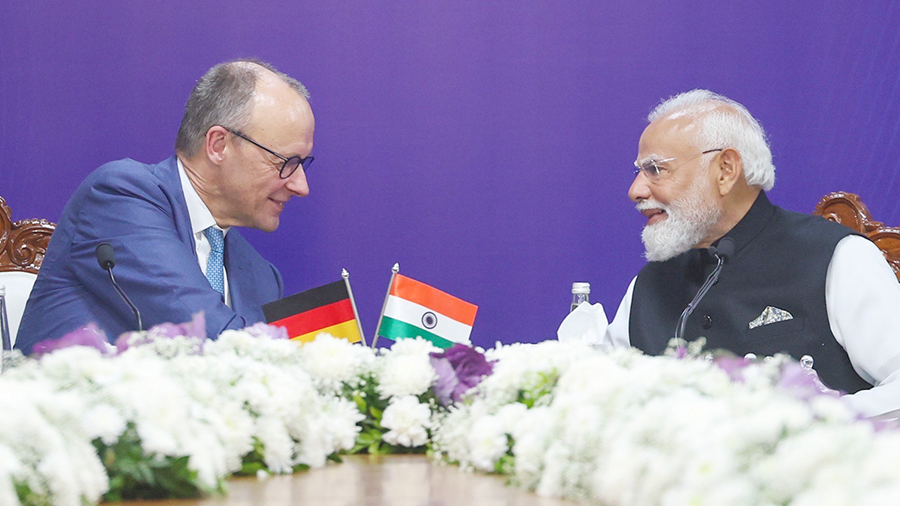
As Prime Minister Narendra Modi and Chancellor Merz engaged from the Sabarmati Ashram to the defence dialogue tables, they charted a course for an alliance that is global in ambition, spanning geopolitical realignment, technological co-creation and green transformation, which has infused “new energy, new confidence and new dimensions” into a relationship rooted in shared democratic values and future-oriented cooperation
A Visit of Strategic Timing and Profound Symbolism
Foreign Secretary Vikram Misri aptly noted the “particularly significant” timing of Chancellor Merz’s visit. Arriving in Ahmedabad, Chancellor Merz was welcomed by India’s top political leadership, accompanied by a high-powered official delegation and a large business contingent, underscoring the centrality of trade, investment and technology in bilateral ties.
Accompanied by a high-powered official and business delegation, the choice of India as the Chancellor’s maiden Asian destination signalled Berlin’s commitment to diversifying partnerships and India’s central role in that strategy.
The itinerary itself wove together the threads of this multifaceted relationship: a solemn homage to Mahatma Gandhi at Sabarmati Ashram, the vibrant cultural diplomacy of the International Kite Festival in Ahmedabad jointly inaugurated by the two leaders and visits to Gujarat’s architectural marvels like the Adalaj stepwell.
These moments of cultural connection set the stage for hard-nosed strategic and economic discussions in Gandhinagar, illustrating a partnership that draws strength from both shared values and shared interests.
Economic Convergence: Engineering Meets Scale, From Trade to “Limitless” Co-Creation
Germany remains India’s largest trading partner in the European Union, with bilateral trade crossing the $50-billion mark, the highest ever. Over 2,000 German companies operate in India, while Indian enterprises have expanded their footprint in Germany across IT, pharmaceuticals and advanced manufacturing.
PM Modi announced the decision to transform the “seamless economic partnership” into a “limitless” one, extending cooperation into strategic sectors. With bilateral trade surpassing the $50 billion mark and over 2,000 German companies entrenched in India, the foundation is strong.
The CEOs Forum in Gujarat echoed this optimism, with industry leaders lauding the expanding cooperation. The new ambition, however, lies in moving beyond trade to deep industrial integration.
As PM Modi highlighted India’s sustained growth rate of over 8% and reforms in sectors like defence, space, and mining, he invited German industry to merge its “precision and innovation with India’s scale and speed.” On the same strategic lines, Chancellor Merz decides to make India his first Asian destination reflects Germany’s trust in India as a core partner in its diversification strategy.
Strategic & Global Dialogue: From Buyers to Co-Creators
A breakthrough during the visit was the signing of an agreement to strengthen bilateral defence industrial cooperation. India and Germany agreed to simplify defence trade procedures with a clear focus on co-production and co-development, a decisive shift from conventional procurement to strategic collaboration.
This aligns seamlessly with India’s Atmanirbhar Bharat vision and Germany’s push for resilient, trusted defence partnerships amid what Chancellor Merz observed that “rough winds are blowing in world politics”, framing substantive discussions on pressing global challenges.
The leaders also announced a new consultation mechanism on the Indo-Pacific, reflecting shared concerns over regional stability, freedom of navigation and rule-based order.
Global Issues and Shared Worldviews- Navigating a Turbulent World
Beyond bilateral matters, Prime Minister Modi and Chancellor Merz exchanged views on major global challenges. India reiterated its consistent position in favour of peaceful dialogue and diplomacy, thus highlighting Germany’s principled stance on human rights, an area where both democracies increasingly find common ground.
A strong convergence emerged on counter-terrorism, with PM Modi terming it the “ultimate and serious threat to humanity” and both leaders resolving to fight it together.
Both leaders also reaffirmed their commitment to reforming global institutions. Through the G4 framework, India and Germany continue to advocate for UN Security Council reform, reflecting their shared belief that global governance must reflect contemporary realities.
Building a Sustainable Future: Technology, Energy and the Green Transition
At the heart of India–Germany strategic growth lies technological co-creation. From Industry 4.0 and artificial intelligence to cyber security and digital manufacturing, the partnership is steadily shifting from trade to joint value creation.
The partnership is increasingly defined by its future-oriented, green agenda. A standout deal was the long-term binding agreement between Germany’s Uniper and India’s AM Green for the supply of up to 500,000 tonnes of green ammonia annually from 2028, for which Prime Minister Modi welcomed the deal as a cornerstone of the global green energy transition. This complements the decision to establish an India-Germany Centre of Excellence as a shared platform for knowledge and innovation in renewable energy.
Education, Mobility and Human Capital: Investing in the Next Strategic Horizon
Recognising that strategic partnerships are ultimately sustained by people, India and Germany unveiled a comprehensive roadmap for cooperation in education and skilling.
Prime Minister Modi invited German universities to establish campuses in India, signalling a new era of academic collaboration. This, coupled with Joint research programs, academic- industry linkages and skill development initiatives, as the Global Skills Partnership aims to prepare the workforce in both nations, thus building the human capital required for the industries of tomorrow.
Chancellor Merz’s gesture of announcing visa-free transit for Indian citizens was welcomed as a significant step toward strengthening people-to-people ties, which was gracefully thanked by PM Modi, as this initiative will further strengthen people-to-people ties.
From Berlin to Beyond: The Next Strategic Horizon
Germany today is more than a bilateral partner; it is India’s gateway to Europe as Berlin navigates its Zeitenwende (turning point) and India its Amrit Kaal (epoch of elixir), their strategic trajectories are converging, a model of international cooperation rooted in democratic values, sustainable development and technological innovation.
Emerging domains such as green hydrogen, digital governance, cyber security standards, biotechnology, space cooperation and resilient public health systems offer a vast scope for future collaboration.
However, challenges persist…
Navigating regulatory complexities, harmonising standards, bureaucratic complexity and deepening mutual understanding remain work in progress as these are not structural obstacles. Both sides must invest in continuous dialogue, capacity building and people-to- people contacts to harness the full potential of this strategic partnership.
With sustained political will, institutional continuity and people-centric engagement, they are eminently surmountable.
Conclusion: An Indispensable Democratic Axis
The story of India and Germany is no longer confined to diplomatic corridors as the two democracies move forward together; they are not just strengthening bilateral ties partnership today stands as a model of constructive, future-oriented diplomacy. It is not merely about shared prosperity, but about shared responsibility for global stability, sustainable development and democratic resilience, thus building to define the contours of a changing world.
“Berlin and Beyond” signifies a partnership that has outgrown its old limitations and is now shaping a new grammar of global cooperation, thus being matured into a crucial democratic axis, capable of offering stability in an unstable world through the language of technology, sustainability, trust and human connection.
From economic resilience and climate leadership to strategic security and human connectivity, India and Germany are forging a new grammar of multilateral power.
Their journey together is poised to shape not only their own futures but also contribute decisively to the trajectory of the 21st century.
Takeaway: From a Defining Visit to a Durable Partnership Cements a Limitless Alliance
Chancellor Friedrich Merz’s maiden visit to India and his wide-ranging engagement with Prime Minister Narendra Modi have marked a decisive inflexion point in India–Germany relations, which has transformed the India-Germany partnership from a strong bilateral tie into a premier strategic alliance.
More than a ceremonial milestone, the visit translated long-standing strategic intent into tangible commitments from defence co-production and clean energy partnerships to education, mobility and deeper economic integration.
At a moment when global politics is being shaped by conflict, uncertainty and fragmentation, New Delhi and Berlin chose cooperation, stability and trust
The Modi–Merz engagement underscored that India and Germany increasingly see each other as indispensable strategic partners, not just economic collaborators. This partnership, built on shared values and complementary economies, is now a crucial axis for shaping a stable, rules- based and innovative future.



Leave a Reply