

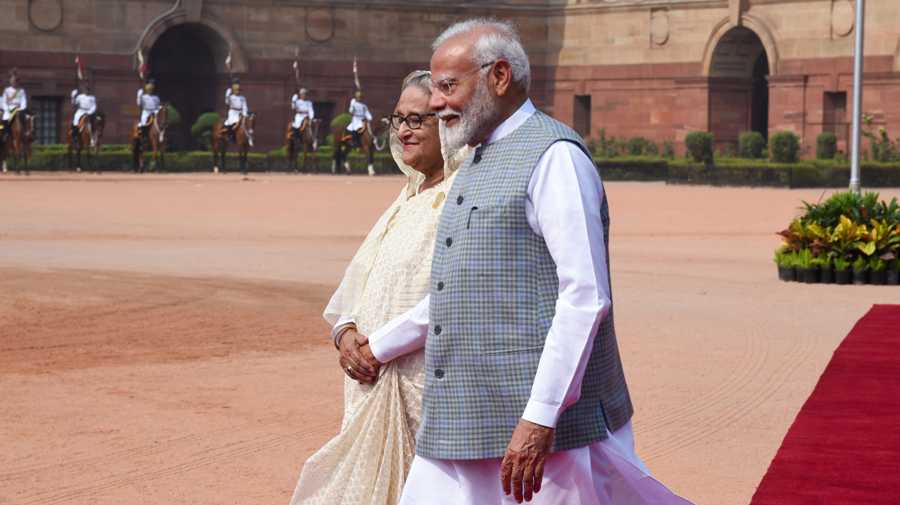
Prime Minister Sheikh Hasina was the first guest on a bilateral visit (21-22 June 2024) that India received after Prime Minister Narendra Modi formed the government for a third term. Her visit to India was due since she assumed office for a fourth term earlier in January this year. It is entirely due to the political will of the two mature leaders, that the bilateral ties between Bangladesh and India have flourished and development partnerships are monitored by the foreign ministers of the two countries to hasten the process.
On the occasion of his maiden visit to Bangladesh in June 2015, Prime Minister Narendra Modi said that his and PM Sheikh Hasina’s minds are “perfectly matched” and that both are focussed on “Vikas (development)”. He added, “India and Bangladesh are not just neighbours, but also want to go together (Hum paas paas hai, aur hum saath saath hain).”
Bangladeshi envoy Mustafizur Rahman believes that the destinies of India and Bangladesh are intertwined and the relationship between the two countries could be a valuable contributor to regional connectivity. Speaking at a think tank event in April he said, “The destinies of our two countries and people are intertwined, not only due to our geographical proximity, shared history, culture, heritage and value system but also because of the indelible bond that was forged when we stood together, shedding blood together in 1971 for the independence of Bangladesh.”
For India, connectivity, trade, infrastructure and capacity building are constant features of engagement and it deems such ties as important not just from the security perspective but mainly for mutual development- as is manifested in its relation with Bangladesh.
Of all the neighbouring countries, Bangladesh has emerged as the major partner with which India’s infrastructure development engagement has broadened both in terms of finance and the nature of projects. With around $7.9 billion (LOCs), Bangladesh, amongst South Asian countries, has the highest level of exposure and the focus has been on connectivity, power generation and power transmission lines.
Bangladesh is very important from a connectivity and strategic perspective, with India assisting in railway and port infrastructure as well. The country’s ports give much shorter access to India’s Northeast states and EXIM Bank has been focused on funding the upgradation and development of key ports and their linkages with railways.
Both nations agreed to enhance their cooperation in shipping and inland water transit, including the exploration of direct shipping links and the commencement of riverine services under selected Protocol on Inland Water Transit and Trade (PIWT&T) routes. In a significant step towards bolstering trade and connectivity, India and Bangladesh initiated the first trial movement of vessels between Maia Port in India and Sultanganj Port in Bangladesh this year, significantly reducing the distance for cargo transport.
Rail projects are largely covering Dhaka with the port cities. But they are also very important strategically in the sense that they are connecting either to Agartala or to the rest of the Indian mainland.
India’s landlocked Northeast is set to get a crucial connectivity link to the Bay of Bengal with the opening of the long-awaited Bangladesh-India friendship bridge, known as Maitri Setu over the Feni River, which acts as a boundary between India (in Tripura) and Bangladesh. Built by National Highways and Infrastructure Development Corporation Ltd at a project cost of Rs. 133 crore, the 1.9-km-long bridge connects Ramgarh in Bangladesh with Sabroom in India.
Last year Bangladesh gave India access to Chattogram and Mongla ports for transit and trans-shipment of cargo vessels. Passenger movement through Maitri Setu which connects India and Bangladesh in the South Tripura district will start by September this year. The bridge was inaugurated by Prime Minister Narendra Modi and Sheikh Hasina virtually in March 2021.
The recent years have seen sustained high-level engagements between the two countries, with notable visits including the Honourable President and Prime Minister of India attending significant celebrations in Bangladesh in 2021. Prime Minister Hasina herself visited India in September 2022 and participated in the G20 Summit in New Delhi in 2023.
During her recent state visit, India and Bangladesh signed 10 MoUs whereby both leaders endorsed a vision statement on peace and prosperity, renewing longstanding ties. The talks focused on defence ties, management of Mongla port, and cross-border power trade. India plans to send a technical team for the Teesta River conservation project.
In PM Modi’s words, the two countries have outlined a “futuristic vision” based on India’s ambition for a “Viksit Bharat by 2047” and Bangladesh’s national development goal of “Smart Bangladesh Vision 2041”. Significant agreements encompassing connectivity, commerce and the power sector were signed.
In their wide-ranging discussions, Modi and Hasina decided to expand power and energy collaboration and together develop intra-regional electricity trade, including competitively-priced power generated from clean energy projects in India, Nepal and Bhutan, through the Indian electricity grid. They agreed to the construction of the Inland Container Depot (ICD) at Sirajganj under grant assistance. The two leaders have also agreed to a Joint Technical Committee for discussions on the renewal of the Ganga Water Treaty. Indian entities are also set to undertake the upgradation of Mongla Port in Bangladesh, the second largest port in the neighbouring country, financed out of LOC extended by EXIM Bank.
India and Bangladesh have strengthened their defence ties through a new deal signed after Bangladesh PM Sheikh Hasina’s visit to India. On June 30, the Bangladesh Navy signed a contract for a ‘Made in India’ 800-tonne ocean-going tug with India’s Garden Reach Shipbuilding and Engineers (GRSE) Ltd as part of the line of credit offered by India to its neighbour. A few weeks ago, GRSE signed another contract with Bangladesh for the delivery of a trailing suction hopper (TSH) dredger.
Addressing a special press briefing during PM Hasina’s visit to New Delhi, Foreign Secretary Vinay Kwatra highlighted the importance of Bangladesh in India’s strategic plans for regional cooperation and security stating that the neighbouring country is crucial for India’s SAGAR (Security and Growth for All in the Region) doctrine and its vision for the Indo-Pacific region; “Bangladesh is a key part of India’s SAGAR doctrine and the Indo-Pacific vision. The renewal of the MoU on maritime cooperation and blue economy that was signed in exchange earlier today aims to develop our ocean-based blue economy and maritime cooperation.”
Rooted in equality, trust, and understanding, with connections based on their common history, language, and culture, the India and Bangladesh relationship goes beyond just strategic cooperation. In fact, the cornerstone of India-Bangladesh bilateral relations is the birth of Bangladesh. India and Bangladesh with their geographical contiguity and shared resources are natural partners and cooperation between the two countries is directly proportional to their mutual development. In a short span of ten years, PM Narendra Modi and PM Hasina have achieved more concrete outcomes in the relationship than in the previous 40 years and it is no surprise that the two PMs referred to this period in the relationship as a “Sonali Adhyaya” or golden era.


Leave a Reply