

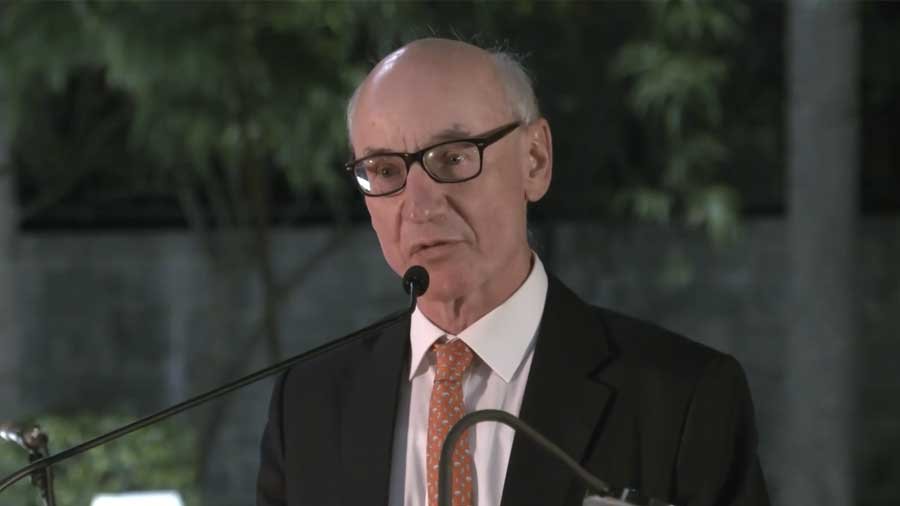
At his first National Day reception in India, Austria’s Ambassador highlights expanding bilateral engagement, the importance of international law and Austria’s forthcoming tenure on the UN Security Council.
Austria’s National Day is a celebration of sovereignty, independence and the enduring value of peace. For Ambassador Dr Robert Zischg, Austria’s National Day reception on 26 October 2026 at his residence in New Delhi was particularly significant, marking his first such celebration in India since assuming office in January.
Welcoming members of the Indian government, the diplomatic corps, international organisations, business representatives and the Austrian community, Ambassador Zischg reflected on the growing momentum in Austria–India relations and the principles guiding Austria’s engagement with the international community.
Describing his first nine-and-a-half months in India as an experience of discovery, he acknowledged the scale and diversity of the country, expressing appreciation for the cooperation extended by India’s Ministry of External Affairs and his colleagues at the Austrian Embassy and trade commission.
A New Chapter in Austria–India Relations
The Ambassador highlighted an unprecedented level of high-level engagement between the two countries in 2026. Austria’s Federal Chancellor, Dr Christian Stocker, visited India in April, meeting President Droupadi Murmu and Prime Minister Narendra Modi, accompanied by a substantial business delegation. The visit, the first by an Austrian Chancellor to India in more than four decades, reflected the importance Vienna attaches to its partnership with New Delhi.
Other ministerial and official visits throughout the year have further strengthened political and economic dialogue.
Economic cooperation remains an important pillar of the relationship. According to the Ambassador, bilateral trade exceeded €3 billion in 2025, while approximately 117 Austrian subsidiaries operate in India, with expectations of further growth.
The evolving partnership encompasses trade, investment, technology, innovation and cultural exchange. Austria, a member of the European Union since 1995, sees considerable potential in deepening cooperation with India as both countries navigate changing global economic and geopolitical circumstances.
For Ambassador Zischg, these developments demonstrate that the relationship is not merely sustained by diplomatic engagement but is increasingly supported by business partnerships and practical collaboration.
Austria’s Return to the UN Security Council
He also emphasised on Austria’s election as a non-permanent member of the United Nations Security Council for the 2027–2028 term. Elected on 3 June 2026, Austria secured 131 votes in the UN General Assembly.
The Ambassador said that Austria intends to use its tenure to uphold multilateralism and the principles of the UN Charter at a time when international conflicts and geopolitical rivalries are placing the rules-based international order under considerable strain.
“Austria stands firmly for multilateralism and the principles of international law, particularly the UN Charter,” he said.
For a country of Austria’s size, he argued, an international system governed by law rather than the strength of individual states is fundamental to national security and international stability.
“International law must apply equally to every state, large and small,” he stressed.
Addressing the war in Ukraine, the Ambassador underlined its direct significance for Europe. Russia’s full-scale invasion of Ukraine on 24 February 2022, he observed, had profoundly challenged assumptions about peace and security on the continent.
For Austria, he said, a peaceful and just resolution of the conflict remains a paramount concern.
National Day and the Meaning of Neutrality
Austria’s National Day commemorates the country’s declaration of permanent neutrality on 26 October 1955, following the restoration of its sovereignty after the Second World War.
For a decade, Austria had been occupied by the four Allied powers. The Austrian State Treaty, signed on 15 May 1955, paved the way for the withdrawal of foreign troops and the restoration of full independence. On 26 October that year, the Austrian Parliament adopted the constitutional law on permanent neutrality.
Reflecting on this history, Ambassador Zischg explained that Austria’s experience of occupation continues to shape its understanding of sovereignty and independence.
“Austrians therefore fully understand what foreign occupation means,” he said, underscoring the importance his country attaches to preserving its independence and ensuring peace in Europe.
Austria’s neutrality, alongside its membership of the European Union, informs its approach to international affairs, including its emphasis on dialogue, diplomacy and the peaceful settlement of disputes.
A Personal Note of Gratitude
Moving beyond geopolitics, the Ambassador acknowledged the support he had received since arriving in India. He thanked Secretary (West) Sibi George and the Ministry of External Affairs for their cooperation, particularly in facilitating the numerous official visits hosted during the year.
He also commended the Austrian Embassy team and the trade commission for their dedication, describing their collective efforts as instrumental in navigating the demands of a busy diplomatic calendar.
The reception retained a distinctly Austrian character through its culinary traditions, featuring familiar specialities such as goulash, cabbage noodles, apple strudel and chocolate cake, alongside Austrian wines. The gathering offered guests an opportunity to experience the country’s cultural heritage in an atmosphere of friendship and hospitality.


Leave a Reply