

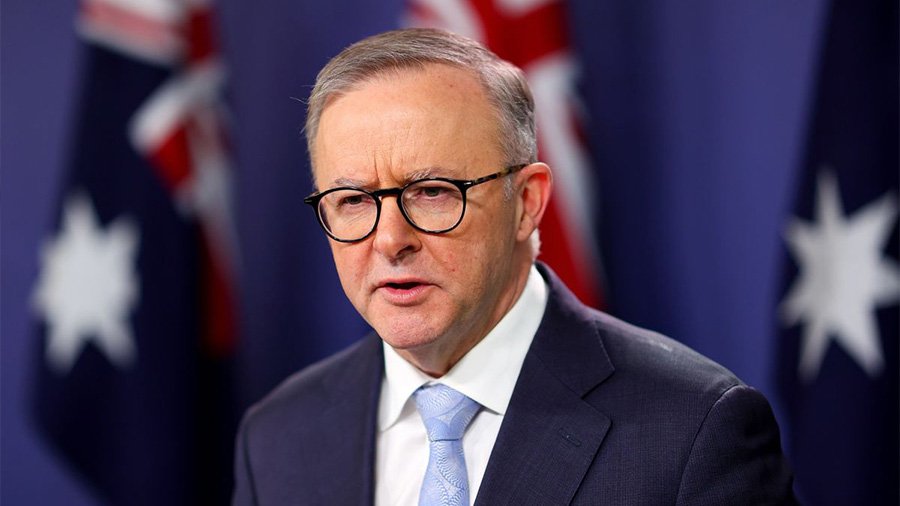
As Australian Prime Minister Anthony Albanese secures a second term with a thumping win, it is expected to have a significant impact on India-Australia relations and also on the wider Indo-Pacific region.
To start with, Prime Minister Narendra Modi congratulated Anthony Albanese on his resounding victory and re-election as Prime Minister of Australia and said he looks forward to working with him to further deepen the India-Australia Comprehensive Strategic Partnership.
Albanese has become the first Australian Prime Minister to win a second consecutive three-year term in 21 years.
Earlier, Anthony Albanese’s Labor Party defeated the ruling coalition led by Scott Morrison in Australia’s 2022 elections.
On the other hand, despite a left-centre government, it is predicted that Australia will strengthen its security commitments with both the US and India, benefiting the wider Indo-Pacific region.
It is expected that Anthony Albanese’s second term will revisit the scope and range of India-Australia relations and the wider strategic landscape for Canberra.
As India and Australia expand their strategic engagement, it will have a profound impact on the geopolitics of the Indo-Pacific, thereby altering the existing security architecture in the region.
It is noted that both the aspiring great powers—India and Australia—share security concerns regarding the rise of China and the changing international system, where the preeminence of the United States is being challenged.
In addressing these security concerns, Australia and India have tightened their operational priorities, which has implications at the strategic level. One such important operational issue was addressed with the inclusion of Canberra in the annual Malabar exercise, where, for the first time, all members of the Quadrilateral Security Dialogue (Quad) participated in a maritime exercise since 2007.
The Malabar military exercises, in which Australia participated for the first time in 2007, reaffirmed the much-sought-after strategic partnership. It is noted that the Australian Navy deployed its HMAS Ballarat, an Anzac-class frigate, as part of the Malabar exercises.
Further, as a part of its commitment to multilateral exercises, the Australian Navy participated in both the first and second phases of the Malabar exercises. Australia’s participation has developed the necessary interoperability for more trilateral exercises involving both New Delhi and Canberra.
Earlier, the foundation of the strategic engagement between India and Australia was mooted as a part of the “Comprehensive Strategic Partnership” agreement, sealed during the virtual state summit held between Indian Prime Minister Narendra Modi and Australian Prime Minister Scott Morrison, elevating the already existing strategic partnership to a strategic alliance between New Delhi and Canberra.
A subset of the ‘Comprehensive Strategic Partnership’ is the game-changing Logistics Exchange Agreement, on similar lines to the Indo-United States logistics agreement.
The logistics agreement will enable both New Delhi and Canberra’s navies to extend their areas of operation.
Further, this operational innovation will enable New Delhi and Canberra to reconcile strategic differences as they approach their maritime grand strategic vision in the Indo-Pacific. The momentum for the Indo-Australian strategic alliance has increased in recent times at both the operational and strategic levels, coinciding with China’s increased maritime assertiveness.
Earlier, under Scott Morrison’s premiership, India and Australia began to enhance the range and scope of their maritime operational reach through bilateral naval exercises called ‘AUSINDEX’ in 2015, and the two armies also launched exercises named AUSTRAHIND in 2016.
Besides that, there are also regular staff-to-staff talks between the three wings of the armed forces on both sides, developing the necessary base for better interoperability among the two countries’ armed services, thereby facilitating the scope of the Mutual Logistics Arrangement.
At present, India has a Mutual Logistics Arrangement with many countries such as the US, France, Oman, the Philippines, Indonesia (Sabang Port), and others. Similar agreements are planned with Japan and Russia to facilitate the Indian Navy’s range and scope of operations in the wider Indo-Pacific region. A logistics arrangement with Australia will facilitate the Indian Navy’s continuous deployments in the Indian Ocean’s eastern choke points through the maritime surveillance aircraft P-8I, thereby denying Chinese submarine intrusion in the Indian Ocean.
The Indo-Australian Logistics Agreement will be modelled on the Indo-US agreement, with profound variations impacting operational surveillance, allowing the Indian Navy to oversee the southeastern Indian Ocean extending to the southwest Pacific, thereby developing capabilities to monitor Chinese submarine activities.
Justifying the commitment to the Logistics Agreement, the Indian Navy will now be undertaking P-8I operations from Australian bases in the Cocos (Keeling) Islands and the Port of Darwin, thereby monitoring China’s submarine movements in the Indian Ocean.
Further, New Delhi may utilise this leverage to conduct reciprocal naval exercises around Australia’s Northern Territory, including gaining operational rights for India’s P-8Is from the Royal Australian Air Force bases at Darwin or the Cocos Islands. This will facilitate the necessary interoperability essential for India and Australia’s anti-submarine warfare capabilities.
One important dimension of Canberra’s anti-submarine warfare includes the purchase of P-8 long-range surveillance aircraft, the procurement of three air warfare destroyers, and plans for several future frigates with significant anti-submarine warfare (ASW) capabilities to replace the Anzac-class vessels.
Australia’s maritime reach in Asia will be boosted by aerial refuelling and early-warning aircraft—both significant force multipliers—and the introduction of two large amphibious vessels.
On the other hand, Australia also has a forward presence in the Cocos (Keeling) Islands in the Indian Ocean, which consist of two atolls and 27 islands, some 2,950 kilometres northwest of Perth and 1,272 kilometres southwest of Jakarta. The islands serve as a refuelling stop and forward base for the Royal Australian Air Force’s P-3 Orion surveillance fleet, covering the Indian Ocean.
Once upgraded, the Cocos Islands base will support the latest generation P-8A Poseidon maritime patrol aircraft and the world’s largest drone—the US-built Global Hawk—for anti-submarine warfare.
In conclusion, Anthony Albanese’s second term will provide a new strategic framework for Canberra in the wider Indo-Pacific region, including strengthening existing relations with both India and the US.


Leave a Reply