

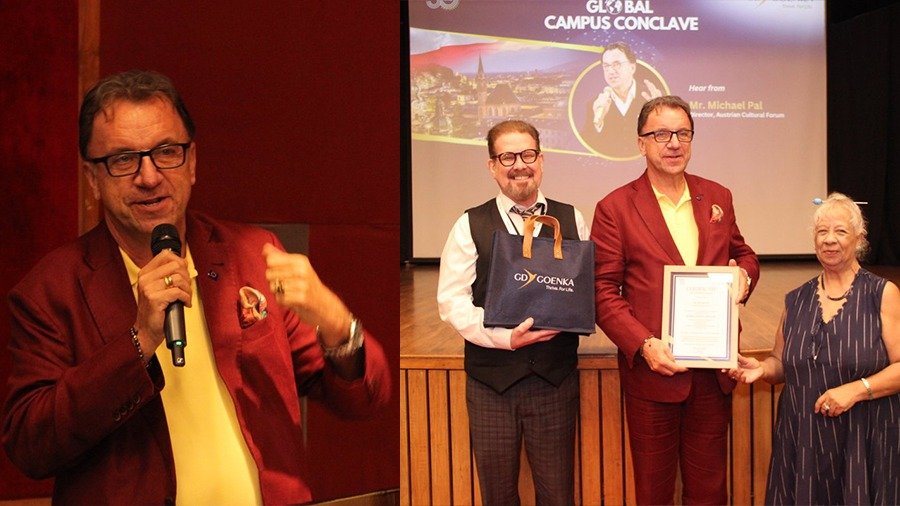
From a 30,000-year-old figurine to quantum physics, from learning by heart to studying abroad, Mr. Michael Pal, Director of the Austrian Cultural Forum, New Delhi, offered students at the Global Campus Conclave a wide-ranging reflection on knowledge, education, culture and the importance of experiencing the world beyond a screen.
Education, Mr. Michael Pal suggested, does not begin with a smartphone, a search engine or even a classroom. It begins with everything that generations before us have created, discovered and passed on.
Opening his address at the Global Campus Conclave, organised by Diplomatist Magazine at GD Goenka The Flagship School, New Delhi, Pal reminded the young audience that the present rests on thousands of years of human development.
Austria, he explained, offers a fascinating glimpse into this long human story through the Venus of Willendorf, a small prehistoric limestone figurine dating back approximately 30,000 years. Discovered on the banks of the Danube, the artefact is now housed at Vienna’s Natural History Museum.
For Pal, the ancient figurine is more than an archaeological object. It represents the extraordinary continuity of human creativity and knowledge.
He encouraged the students to visit Vienna and experience such history first-hand, an invitation that neatly connected with another theme running through the conclave: the value of experiencing another culture rather than merely reading about it.
The knowledge that stays with you
Having watched the students perform music and dance during the programme, Pal turned to an issue at the heart of contemporary education: what should young people retain in an age when information is always at their fingertips?
Today, almost any fact can be found within seconds through a mobile phone or computer. But Pal cautioned against becoming entirely dependent on technology.
“Don’t rely on these computers, on your telephones, where you can look up every information. You need it by heart, some basic knowledge.”
For him, there remains a fundamental difference between being able to search for information and actually possessing a foundation of knowledge.
He referred to Austria’s traditional eight-year Gymnasium education model, which places considerable emphasis on building that foundation. The initial years focus on acquiring basic knowledge, while the subsequent years revisit and deepen it, preparing students for university education.
The objective, he suggested, is not simply to fill students with facts. It is to give them a foundation on which they can develop deeper understanding and independent thinking.
In a world increasingly shaped by artificial intelligence, this message assumes even greater relevance. Technology can provide answers, but students still need the intellectual foundation to question those answers, understand their context and make informed decisions.
Small country, strong academic tradition
Pal also used Austria’s experience to challenge the assumption that academic influence is necessarily linked to a country’s size.
With a population of around nine million, Austria is relatively small by global standards. Yet it has maintained a strong tradition of academic, scientific and cultural achievement.
He highlighted Austrian physicist Anton Zeilinger, who was awarded the 2022 Nobel Prize in Physics for pioneering experiments with entangled photons and contributions to quantum information science.
For Indian students considering international education, Pal presented Austria as a destination offering opportunities in both academic and research fields.
His advice, however, came with an important qualification: learn German.
While Austria offers an increasing number of programmes taught in English, particularly at universities, German remains an important part of academic, social and professional life.
“Mostly it’s on German language internationally,” Pal noted, encouraging students to develop language skills alongside their academic qualifications.
From classrooms to international collaboration
Pal also highlighted opportunities for students and institutions to participate in academic exchange between India and Austria.
He encouraged students, researchers and universities to explore partnerships through OeAD — Austria’s Agency for Education and Internationalisation, which supports international academic cooperation, mobility and educational exchange.
Such cooperation, he emphasised, can extend well beyond a student’s individual study experience. Indian and Austrian institutions can identify partner universities, undertake joint research, exchange students and academics, and participate in longer-term collaborative projects.
The growing institutional engagement between the two countries reflects this approach. The Austria–India Higher Education Cooperation Forum, held in New Delhi in 2025, brought together higher-education institutions from both countries to explore partnerships and new avenues of cooperation.
For students, therefore, studying abroad need not mean simply leaving one country to earn a degree in another. It can mean becoming part of a larger academic network that connects institutions, researchers and ideas across borders.
Education beyond the classroom
But Pal’s invitation to Austria extended well beyond universities.
He spoke enthusiastically about Austria’s history, museums, architecture, food, landscapes and sporting opportunities. He encouraged students to experience the country as a whole rather than seeing it only as an educational destination.
Austria’s cultural heritage, he noted, offers students opportunities to encounter centuries of European history and artistic achievement, while its natural landscape provides a wide range of outdoor and sporting activities.
And there was a lighter side to his presentation as well.
Pal spoke about Austrian cuisine, including the internationally recognised Wiener Schnitzel, while also pointing out that Austria offers plenty of options for those who do not eat meat, including traditional dumpling dishes.
He drew a parallel between Indian and Austrian food cultures: both societies, he observed, have a strong appreciation for food and the social experience that comes with it.
For Pal, these seemingly small cultural experiences are part of the larger educational journey.
“Studying in Austria is not only learning, it’s also about recreation and about getting a full human being.”
In other words, international education should not be reduced to academic credentials. It should help students become more confident, culturally aware and well-rounded individuals.
That means exploring museums, meeting people, learning languages, trying unfamiliar food, participating in sports and understanding a society beyond what appears in a textbook.


Leave a Reply