

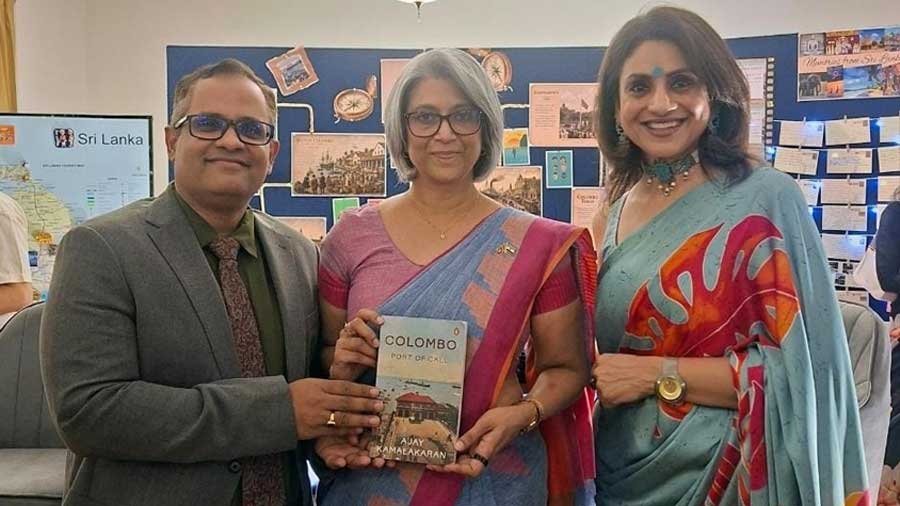
History often remembers cities through kings, wars and monuments. But what if a city’s story could instead be told through the eyes of those who arrived at its shores, writers, explorers, revolutionaries, artists and dreamers? That intriguing premise formed the heart of an engaging literary evening hosted by the High Commission of Sri Lanka in India, where author Ajay Kamalakaran discussed his latest book, Colombo: Port of Call, in conversation with renowned storyteller, community builder and founder of Chapters by Shibani, Shibani Sethi.
More than a conventional book discussion, the evening unfolded as an exploration of Colombo’s layered past, its cosmopolitan identity and the people whose journeys shaped its story. Through a lively exchange, rich anecdotes and thoughtful audience participation, the conversation celebrated not only a remarkable book but also the enduring cultural and historical ties between India and Sri Lanka.
“Why tell Colombo’s story through visitors?”
Opening the discussion, Shibani Sethi drew attention to one of the book’s most distinctive features. Instead of narrating Colombo’s history through political events or local chronicles, Ajay Kamalakaran chose to reconstruct the city through the observations of travellers who visited it over nearly two centuries.
Responding to her question, Kamalakaran explained that Colombo was once one of the most significant ports on the maritime route connecting Europe with Australia during the golden age of steamships. Every traveller carried away a different impression of the city, and together those impressions created a fascinating mosaic of Colombo’s identity.
He noted that the book was also an attempt to preserve the city’s rapidly disappearing heritage.
Many of Colombo’s colonial bungalows are giving way to high-rise developments, while changing lifestyles are gradually replacing the close-knit neighbourhood culture that once defined the city. Through historical accounts, he hoped to document a Colombo that future generations may no longer experience.
Yet, despite rapid urban transformation, he believes one characteristic has remained unchanged, the warmth, openness and cosmopolitan spirit of the city.
A Journey Across Languages and Archives
One of the most fascinating aspects of the conversation centred on the extraordinary research behind the book.
When Shibani asked whether he spoke Japanese, Kamalakaran smiled and admitted that he did not. Instead, he relied on librarians, historians and researchers across different countries to help him access Japanese sources relating to Emperor Hirohito’s little-known visit to Ceylon. He also worked with French and Russian archival material, while drawing upon multilingual travel accounts that have rarely been explored by English-language historians.
He observed that history often becomes “English-centric”, causing many remarkable stories written in other languages to remain overlooked.
His extensive acknowledgements, he remarked, are a tribute to the many scholars and archivists whose expertise helped reconstruct Colombo’s forgotten past.
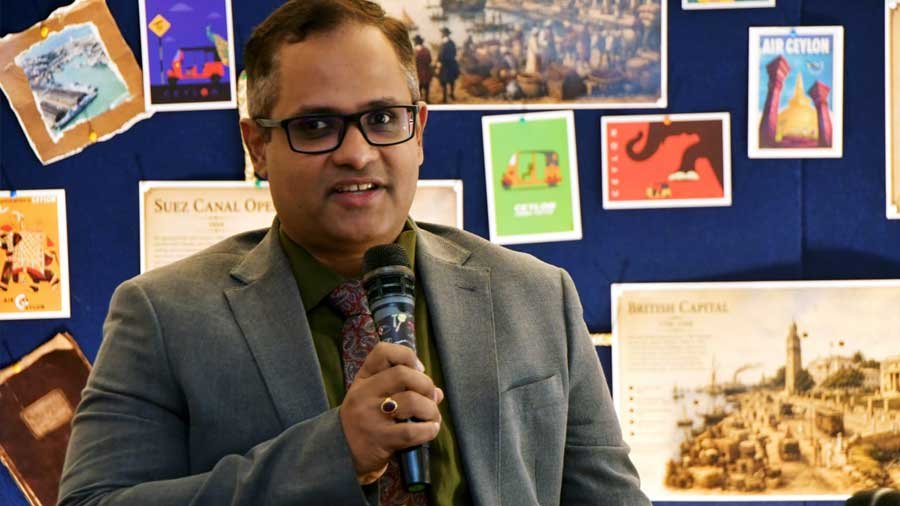
Gandhi, Mark Twain and the Colombo They Encountered
The discussion soon shifted from archival research to some of the colourful personalities featured in the book.
One of the evening’s most entertaining moments came when Shibani invited Kamalakaran to recount Mahatma Gandhi’s visit to Colombo.
Rather than addressing a vast public gathering as he had expected, Gandhi found himself speaking before an audience of affluent women dressed in elaborate jewellery. Initially disappointed, he decided to stay and delivered an impassioned appeal urging them to donate their ornaments for the welfare of underprivileged plantation workers. He even remarked that, were he a woman, he would never dress merely to impress others.
The audience laughed as Kamalakaran described imagining the stunned silence that must have followed Gandhi’s unexpected appeal.
He also shared another little-known aspect of Gandhi’s visit. Gandhi was surprised to discover that many Sri Lankan Buddhists consumed meat and alcohol, something that challenged his own assumptions about Buddhist society. While he accepted dietary differences, he remained deeply opposed to alcohol and supported prohibition campaigns during his visit.
The conversation then moved to Mark Twain, whose observations of Colombo occupy an important place in the book.
Twain was fascinated by the distinctive outrigger boats that ferried passengers from anchored steamships to the harbour, boats unlike anything he had previously encountered. Kamalakaran explained that beyond these unusual vessels, what truly transformed Twain’s perspective was his encounter with the people of Ceylon. The experience broadened his understanding of the East and reflected how travel has the power to reshape deeply held perceptions.
Separating Myth from History
Throughout the evening, Kamalakaran emphasised that one of the greatest challenges of writing the book was distinguishing historical fact from long-repeated legend.
Addressing stories surrounding Russian playwright Anton Chekhov, he explained how popular myths often acquire the status of accepted history. Many colourful anecdotes simply could not be substantiated through archival evidence and therefore found no place in the book.
“My responsibility as a historian and storyteller,” he suggested, “was to separate documented history from folklore.”
That commitment to evidence also led him to investigate countless family stories and inherited memories, many of which ultimately proved impossible to verify.
The Temple of the Tooth and Forgotten Diplomatic Episodes
Religion, diplomacy and history intertwined during another fascinating segment of the discussion.
Speaking about Sri Lanka’s revered Temple of the Tooth in Kandy, Kamalakaran recalled the visit of King Chulalongkorn of Siam, who was denied permission to hold the sacred relic, a decision that reportedly caused diplomatic discomfort at the time.
He also narrated an episode involving Mahatma Gandhi, who insisted that an elderly woman be allowed to view the sacred relic after officials had declared visiting hours closed, a gesture reflecting Gandhi’s empathy and respect for ordinary devotees.
Languages that Tell Their Own Stories
The conversation moved naturally to Sri Lanka’s remarkable linguistic diversity.
Kamalakaran explained that Tamil spoken across Sri Lanka is far from uniform. Distinct regional dialects flourish in Jaffna, Negombo, the Hill Country and among Sri Lankan Muslim communities, each reflecting centuries of cultural exchange with Arabic, Malay and other linguistic traditions.
He observed that while modern media has gradually standardised spoken Tamil, regional variations continue to preserve unique aspects of Sri Lanka’s multicultural heritage.
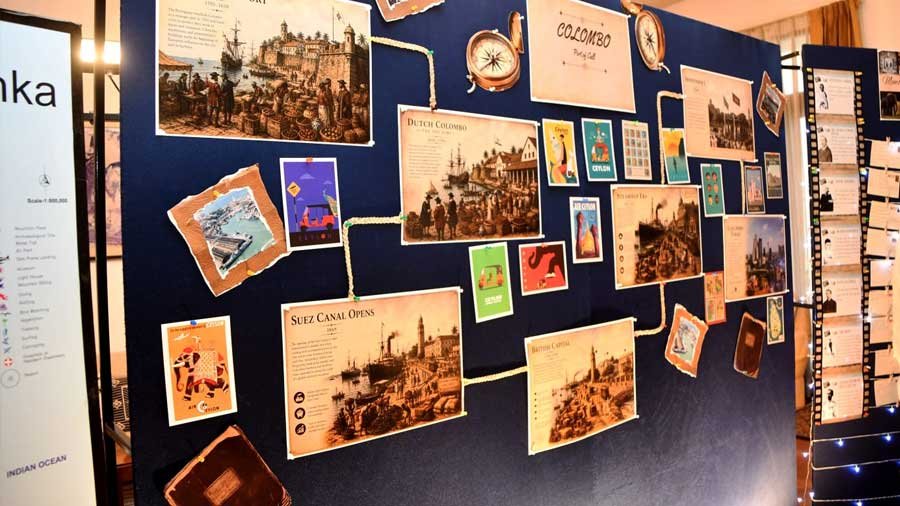
Audience Memories Bring Colombo Alive
Perhaps the most touching part of the evening came when attendees were invited to share their own memories of Colombo.
One participant recalled the city’s pristine greenery and warm hospitality.
Another remembered attending the Galle Literary Festival.
Others spoke of Colombo’s outdoor book markets, the World Trade Centre, Galle Face Green, Colombo Swimming Club and the extraordinary kindness of strangers encountered during their visits.
Listening to these reflections, Kamalakaran remarked that every one of those memories deserved to become a story of its own.
Questions Beyond the Book
The audience interaction extended well beyond the pages of Colombo: Port of Call.
Questions ranged from the history of early Christianity in Sri Lanka and archaeological discoveries to the challenges of researching historical myths and preserving oral traditions.
Asked whether private historians can still uncover forgotten stories despite the abundance of modern documentation, Kamalakaran acknowledged that such work demands patience, extensive archival research and, occasionally, a measure of good fortune. Many of the most remarkable discoveries, he noted, emerge unexpectedly from old newspapers, travel journals and forgotten records.
Colombo: More Than a Transit City
Towards the close of the conversation, Shibani asked a deceptively simple question:
“If you had to introduce Colombo to someone through just one story from your book, which would it be?”
Rather than choosing a single anecdote, Kamalakaran reflected on Colombo itself.
It is, he said, a city that has constantly reinvented itself while retaining its welcoming character. Once a vital maritime crossroads connecting East and West, Colombo today remains a place where cultures, languages and histories intersect naturally.
He expressed the hope that travellers would stop treating Colombo merely as a transit point on their way to Sri Lanka’s beaches and hill country. Instead, they should linger, explore its streets, meet its people and discover a city whose stories are hidden in everyday life rather than tourist itineraries.
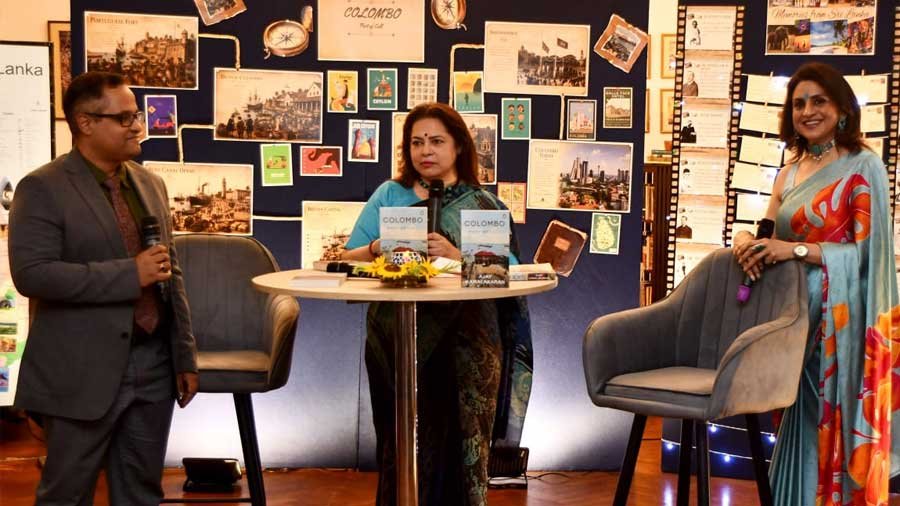
Celebrating Shared Histories
The evening concluded not merely with the discussion of a book, but with a celebration of shared cultural memory.
Skillfully moderated by Shibani Sethi, the conversation transformed historical research into compelling storytelling, while Ajay Kamalakaran demonstrated how archives, forgotten travelogues and personal curiosity can together illuminate an entire city’s past.
Hosted by the High Commission of Sri Lanka in India, the event also highlighted the power of literature as a bridge between nations. In revisiting Colombo’s history through the voices of travellers from across the world, Colombo: Port of Call reminds readers that cities are not defined solely by their monuments, but by the countless journeys, encounters and memories they inspire.
As the audience dispersed, many carried home not only signed copies of the book but also a renewed appreciation of Colombo, a city whose greatest stories continue to arrive, quite fittingly, by way of those who pass through its port.


Leave a Reply