

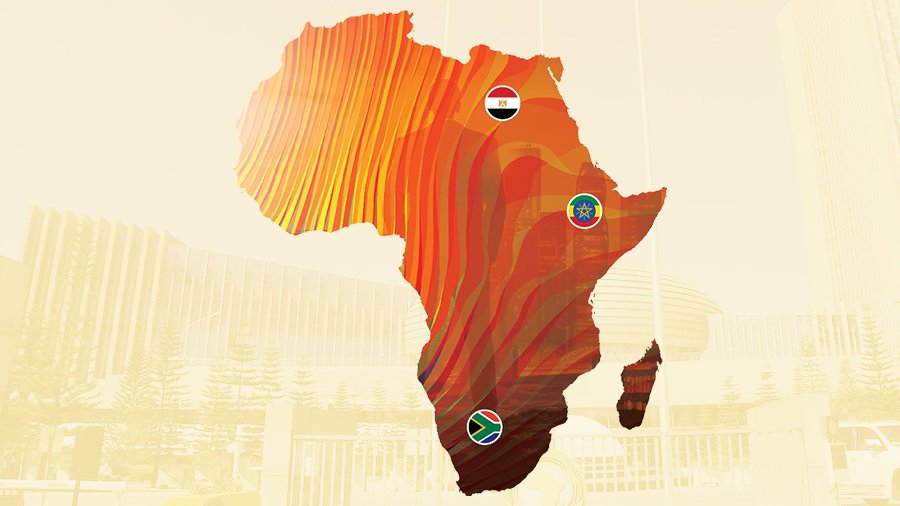
Ethiopia, South Africa, and Egypt Competing for Continental Leadership
There is an old African proverb that goes like this: “When two elephants are fighting, it is the grass that suffers”. It is 2026, and this proverb is still relevant in geopolitics. Through the corridors of Addis Ababa, Cairo, and Pretoria, three nations are locked into a fierce race, and this race is as much about politics as it is about legitimate ambition for a continent that is growing faster compared to Asia[1]. As per the reports, Africa is expected to register a GDP of 4.6 percent in 2026, the fastest among all the regions across the globe. And among those countries, a struggle ensues to decide whose voice matters the most[2].
As of 2026, the only three nations on the African continent that are part of the BRICS table and have significant clout within the African Union are Ethiopia, Egypt, and South Africa. The. Co-membership of these nations in BRICS was made official with the formal induction of both Ethiopia and Egypt in January 2024[3].
The entry of Ethiopia and Egypt into the BRICS has ushered in a new form of competition among these African nations, but this time, rather than relying on military power, these nations are employing softer means to prove their mettle. The three nations, therefore, represent three different schools of African leadership thinking: Ethiopia’s institutional multilateralism, Egypt’s civilisational realpolitik, and South Africa’s post-apartheid liberal governance model. The “dual voice” that these three nations represent is, therefore, a complex one that encapsulates the diversity that Africa embodies and the different ways through which power can be asserted. To comprehend this, one would need to examine the value that these nations bring to the BRICS table.
Ethiopia’s Stake
Ethiopia’s claim to continental leadership is based on institutional geography, not geographic size, and hence the membership in the BRICS is significant. Ethiopia’s influence is based on its close proximity to the continent’s governance, unlike South Africa, where the influence is based on institutions and the markets. Addis Ababa is the headquarters of the African Union, home to approximately 2000 diplomats and a permanent venue for the continent’s political negotiations. Over the years, Ethiopia has been able to provide an outsized international presence in comparison to its economic capabilities, thanks to this concentration of diplomatic effort. Hosting the AU’s institutional machinery provides Ethiopia an advantage in shaping and participating in important continental negotiations.
The concept of developmental autonomy was strongly emphasised by representatives from Ethiopia during the 2025 BRICS summit. Emphasis was placed on the right of African states to pursue transformation through infrastructure and industrialisation, and to reduce excessive dependence upon external constraints. The Grand Ethiopian Renaissance Dam was more or less implied in this narrative, as it has become shorthand for the broader notion that Africa possesses the capacity to create, fund, and execute projects at a continental level, based on its own terms and conditions.
Starting in 2026, the Ethiopian government has started expanding this notion into new policy areas. The appointment of Prime Minister (PM) Abiy Ahmed as the AU Champion for Artificial Intelligence and Digital Health demonstrates a concerted effort to position Ethiopia as the leader in the continent’s forward-looking policy debates[4].
Initiatives targeting the establishment of Addis Ababa as an AI norm-setting centre offer additional insight into how Ethiopia is utilising its central institutional role to shape not only current discussions but also the contours of Africa’s technological future. However, Ethiopia’s leadership path is subject to limitations. Internal challenges, the enduring consequences of the Tigray conflict, and persistent economic strains all serve to complicate its standing in the international arena. The leadership of Ethiopia is more accurately characterised as facilitative, prioritising the roles of convening and coordinating over that of leading.
South Africa: The Democratic Anchor Under Pressure
One of the pillars upon which South Africa has built its position of leadership in Africa is more than just an expression; it is a foundation of commonality built through a decade of institutional hegemony. For years, South Africa was the only representative in BRICS from Africa, and its role was that as a bridge and negotiator. For translating the priorities of the continent into the language of the BRICS bloc through the financial hub in Johannesburg and the diplomatic machinery in Pretoria. This role was never totally unchallenged, but has been solidly embedded institutionally. Under Cyril Ramaphosa’s leadership, this has become even more institutionalised through a concentration on mediation, multilateralism, and “African solutions to African problems” within his foreign policy.
However, throughout the post-expansion period, particularly during the 2025 BRICS Summit, South Africa’s tone remained measured[5]. Rather than exerting supremacy, it emphasised on coordination, including the alignment of BRICS initiatives with continental frameworks like the African Continental Free Trade Area. This change in tone has occurred in reaction to internal and external factors. The internal factors that contributed to the change in tone include persistent energy crises and uneven growth; consequently, South Africa’s ability to assert its will over the other BRICS member states has been weakened by its diminished ability to establish an effective legacy of leadership and, therefore, to participate in decision-making processes within that group. limited its ability to assert control, which has resulted in a weakened influence over member states and hindered the effective decision-making process. While externally, the joining of Ethiopia and Egypt has diminished its sole representational role.
Egypt: The Civilisational Claimant
Egypt has a unique perspective that encompasses this triad in a way that is completely different from other countries. Egypt showcases a civilisational narrative. Egypt is the cradle of African and Arab identity, the geographical fulcrum linking Africa and the Middle East, and a state whose decisions echo from Khartoum to Nairobi. Egypt combines economic heft with strategic ambition. The country has three priorities: connectivity, energy, and infrastructure. The ongoing conflict between Egypt and Ethiopia over the GERD illustrates the level of competition between Egypt and Ethiopia, with Egypt viewing this competition as not only ne based upon economic interests, but also to be important for the future of both nations[6]. Furthermore, Egypt’s engagement with Somalia in support of providing security can also be viewed as a “geographic hedge” against any further regional ambitions of Ethiopia, including access to the Red Sea through Somaliland. Egypt has also made an attempt to establish itself as the primary spokesperson on behalf of the Arab world with African nations within BRICS. However, Egypt’s assertive approach has not gone uncontested; various states, particularly those outside the Arab world, challenge Egypt’s right to represent itself as such.
Convergence, Tension, and the Dual Voice
Ethiopia, Egypt, and South Africa epitomise the diversity of African leadership. Each displays different capacity; for instance, South Africa has an institutional foundation throughout Africa, while Ethiopia is situated near its continental administrative centre and Egypt possess a significant historical presence due to its strategic position within Africa. Although their approaches differ, their objectives converge, focusing on financial reform, local currency trade, and South-South cooperation, resulting in a dual voice that is both the continent’s strength and its challenge. The 2025 BRICS Summit in Rio exposed the cost of disunity when disagreements over Africa’s representation in the UN Security Council, yet this competition clarifies what 21st-century African leadership entails[7]. The AfCFTA highlights how rivalry can become complementarity[8]. Therefore, Africa’s dual voice in BRICS will coalesce only if these nations prioritise coordination over dominance.
References:
[1] Queenie Nair, “ Beyond the Asian Century, Africa Emerges as the New Global Growth Engine,” ET Edge Insights, February 20, 2026, https://etedge-insights.com/featured-insights/beyond-the-asian-century-africa-emerges-as-the-new-global-growth-engine/
[2] “Africa Will Grow More Than Asia,” Welcome Africa, accessed April, 2026, https://welcomeafrica.org/en/africa-will-grow-more-than-asia/
[3] Press Trust of India, “ India Welcomes Egypt, Iran, UAE, Saudi Arabia and Ethiopia Joining BRIC,” The economic Times, June 10, 2024, https://economictimes.indiatimes.com/news/india/india-welcomes-egypt-iran-uae-saudi-arabia-and-ethiopia-joining-brics/articleshow/110883057.cms?from=mdr
[4] “Abiy Named AU Champion for AI and Digital Health as U.S. Business Delegation Deepens Ties in Addis,” Ethiopian Business Review, March 9, 2026, https://ethiopianbusinessreview.net/abiy-named-au-champion-for-ai-and-digital-health-as-u-s-business-delegation-deepens-ties-in-addis/
[5] Cyril Ramaphosa, “ Statement by President Cyril Ramaphosa to the Extraordinary BRICS Leaders’ Meeting, 8 September 2025,” Department of International Relations and Cooperation (DIRCO), September 8, 2025, https://dirco.gov.za/statement-by-president-cyril-ramaphosa-to-the-extraordinary-brics-leaders-meeting-8-september-2025/
[6] Sherif Mohyeldeen, “ The Dam That Broke Open an Ethiopia-Egypt Dispute”, Carnegie Endowment for International Peace, February 12, 2021, https://carnegieendowment.org/research/2021/04/the-dam-that-broke-open-an-ethiopia-egypt-dispute
[7] Peter Fabricius, “ New Africa BRICS Members Decry Preferential Treatment for South Africa,” Institute for Security Studies (ISS Africa), May 16, 2025, https://issafrica.org/iss-today/new-africa-brics-members-decry-preferential-treatment-for-south-africa
[8] “African Continental Free Trade Area,” African Union, accessed April 1, 2026, https://au.int/en/african-continental-free-trade-area



Leave a Reply