

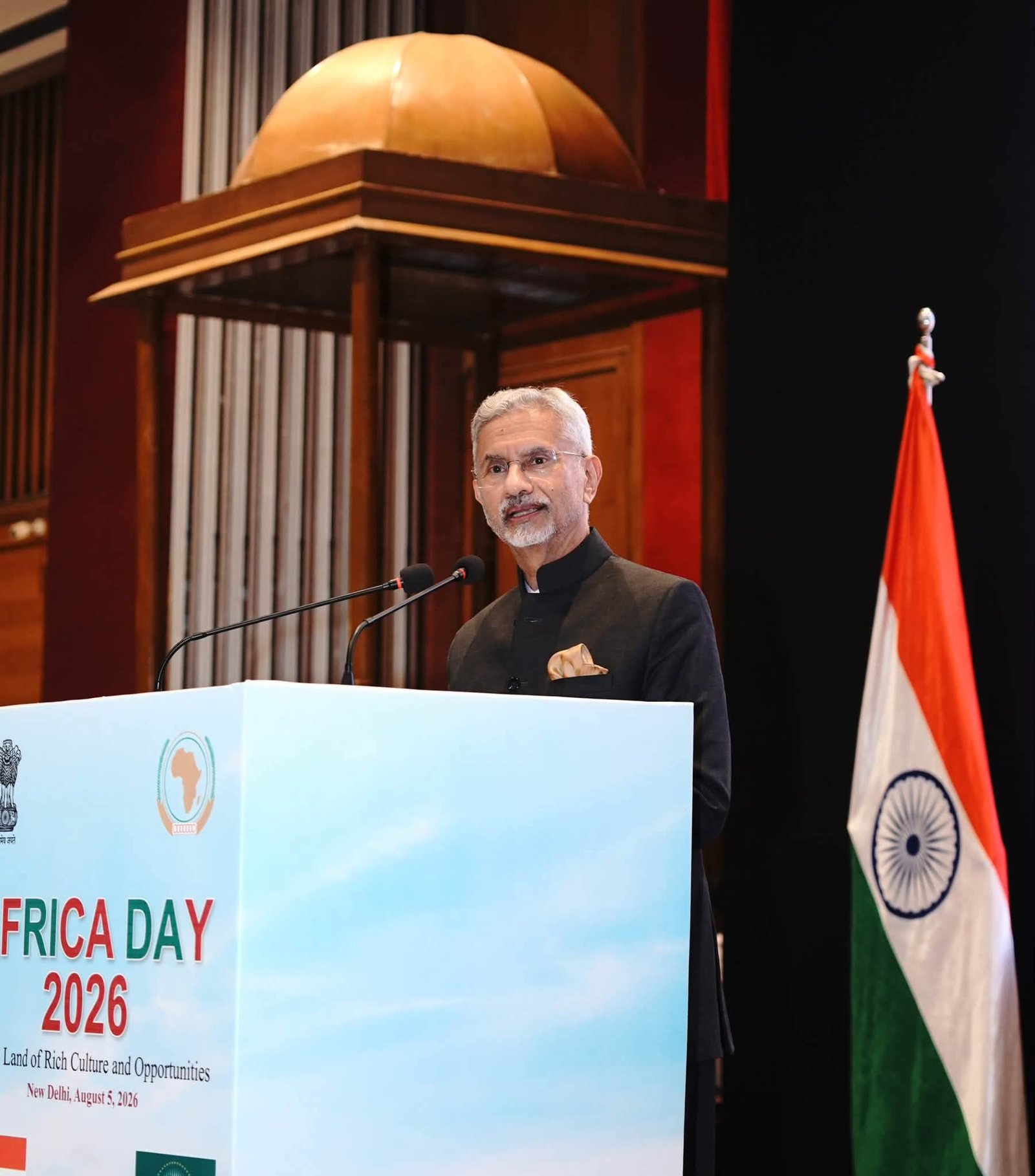
India’s External Affairs Minister, Dr. S. Jaishankar, reaffirmed India’s deep-rooted and future-oriented partnership with Africa while addressing the Africa Day celebrations at the Ashok Hotel, New Delhi, on 5 August.
Addressing diplomats, policymakers, parliamentarians and distinguished guests, the External Affairs Minister described India–Africa ties as a relationship founded on history, solidarity, shared aspirations and a common vision for the Global South.
Welcoming the diplomatic fraternity, Dr. Jaishankar extended a special greeting to nearly 50 African diplomats participating in a specially curated training programme at the Sushma Swaraj Institute of Foreign Service. He noted that their presence reflected the growing institutional engagement between India and African nations.
Reflecting on the significance of Africa Day, he observed that the occasion represents far more than a commemorative event. It embodies the ideals of Pan-Africanism, unity and the collective aspirations of the African continent while also reminding India of the historic bonds that have united both regions over centuries.
Tracing the evolution of India–Africa relations, the Minister highlighted that the Indian Ocean has historically connected, rather than divided, the peoples of India and Africa. For centuries, the seasonal monsoon winds facilitated trade, cultural exchanges and the movement of ideas, creating enduring civilisational links between the two regions. These exchanges, he noted, extended beyond commerce to include philosophy, knowledge, traditions and people-to-people contacts.
Dr. Jaishankar recalled that India and Africa also shared the painful experience of colonialism and stood shoulder to shoulder in the struggle for freedom and human dignity. He noted that the relationship between the two sides continues to draw strength from the ideals of their founding leaders. It was on African soil that Mahatma Gandhi refined the principles of Satyagraha and non-violence, ideas that later inspired freedom movements and iconic leaders across the world, including Nelson Mandela.
The External Affairs Minister observed that, following independence, India and African nations emerged as confident, sovereign and equal partners. Together, they helped shape the broader framework of South-South Cooperation and continue to champion the interests of developing countries in global affairs.
Highlighting the contemporary dimension of the partnership, Dr. Jaishankar said India’s engagement with Africa is guided by the ten principles for India–Africa cooperation articulated by Prime Minister Narendra Modi. These principles emphasise development partnership, capacity building, digital transformation, trade and investment, open markets, maritime security, and reforms of global governance institutions.
Speaking about India’s growing diplomatic engagement with the continent, he noted that he has personally visited African countries on more than twenty occasions and looked forward to many more visits in the months ahead. India has also significantly expanded its diplomatic footprint across Africa by opening new resident missions, further strengthening political and economic engagement.
The Minister underlined India’s consistent support for Africa’s enhanced role in global governance. He reiterated India’s firm backing for Africa’s rightful representation in a reformed United Nations Security Council and welcomed the African Union’s inclusion as a permanent member of the G20, describing it as a landmark achievement for the Global South.
Economic cooperation, he said, remains one of the strongest pillars of the partnership. Bilateral trade between India and Africa reached approximately US$93 billion last year, while Indian investments continue to expand across sectors such as energy, telecommunications, pharmaceuticals, infrastructure and engineering. India, he emphasised, remains committed to development partnerships that build local capacity and support sustainable national growth.
The Minister highlighted India’s extensive development cooperation across Africa through concessional Lines of Credit and grant assistance that have supported hundreds of infrastructure, connectivity and capacity-building projects across the continent. He stressed that India’s development model is demand-driven and based on the priorities identified by African partners themselves.
Human resource development, he noted, remains at the heart of India’s Africa policy. Over the past eleven years, India has offered more than 80,000 scholarships and training opportunities through programmes such as the Indian Technical and Economic Cooperation (ITEC) initiative and the Indian Council for Cultural Relations (ICCR). These initiatives, he said, continue to build lasting people-to-people connections while strengthening institutional capacities across Africa.
The Minister also highlighted India’s role as a reliable partner during times of crisis. Whether responding to natural disasters, humanitarian emergencies or public health challenges, India has consistently extended medicines, vaccines, medical supplies and disaster relief to African countries. Such cooperation, he observed, reflects India’s enduring philosophy of “Vasudhaiva Kutumbakam” — the world is one family.
On peace and security, Dr. Jaishankar emphasised that stability in Africa is essential for global peace and prosperity. India will continue working closely with African partners through defence cooperation, military training, maritime security, anti-piracy initiatives and capacity-building programmes aimed at addressing emerging security challenges.
Referring to the postponement of the Fourth India–Africa Forum Summit due to the Ebola outbreak, the Minister said India remains in close consultation with the African Union and looks forward to convening the Summit at the earliest mutually convenient opportunity. He reaffirmed India’s continued support for the Africa Centres for Disease Control and Prevention (Africa CDC), including assistance through medical equipment and healthcare cooperation.
Looking ahead, Dr. Jaishankar described Africa as a continent standing at the threshold of unprecedented transformation. With its youthful population, abundant natural resources and entrepreneurial energy, Africa is poised to play a defining role in shaping the global economy. India, likewise, continues its own journey of innovation-led growth, making the two partners natural collaborators in building a more inclusive and equitable international order.
Concluding his address, the External Affairs Minister delivered a powerful message that encapsulated India’s vision for the partnership: “Africa is our partner. Africa is our priority.”
He stressed that the emergence of a truly multipolar world is inseparable from Africa’s rise and reaffirmed India’s unwavering commitment to working alongside African nations in building a future founded on mutual respect, sustainable development and shared prosperity.


Leave a Reply