

Why the US–New Zealand investment in the Cook Islands matters for India and Australia
The decision by the United States and New Zealand to finance the redevelopment of Penrhyn Port in the Cook Islands is about much more than upgrading an ageing wharf. It is an example of how strategic competition in the Pacific is increasingly being conducted: through infrastructure, development assistance, economic access and the ability to remain a reliable long-term partner.
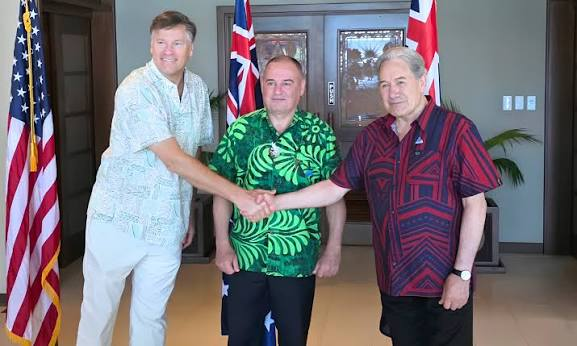
Announced during the Pacific Islands Forum Leaders Meeting in Palau, the project will upgrade the port at Omoka on Penrhyn, also known as Tongareva—the northernmost island of the Cook Islands. The United States intends to contribute US$50 million, subject to congressional processes, while New Zealand plans to provide NZ$17.5 million, or approximately US$10 million. The final design and implementation arrangements will follow a feasibility study and further technical work.
For Penrhyn’s community, the immediate purpose is straightforward. The port is a lifeline through which food, fuel, construction materials and other essential supplies reach an isolated population. Better facilities should improve maritime safety, transport reliability, disaster response and economic opportunity across the northern Cook Islands.
Yet infrastructure in the Pacific is rarely only local. Ports, airfields, telecommunications networks and undersea cables shape who can reach an island, who can sustain operations there and which external partners become embedded in its economy. Development infrastructure therefore carries strategic consequences even when it is neither designed nor declared as a military facility.
Strategic geography returns
Penrhyn’s significance is partly geographical and partly historical. During the Second World War, American personnel constructed the island’s original port and airfield to support operations across the Pacific. More than eight decades later, Washington is returning to renew part of that infrastructure.
The symbolism is difficult to miss. After years in which many Pacific governments believed the United States had become episodically engaged in their region, Washington is demonstrating that it can again fund substantial physical infrastructure. New Zealand’s involvement is equally important because of its constitutional, citizenship and defence relationship with the self-governing Cook Islands.
The port does not suddenly transform Penrhyn into an American military base. Nor should every infrastructure project be interpreted through the lens of an impending conflict. However, a safe and resilient port can support humanitarian assistance, disaster relief, fisheries enforcement, maritime surveillance and government operations. In a regional emergency, such facilities also increase the number of locations from which partners can deliver supplies and sustain a presence.
This matters because the Pacific is an enormous maritime space with very limited infrastructure. Strategic access depends less on possessing a few large bases than on having a dispersed network of dependable ports, airfields, communications systems and trusted relationships.
Providing an alternative to China
The announcement also follows heightened concern over China’s expanding relationship with the Cook Islands. In February 2025, Cook Islands Prime Minister Mark Brown signed a comprehensive strategic partnership with Beijing covering areas including trade, investment, infrastructure, ocean science and seabed minerals.
Although the agreement did not establish a Chinese security presence, its breadth and the initial lack of consultation generated concern in New Zealand. Wellington subsequently suspended part of its development assistance while seeking greater transparency.
Against this background, the Penrhyn project is clearly part of the wider competition for influence. The United States and the Cook Islands have also established a framework for cooperation on seabed mineral resources. The Cook Islands’ vast exclusive economic zone contains polymetallic nodules associated with strategically important minerals, including cobalt, nickel and manganese.
The central lesson is that China cannot be countered through warnings alone. Pacific states have genuine infrastructure, connectivity, climate-resilience and development requirements. If traditional partners cannot meet those needs, other countries will.
The United States and New Zealand are therefore pursuing the correct approach: providing a credible and practical alternative that responds to a project identified by Cook Islanders themselves. The most effective form of strategic competition is not asking Pacific governments to reject China. It is ensuring that they have multiple high-quality choices and do not become excessively dependent on any single external partner.
Delivery, however, will be the real test. The project remains subject to feasibility work, detailed design and—in the American case—congressional funding processes. Pacific governments have heard many announcements that took years to produce visible results. Strategic credibility will depend on completing the port on time, involving Cook Islands workers and businesses, maintaining the facility and ensuring that the benefits reach the local community.
Why India should pay attention
For India, the Penrhyn announcement illustrates why the Pacific Islands should occupy a more prominent place in its Indo-Pacific policy.
India’s strategic attention has traditionally concentrated on the Indian Ocean, South Asia and the western Pacific. Yet the Indo-Pacific is a connected maritime system. Developments in the South and Central Pacific affect sea-lane resilience, access to critical minerals, diplomatic alignments and the regional balance of influence.
India already has an institutional foundation through the Forum for India–Pacific Islands Cooperation. Its relationship with the Cook Islands is also developing: in August 2026, India’s High Commissioner formally presented her credentials in Rarotonga alongside the first resident-accredited United States ambassador following the establishment of US–Cook Islands diplomatic relations in 2023.
New Delhi does not need to imitate China’s infrastructure model or attempt to match American financing dollar for dollar. India’s comparative advantage lies elsewhere: digital public infrastructure, affordable healthcare and pharmaceuticals, renewable energy, technical education, climate adaptation, maritime training and capacity building.
India could use the Penrhyn project as an opportunity to offer complementary assistance. This might include digital systems for port management, hydrographic expertise, maritime safety training, solar power and storage, telemedicine, scholarships, or support for fisheries monitoring. Indian companies could also explore whether they can contribute engineering services, equipment or maintenance support under transparent procurement arrangements.
Such involvement would give substance to India’s claim to be a leading Indo-Pacific power. It would also show Pacific governments that India approaches them as sovereign partners with development priorities, rather than merely as pieces on a geopolitical chessboard.
Australia’s role
Australia should welcome the project, but it should not regard American and New Zealand engagement as a substitute for its own responsibilities.
Canberra’s interests include preventing strategic coercion, strengthening maritime domain awareness, protecting fisheries and ensuring that Pacific infrastructure remains financially and operationally sustainable. Australia already has a bilateral partnership with the Cook Islands and should examine how its programmes can complement the port redevelopment.
Useful contributions could include hydrographic surveying, customs and biosecurity systems, disaster-response planning, maritime surveillance and coordination with the Pacific Maritime Security Program. Australia could also help connect the port with wider regional shipping, communications and emergency-response networks.
More broadly, Canberra should encourage coordination among Australia, New Zealand, the United States, India, Japan and other partners. Poorly coordinated projects can overwhelm small Pacific administrations and produce duplication rather than resilience. Cooperation should therefore be organised around priorities established by Pacific governments, not around external competition for diplomatic credit.
Infrastructure as strategic statecraft
The Penrhyn decision demonstrates that ports have become instruments of strategic statecraft. They connect communities and support economic life, but they can also strengthen national resilience, maritime awareness and the capacity of trusted partners to respond during a crisis.
The project should not be exaggerated into evidence of a new military base or an inevitable confrontation with China. Its importance is subtler. Washington and Wellington are showing that they intend to compete for influence by delivering something tangible that the Cook Islands has wanted for years.
For India, the message is that the Pacific cannot remain a peripheral element of its Indo-Pacific strategy. For Australia, it reinforces the need for persistent engagement and coordinated delivery. For the Cook Islands, the best outcome is neither exclusive alignment with China nor dependence on traditional partners. It is the freedom to choose among credible partnerships while retaining control over national infrastructure and resources.
If completed effectively, the Penrhyn port upgrade will provide more than a safer harbour. It will show that strategic competition can generate practical benefits when major powers listen to Pacific priorities—and when partnership is measured by what is delivered, not merely what is promised.


Leave a Reply