

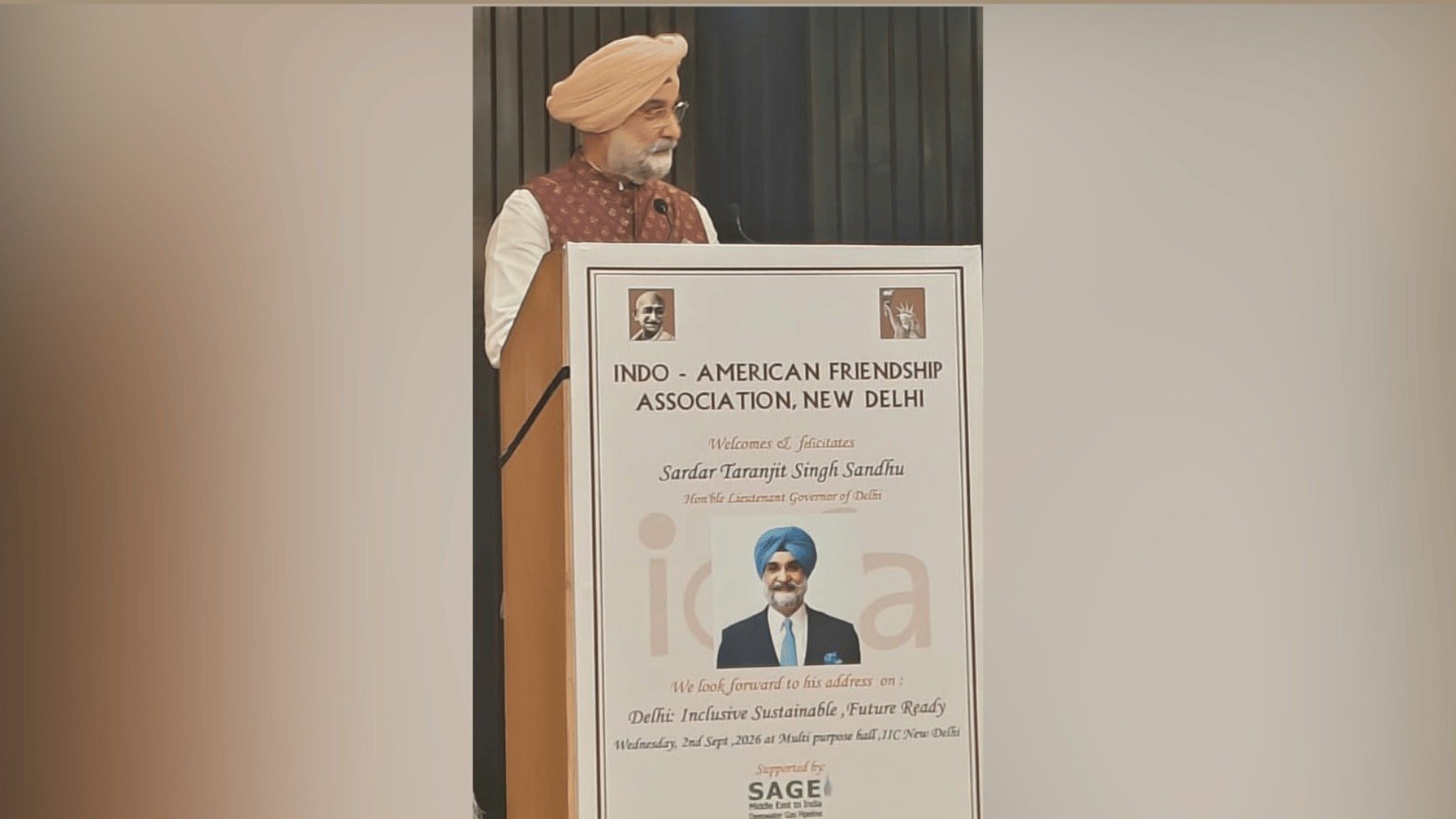
At a reception hosted by Ambassador Surendra Kumar (Retd.), Founder-President of the Indo-American Friendship Association, at the India International Centre on September 2, Lieutenant Governor of Delhi Sardar Taranjit Singh Sandhu outlined his vision for a national capital that combines growth with inclusion, sustainability, innovation and a better quality of life for its citizens.
Delhi has never been a static city. It has evolved through centuries of history, absorbing new communities, ideas, institutions and aspirations while retaining its distinctive cultural and civilisational character.
For Lieutenant Governor Sardar Taranjit Singh Sandhu, the challenge before the national capital today is to ensure that this evolution continues in a manner that is inclusive, sustainable and future-ready.
Addressing a gathering of diplomats, distinguished guests and former Indian ambassadors, Lieutenant Governor Sandhu said Delhi’s responsibility extends beyond managing the city of today.
“Our responsibility is not only to manage the city as it exists today, but to prepare it for the needs and aspirations of the generations that will inherit it,” he said.
Inclusion at the heart of development
He identified inclusion as the first essential pillar of a future-ready Delhi.
For him, urban development must ultimately be measured by its impact on people’s lives. Access to quality education, healthcare, housing, public transport, employment and entrepreneurship opportunities must extend across society.
He stressed that women, children, senior citizens, persons with disabilities and economically vulnerable communities must be able to participate fully in urban life.
“A modern city must be measured not simply by the infrastructure it creates, but by the opportunities it creates for its people,” Lieutenant Governor observed.
This approach places people at the centre of Delhi’s development — an important consideration as the capital expands and its infrastructure, housing and mobility requirements grow.
Sustainability as a development imperative
The second pillar of the Lieutenant Governor‘s vision is sustainability.
Delhi’s future growth, he argued, cannot come at the expense of its ecological well-being. Air quality, water security, water management, green spaces and sustainable mobility are interconnected with the everyday quality of life of the city’s residents.
His emphasis is consistent with his broader public position that Delhi must move beyond conventional, concrete-led urban expansion and build a model of development that protects its ecological assets while improving liveability. Recent discussions around Delhi’s long-term development have similarly emphasised the importance of the Yamuna, the Ridge, biodiversity areas, green spaces and sustainable urban growth.
“This vision of sustainable growth also finds resonance in the concept of Sapt-Dhara, articulated by our Hon’ble Prime Minister Shri Narendra Modi, with its emphasis on areas including the green economy, blue economy, technology and innovation,” the Lieutenant Governor said.
For Delhi, he pointed to cleaner mobility, renewable energy, efficient water management, water conservation and greener public spaces as important components of this transition.
“A sustainable Delhi is not only an environmental objective; it is an investment in the health and well-being of future generations,” he said.
Technology with responsibility
Technology and innovation form the third pillar of the Lieutenant Governor’s vision.
Artificial intelligence, digital infrastructure and data-driven governance, he noted, have the potential to transform the way cities operate — from improving mobility and civic infrastructure to making public spaces more accessible and governance more responsive.
But technology, he cautioned, cannot become an objective in itself.
“Technology must remain a means to serve citizens, not an end in itself,” Sandhu said, adding that a future-ready city must balance innovation with accountability, privacy, accessibility and public trust.
Delhi as an economic and knowledge hub
Lieutenant Governor also highlighted the economic dimension of Delhi’s future.
The capital, he said, must remain a centre of enterprise, investment, knowledge and employment, supported by an ecosystem where businesses can grow, entrepreneurs can innovate and young people can find meaningful opportunities.
The recently unveiled Delhi Master Plan 2047 provides an important framework in this direction. The plan envisages long-term urban development with an emphasis on housing, transit-oriented development, education and medical hubs, connectivity and sustainability. The Union Ministry of Housing and Urban Affairs has described it as a roadmap for a developed Delhi and a developed India.
He has also emphasised the importance of linking education and skills with employment and entrepreneurship, particularly in the context of India’s demographic advantage.
Ease of doing business, skilled human capital, modern infrastructure and strong connectivity, he said, will all be important to Delhi’s economic future.
People at the centre
Yet, amid discussions of infrastructure, technology and economic growth, Sandhu returned to what he considers Delhi’s most important asset — its people.
“The city’s greatest asset is not its roads or its technology. It is its people,” he said.
Delhi’s history, he noted, has been shaped by people who came to the city with aspirations and contributed to its growth. Building its next chapter, therefore, cannot be the responsibility of government alone.
“It requires partnership between government, citizens, business, academic institutions, civil society and communities,” he said.
Such a partnership will be essential if Delhi is to achieve the balance between growth and liveability that its future demands.
A Delhi for the next generation
Lieutenant Governor’s vision ultimately brings together four closely connected objectives: economic vitality, environmental responsibility, technological advancement and social inclusion.
His larger message is that Delhi’s transformation should not mean abandoning its past in pursuit of the future. Rather, the national capital must preserve its heritage while embracing new forms of development, innovation and opportunity.
“A Delhi that preserves its heritage while embracing the future” is, he suggested, the Delhi that can truly prepare itself for the decades ahead.
The objective, ultimately, is straightforward: a capital that offers its citizens not merely better infrastructure, but a better quality of life and greater opportunities.
As Delhi moves towards 2047, that balance between heritage and modernity, growth and sustainability, innovation and accountability, will define whether the capital can emerge as a genuinely global, inclusive and future-ready city.


Leave a Reply