

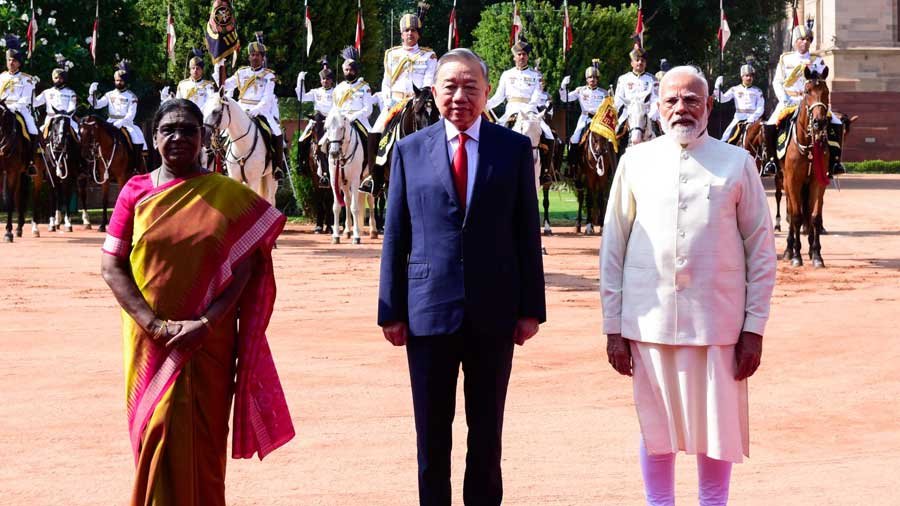
History is often shaped by moments that are both symbolic and strategic. The State Visit of General Secretary of the Communist Party of Viet Nam and President To Lam to India from 5–7 May 2026 was one such occasion. More than a ceremonial exchange between two trusted partners, it marked the beginning of a new chapter in one of Asia’s most significant bilateral relationships.
The visit was historic on several counts. It was the first State Visit to India by a Vietnamese leader serving concurrently as General Secretary of the Communist Party and President of Viet Nam, reflecting the importance Hanoi places on its relationship with New Delhi. More importantly, it culminated in the elevation of bilateral ties to an Enhanced Comprehensive Strategic Partnership, signalling a shared commitment to deepen cooperation across diplomacy, defence, trade, technology, innovation, education, and people-to-people exchanges.
A Welcome Befitting a Strategic Partner
India accorded General Secretary and President Tô Lâm the highest ceremonial honours. At Rashtrapati Bhavan, he was received by President Droupadi Murmu and Prime Minister Narendra Modi with a 21-gun salute, Guard of Honour, and the President’s Bodyguard cavalry escort, a reflection of the importance India attaches to Viet Nam within its Act East Policy and Indo-Pacific vision.
One of the most poignant moments of the visit followed at Raj Ghat, where the Vietnamese leader paid floral tributes to Mahatma Gandhi. The gesture symbolised the deep historical goodwill between the two countries. India’s support for Viet Nam’s struggle for independence and the enduring influence of Gandhi’s philosophy of peace and justice continue to resonate strongly in bilateral relations.
Defining a New Strategic Partnership
The substantive discussions at Hyderabad House reflected how far India–Viet Nam relations have evolved—from political solidarity during the Cold War to a mature partnership driven by shared strategic interests.
Prime Minister Narendra Modi and General Secretary-President Tô Lâm reviewed cooperation across defence, maritime security, trade, connectivity, energy, healthcare, science and technology, agriculture, digital transformation, and capacity building. Both leaders also reaffirmed their commitment to a rules-based international order, freedom of navigation, peaceful resolution of disputes, and respect for international law.
The most significant outcome was the adoption of the Joint Statement on the Enhanced Comprehensive Strategic Partnership, providing a comprehensive roadmap for future cooperation. Guided by the principles of “shared vision, strategic convergence, and substantive cooperation,” the new framework expands the relationship beyond traditional diplomacy to encompass emerging technologies, resilient supply chains, innovation, sustainability, education, and long-term economic resilience.
Shared Vision for the Indo-Pacific
One of the intellectual highlights of the visit was General Secretary and President Tô Lâm’s address at the Indian Council of World Affairs (ICWA).
Speaking before diplomats, scholars, and policymakers, he outlined Viet Nam’s vision for a peaceful, stable, and prosperous Indo-Pacific built upon dialogue, multilateralism, mutual respect, and adherence to international law.
His address reflected the growing convergence between Indian and Vietnamese strategic thinking. Both countries reiterated their support for strategic autonomy, ASEAN centrality, and an inclusive regional order where cooperation, not confrontation, remains the guiding principle.
Innovation as the New Frontier
If diplomacy laid the foundation, innovation emerged as one of the defining themes of the visit.
The Viet Nam–India Innovation Forum brought together entrepreneurs, technology companies, researchers, investors, start-ups, and policymakers to explore collaboration in artificial intelligence, semiconductors, digital public infrastructure, biotechnology, renewable energy, fintech, smart manufacturing, and digital governance.
The discussions reflected a shared recognition that the next phase of India–Viet Nam relations will increasingly be driven by innovators, universities, research institutions, and young entrepreneurs.
India’s leadership in digital public infrastructure and information technology complements Viet Nam’s growing strength as one of Southeast Asia’s most dynamic manufacturing economies. Together, the two countries are well positioned to build resilient supply chains and strengthen regional innovation ecosystems.
Expanding Economic Horizons
The economic dimension of the visit gained further momentum in Mumbai, where General Secretary and President Tô Lâm interacted with leading business leaders and investors during the Viet Nam–India Business Forum.
Representatives from manufacturing, pharmaceuticals, agriculture, logistics, renewable energy, information technology, textiles, infrastructure, and financial services explored new investment opportunities and partnerships.
As multinational companies diversify global production networks, India and Viet Nam are increasingly viewed as complementary economies rather than competitors. Stable policy environments, expanding domestic markets, and improving connectivity create significant opportunities for joint ventures, technology transfer, and integration into regional and global value chains.
Both governments reaffirmed their commitment to expanding bilateral trade and encouraging greater two-way investment while deepening cooperation in critical minerals, digital payments, healthcare, maritime cooperation, science and technology, agriculture, education, and skill development.
Investing in People
Education and human resource development also featured prominently during the visit.
Both countries recognised that stronger academic exchanges, institutional partnerships, scholarships, and collaborative research will be essential for preparing a skilled workforce capable of supporting future cooperation in high-technology sectors.
Equally important was the emphasis on strengthening tourism, cultural exchanges, and people-to-people contacts. These societal linkages continue to provide the human foundation upon which the broader strategic partnership rests.
A Partnership for the Future
The significance of the visit extends well beyond the agreements signed or forums convened.
Over the past five decades, India and Viet Nam have steadily transformed their relationship, from political solidarity to defence cooperation, from economic engagement to technological collaboration. The decision to elevate ties to an Enhanced Comprehensive Strategic Partnership acknowledges that both countries now view each other as trusted long-term partners in an increasingly complex geopolitical environment.
For India, Viet Nam remains one of its closest partners in Southeast Asia and an indispensable pillar of its Act East Policy. For Viet Nam, India represents a reliable partner whose engagement is characterised by mutual respect, capacity building, and strategic consistency.


Leave a Reply