

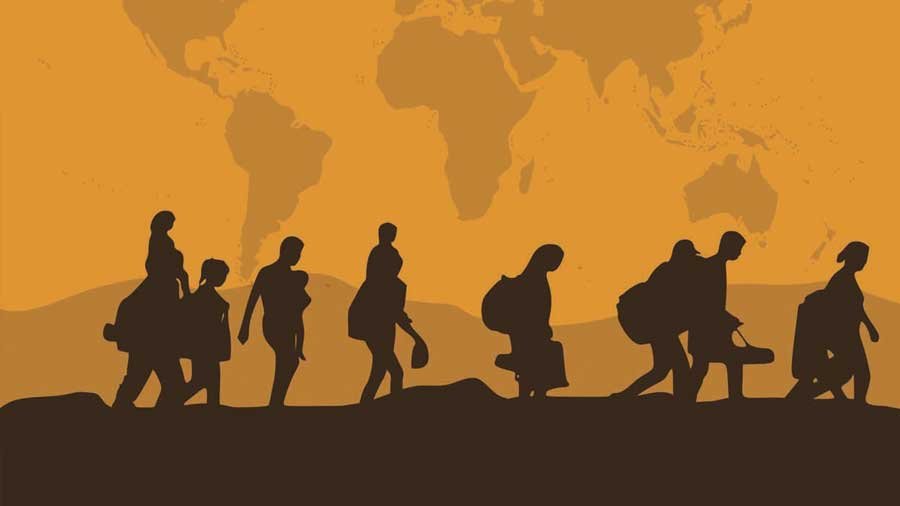
July 2026 marked 75 years since the adoption of the Refugee Convention. The convention, in the 1950s, was an outcome of the Second World War, with displacement and destitution gripping Europe. On the other side, it was the politics of the Cold War that defined who could be a refugee. Today’s world is not the 1950s, and other issues of displacement are taking centre stage. One of them is the issue of climate-induced displacement; however, there is no accepted definition of who constitutes a climate refugee. But it has become imperative in the times we live in to reflect on the issue of climate displacement, an ever-present threat.
The Refugee Convention of 1951 and the following protocol of 1967 remain in today’s day and age as documents that do not address the massive climate displacement around the world. Climate change has displaced 250 million people globally in recent decades; this amounts to 70,000 people per day. Yet there exists no concrete definition of a climate refugee, even with such huge numbers, which could reach a whopping 1.2 billion people displaced by the year 2050. Climate displacement now represents the major problem facing humanity. The intellectual seed for pondering this crisis has also not come from the Global North but from the Global South, where these are more of a lived reality for the populace.
The most important documents for discussing climate displacement as a category come from two key instruments in Africa and Latin America: the Cartagena Declaration of 1984 and the Kampala Convention of 2009. The Cartagena Declaration is a non-binding declaration on refugees. From a narrow scope of individual persecution, it goes into a wide area of situations that can contribute to fleeing, such as generalised violence, foreign aggression, internal conflicts, massive violation of human rights, and “other circumstances which have seriously disturbed public order”. The latter acts as a catch-all, which could be interpreted as climate and natural disasters. Though not a binding document, it serves as a cornerstone of regional cooperation and has broadened the definition of who qualifies as a refugee. The Kampala Convention of 2009 was a game-changer.
The convention is a legally binding document under the African Union framework; it focuses on internally displaced people, and the most forward-looking element is its emphasis on protection beyond traditional state conflict, including in the context of natural disasters, climate change, and large-scale development projects.
The Kampala Convention is thus a one-of-a-kind instrument which legally recognises climate change and natural disasters as significant causes of displacement, and the Cartagena Declaration expands the interpretation of refugeehood into a visionary frame that can accommodate climate victims. Yet despite these regional victories, a humongous gap remains.
The Kampala Convention is limited to a state’s borders and territory and does not address those who have crossed international borders; the issue with Cartagena remains its non-binding, soft-law character and regional limitation to Latin America. Neither of these documents addresses a glaring issue of climate change displacement today: the millions who will be forced to leave their uninhabitable homelands for distant frontiers. Let us be real: the 1951 Convention is frozen in time and set to the tune of geopolitical realities of the Cold War. This offers climate victims no legal status, no protection, and no future.
As we mark the 75 years since its adoption, the international community ought to reflect. It must move away from such a document, frozen in time, toward new imaginaries of a global protocol, which would surely not come from the gallows of Geneva or Brussels but would be led by the Global South, as it has shown through the Kampala Convention and the Cartagena Declaration. This new vision defines, recognises, and protects climate victims. There is no time to ponder whether we should act, but to act before the 1.2 billion projected to be displaced by 2050 becomes our dystopian reality rather than a mere statistic on paper.



Leave a Reply