

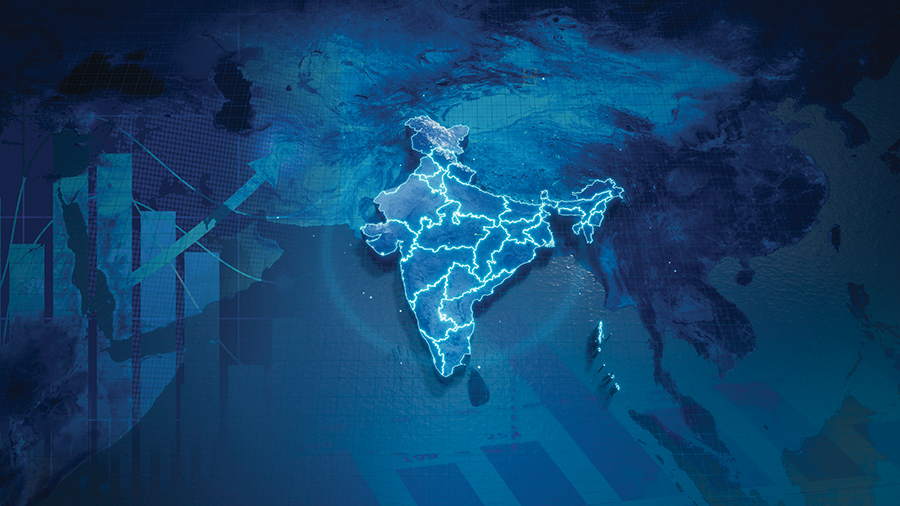
The world economy is going through a long process of recalibration. Now, the Global South, which includes Asia, Africa, and Latin America, is indulging in the indulgence of growth, new concepts, and being elastic. Due to its magnitude, digital set-up, and geopolitical standing, India is at the epicentre of this transformation. It is both a prototype and a heart for industries that want to do business in the Global South.
India’s Strategic Place
India has three big advantages, namely – large population, a lot of digital skills, and links to the rest of the world. India has the largest number of people of working age in the world, with more than 1.4 billion. By 2030, it is expected to have the largest middle class, which will mean that there will be a lot of demand for cheap housing, healthcare, education, and energy. India has made more progress in digital technology than a lot of other rich countries. People can now get to government and financial services in a different way thanks to the India Stack. It has public digital infrastructure tools like Aadhaar (for digital ID), UPI (for payments in real time), and Digi Locker (for safe document storage). UPI handles about 10 billion transactions every month, making India the world leader in digital payments. The method has been applied to comparable projects in Brazil, Singapore, and the UAE. In terms of geopolitics, India is becoming more of a link between the wealthy countries and the Global South. It has a bearing on policies around the world when it yields a place in groups such as the G20, BRICS, and the International Solar Alliance.
India’s lessons for the Global South
India’s approaches can be applied as instances for other marketplaces that are expanding.
Opportunities for Business
India is not only a large market for industries, but it’s also a respectable location for them to go out for reduced, scalable solutions that will drive in other sections of the Global South.
Leading in the South of the World
Corporations that desire to do well in the Global South must go beyond easy commerce and value methods that are open to everyone and foster collaboration. A few of the elementary actions are listed below:
Getting through problems
To be prosperous, one must deal with tough rules, awful infrastructure, and the needs of separate clients. India’s capability shows that these problems can be resolved by establishing new rules and permitting the private sector to make adjustments. The digital public commodities model appeared due to issues with outdated banking and government systems. Subsequently, it has become an international practice.
Final Thoughts
The market of the Global South is not a prospect; it is a present truth. India’s mass, innovation, and management made it the heart of this change. Businesses can gaze at India as an affiliate and a role model. They will not only be able to use this benefit of one of the world’s major development statements, but they will also have a significant impact on producing a better and more balanced outcome.



Leave a Reply