

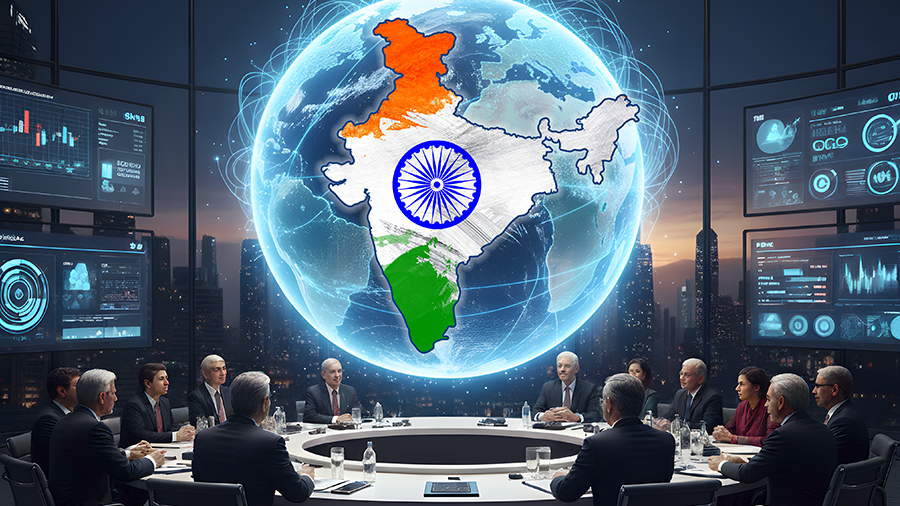
Historically, India has been a great civilization; however, its present dynamics—viz. economy, education, polity, society, etc.—in shaping the world order are an important point of discussion. The world may appear to be unipolar; however, the bone of contention lies in the power-sharing mechanism in the global strategy among the three major countries, viz. the US, China, and Russia. Does this mean India’s visible share appears net zero? Even though India’s achievements are significant, New Delhi still faces internal and external challenges in proving itself as a strong political and diplomatic power across the globe. There is no single factor; rather, a series of factors follow.
Economy of India
The discussion begins with developments taking place within the country and India’s position in the global context. In economic terms, India appears to be positioning itself at third place (nominal GDP) in the near future, with a growth rate of nearly 6.5% for FY 2024–2025. This is phenomenal when viewed structurally, as India has moved from the eleventh position in 2009 to the fourth position by the end of 2025.
However, despite this progress, India still faces major challenges such as high levels of informality in the labour market, low female participation in the workforce, lack of access to quality health and education for underrepresented groups, and low preparedness for vulnerable populations in the face of climate change and related hazards. Achieving the vision of becoming a high-income economy by 2047 requires sustained growth of 7.8% over the next two decades. This is not easy, especially when the global order is facing instability not only economically but also politically—through wars, war-like conditions, and democratic reversals—and socially, mainly due to climate-change effects.
Economic Comparison
Let us make some comparisons. India’s current GDP stands at approximately USD 3.9–4.2 trillion for FY 2024–2025, whereas China’s GDP is around USD 18.74 trillion, and the US leads with USD 28.75 trillion. These are not just numbers; they reflect a journey. India and China started from similar positions, yet China has taken the lead by nearly five times.
GDP per capita, however, presents an even clearer picture. At USD 2,700, India lags far behind the US at USD 85,000 and China at USD 13,300. China’s economy grew tenfold over 40 years, while India’s grew fivefold in the same period. What enabled China to demonstrate that its race mattered? The answer lies in rigorous development of its manufacturing sector, trade liberalization, and strong attraction of foreign direct investment (FDI).
Education
Another crucial factor shaping the global order is higher education and the presence of world-class universities. India’s Gross Enrolment Ratio in higher education stands at nearly 27%, which is very low compared to higher-income economies. Indian higher-education institutions face daunting challenges in competing globally. On one side is the shortage of funding for research and development, and on the other is the challenge of producing world-class researchers.
A large number of Indian students pursue education abroad; however, the reverse trend is limited. Very few foreign students come to Indian universities for research, directly reflecting gaps in quality and global competitiveness. India has about 300 researchers per million population, while the US has more than 4,000. Germany and South Korea have approximately 5,000 and 7,000 researchers per million population, respectively. Rather than imitating university models of developed countries, India needs its own education model—one that enables global collaboration across STEM disciplines as well as the humanities. This requires better financial incentives, improved research environments, and policies that balance traditional and modern knowledge systems.
Multilateral Institutions
India’s participation in multilateral institutions has demonstrated its growing global role, particularly during the G20 Leaders’ Summit held in November 2025. Although the absence of the US was strongly felt, India maintained a firm position, with discussions ranging from digital inclusion to climate-change impacts. India’s strong participation in BRICS 2025 and its assumption of the presidency in 2026 require a focus on contemporary issues such as artificial intelligence and the evolving role of the United Nations. India’s position in the UN Security Council also needs re-evaluation, either through reform or by securing a stronger role within regional groupings that benefit its global standing.
It is noteworthy that a country can shape the global order only when its society has a powerful voice. India is the world’s largest democracy, with over a billion people participating in its political system. Yet, challenges persist—such as a low Happiness Index ranking, lack of transparency, and climate-related vulnerabilities. The World Happiness Index 2025 places India at 118th position out of 147 countries, offering insight into societal well-being. While these factors may not directly determine economic development, a corruption-free and content society is inherently more productive.
Today’s global order is shaped by technological developments such as digitalization, artificial intelligence, supercomputers, and satellite technologies. These advances depend on how human societies adapt to and guide them. Every technological breakthrough is rooted in societies with transparent systems, strong institutions, and a progressive mindset.
India’s Neighbours
Finally, India’s position within its neighbourhood must be considered. One can choose friends but not neighbours. Maintaining cordial relations while strengthening national interests is central to India’s “Neighbourhood First Policy.” India shares deep cultural, ethnic, and civilizational ties with neighbouring countries. Political instability in the region has direct repercussions for New Delhi.
Since 2014, India has doubled its cooperation with neighbours through over 100 projects involving road, rail, airport, and maritime connectivity with Nepal, Bangladesh, Sri Lanka, and Myanmar. However, several missed opportunities remain, including issues such as the 2015 Nepal blockade, water-sharing disputes, and fishing concerns with Sri Lanka. Addressing these diplomatically and cooperatively will help India stay ahead of other regional powers.
Conclusion
There are always lessons to be learned. India holds a unique advantage in its demographic dividend, but only if it is channelled effectively toward growth and societal development. A country’s global standing may appear political or economic, but it ultimately reflects its internal strength. Strong political will, proactive diplomacy, deeper international partnerships, a stronger voice in global institutions, and advancements in education and technology will be the key drivers shaping India’s role in the world order.



Leave a Reply