

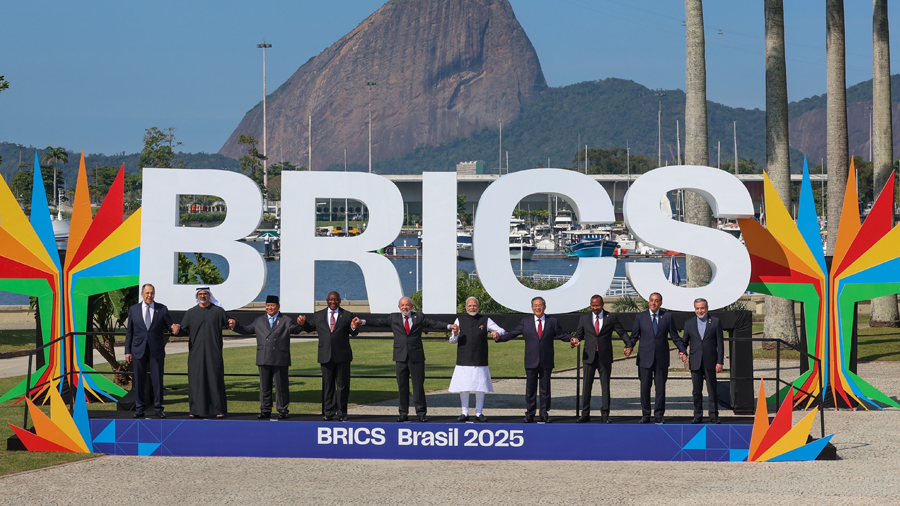
Prime Minister Narendra Modi’s visits to Latin America in 2025, particularly to Brazil for the BRICS Summit in Rio de Janeiro and to Argentina for bilateral talks, have re-energised India’s engagement with a region that has long remained peripheral to New Delhi’s strategic imagination. While such high-level visits do signal strategic intent to widen and deepen partnerships in the region, a formidable task for India’s foreign policy lies in transforming episodic diplomacy into a sustained, institutionalised, and strategically coherent engagement with the Latin American region.
Delhi’s Renewed Outreach
India’s renewed outreach to the region transpires in the broad context of a rapidly changing global order. The region is witness to and influenced by uncertainties in U.S. foreign policy, China’s expanding economic footprints, and the growing salience of the Global South as a political and normative framework. Even as the Trump administration, through its National Security Strategy document, re-invoked a Monroe Doctrine for the 21st century, major power competition-cooperation dynamics are much more complex. China’s expanding influence, particularly in infrastructure, ports, and trade, has quantitatively and qualitatively altered regional power dynamics, while U.S. policy has been marked by uncertainty and episodic engagement. This evolving landscape creates both opportunities and constraints for India, a geographically distant but increasingly consequential actor.
Brazil occupies a central position in India’s Latin America strategy. As founding members of BRICS, both countries share a commitment to multipolarity, reform of global institutions, and greater representation for emerging economies. Prime Minister Modi’s visit to Brazil during the 17th BRICS Summit highlighted the depth of this partnership, with both sides identifying five priority pillars for future cooperation: defence and security; food and nutritional security; energy transition and climate change; digital transformation and emerging technologies; and industrial partnerships in strategic sectors.
The setting up of a USD 20 billion bilateral trade target by 2030 and the creation of monitoring mechanisms reflect a pragmatic attempt to deepen economic ties while reducing overdependence on other major powers. Indian investments in Brazil are estimated at around USD 6 billion, while Brazilian investments in India are closer to USD 1 billion. The trade monitoring mechanism and the India–MERCOSUR Preferential Trade Agreement provide institutional platforms to address trade barriers and expand economic ties. Defence cooperation has also emerged as a critical pillar of the relationship, establishing a Joint Defence Committee and a Strategic Dialogue Mechanism to enhance military cooperation and exchange views on regional and global security issues.
India and Argentina marked 75 years of diplomatic relations in February 2024, reflecting the steady expansion of their partnership across a wide spectrum of issue areas. Regular high-level engagements underscore this momentum, including Argentina’s Foreign Minister co-chairing the 7th Joint Commission Meeting in India in 2024 and the Argentine Defence Minister’s visit in 2023 to advance defence industrial cooperation.
During the 17th BRICS Summit, Prime Minister Narendra Modi’s sideline visit to Buenos Aires further reinforced bilateral cooperation and support for strengthening the India–MERCOSUR Preferential Trade Agreement (PTA). Bilateral trade reached USD 5.2 billion in 2024, with trade reportedly growing by nearly 54 percent in early 2025, making India Argentina’s fourth-largest trading partner, with intensifying Industry-to-industry collaboration. Argentina’s Promotional Regime for Large Investment (RIGI), enacted in 2024, offers legal certainty and tax incentives for long-term foreign investments, presenting new opportunities for Indian companies amid global supply-chain disruptions and geopolitical uncertainties. Cooperation on critical minerals, especially lithium, has emerged as a strategic priority.
In January 2025, India’s Mines Secretary visited Buenos Aires to advance discussions under a 2022 preliminary agreement on mineral exploration and technology cooperation. Since elevating relations to a Strategic Partnership in 2019, defence cooperation has also gained prominence, with Argentina expressing interest in Indian defence systems such as BrahMos and Akash, alongside discussions on joint production and training initiatives.
India and Chile share a growing and diversified partnership rooted in over 70 years of diplomatic relations. This relationship has gained renewed momentum through high-level political engagement, notably the visit of India’s then-President Ram Nath Kovind to Chile in 2019 and Chilean President Gabriel Boric’s visit to India in April 2025.
These interactions have expanded cooperation across trade, defence, energy, climate change, digital public infrastructure, agriculture, space, and critical minerals, positioning Chile as a key partner for India in Latin America. Bilateral trade between India and Chile reached approximately USD 2.45 billion in 2023–24, with India exporting goods worth USD 1.1 billion and importing about USD 1.35 billion. Economic engagement began with the Framework Agreement signed in 2005, which evolved into a Preferential Trade Agreement (PTA), expanded in 2016 and became effective from 2017.
Building on this foundation, India and Chile signed the Terms of Reference for a Comprehensive Economic Partnership Agreement (CEPA) on May 8, 2025, with negotiations commencing for taking the next steps towards early finalisation. The CEPA aims to deepen trade integration, strengthen global value chains, and expand cooperation into areas such as digital services, MSMEs, investment facilitation, and critical minerals. Indian investments in Chile are estimated at USD 620 million, while Chilean investments in India amount to around USD 118 million. Defence cooperation has also emerged as a significant growth area. A major strategic area is critical minerals, particularly lithium and copper, essential for electric mobility and renewable energy.
At the India–Chile Mining Industry Roundtable in April 2025, both sides emphasised cooperation in mineral exploration, sustainable mining, and value-added processing. Chile’s location within the “Lithium Triangle” makes it a vital partner for India’s green energy transition, with collaboration envisaged through joint ventures, long-term supply agreements, and cross-border investments.
Partners for the Global South
Despite India’s significant strides in the region, India’s presence remains uneven, constrained by limited diplomatic infrastructure, low trade volumes relative to China, and insufficient societal and knowledge-based linkages.
The Global South narrative provides India with a valuable normative and strategic framework to deepen ties with Latin America. Shared post-colonial experiences, development priorities, and demands for reform of global governance institutions create natural convergences. India’s leadership through platforms such as the G20 and the Voice of Global South Summits has resonated across the region, particularly because it avoids a confrontational or anti-Western posture and instead emphasises inclusive development and strategic autonomy.
Nevertheless, symbolism must translate into substance. For India to emerge as a credible and long-term partner in Latin America, it must invest in institutional mechanisms, enhance diplomatic capacity, expand economic engagement beyond commodities, and foster deeper people-to-people and knowledge exchanges.
In a changing global order where Latin America’s strategic relevance is rising, India’s success will depend not on high-profile visits alone, but on its ability to embed itself as a consistent, reliable, and value-adding partner across the region.Monish Tourangbam


Leave a Reply