

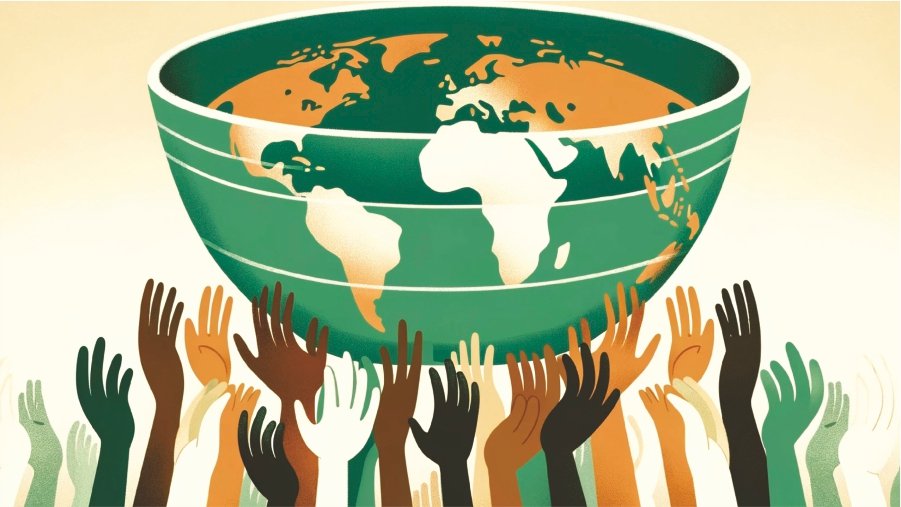
The term Vibrant refers to the demography of India and Africa, representing 900 million young and dynamic people who synergise and scale the South-South Partnership. The population of the USA, Europe, and East Asian countries is declining, and the vibrant youth will shape the future trajectories of human resource development globally. Vision 2047 reflects the idea of a prosperous and great India and emphasises the importance of skilled youth through education. Similarly, Africa places its interest in the proper training of youth and appreciates the Skill India approach.
To counter the emerging USA tariff dictation for the South, there is a strong and genuine concern in resetting their trade and commerce viability and adopting an approach towards local currency for glocalisation. De-dollarisation and the stability of the Indian Rupee (INR) are widely recognised in international trade and commerce today. African countries such as Botswana, Kenya, Mauritius, Seychelles, Tanzania, and Uganda, along with Germany, Israel, Russia, the United Kingdom, New Zealand, Oman, Fiji, Guyana, Malaysia, Myanmar, and Singapore, conduct trade in local currencies. In addition, nations such as Iran, the United Arab Emirates (UAE), Nepal, and Bhutan have agreed to trade in INR.
Vibrant South visualises trade and commerce in their local currencies, and the entry of the African Union into the G20 strengthens this idea of “local for global” economy and inclusive economic growth. The ten guiding principles of coherence and India’s affinity with the African Union’s inclusion in the G20 reaffirm their bonding today.
Vibrant South represents BRICS, and the inclusion of Egypt and Ethiopia from Africa, along with Indonesia, Iran, Saudi Arabia, and the UAE, further strengthens the idea of a New Development Bank currency. It will reduce dependence on the USD and Euro and translate into a more balanced and South-South multipolar world economy.
Vibrant Local Currency
Trading in local currencies will align the India-Africa strategic synergy partnership and offer a range of advantages for both exporting and importing nations. Trading in INR in Africa streamlines extensive imports and exports, reduces the need for frequent currency exchanges, mitigates exchange rate risks, and saves transaction fees and exchange rate differentials. The use of local currency will simplify trade processes, reshape the South-South economic landscape in profound ways, and shift the multipolar global economy in its favour.
India-Africa local currency trade will stabilise their economies, inspire confidence among trading partners, and move towards more economic reforms, trade liberalisation, and the establishment of mechanisms for seamless global trade — enriching the concept of “Local and Vocal for Glocal.”
“As more countries recognise the advantages of trading in Indian currency, it is plausible that momentum will continue to grow. The success of these initiatives will pivot on collaboration, infrastructure development, and effective risk management strategies. While the Indian Rupee may not replace major reserve currencies in the short term, its role as an alternative trade currency is gaining traction and contributing to a more diverse and multipolar global economy” (EXIM Solutions, 2025).
It will shift the Vibrant South global economic landscape, enhance greater autonomy, reduce dependency on the USD and the Euro, and strengthen bilateral and regional partnerships between India and Africa.
Synergy Partnership
Africa is rich in mineral resources, such as 40% of the world’s gold reserves, 90% of chromium and platinum, the largest reserves of cobalt, diamond, and uranium in the world, 65% of the world’s arable land, 12% of the world’s natural gas and oil reserves, and 10% of renewable freshwater resources. India provides strong, sustainable, and inclusive growth, promotes the Green Development Pact, supports multilateral institutions, works for the transfer of technology, and enhances digital public infrastructure. India and Africa synergise their partnership, explore critical minerals, develop agriculture, and work towards alternative energy utilisation.
The 20th CII India-Africa Conclave of 2025 discussed different thematic areas of collaboration, such as trade and investment, digital and physical infrastructure, financial systems, sustainability and climate, education, skill and capacity building, MSME collaboration, inclusion, and manufacturing and industrialisation (CII, August 2025). This conclave also identified focus sectors such as agriculture and allied services, consultancy, defence, education and skill development, financial services, healthcare and pharmaceuticals, information and communication technology, infrastructure, logistics, manufacturing, mining, power and energy, trade, and others (CII, August 2025).
The rich agricultural land resources of Africa must not be engaged for the lust of industrialists. Agricultural land should be utilised for the benefit of small and middle-segment farmers. India promotes millet cultivation and supports the African agricultural sector via a millet business model that provides environmentally friendly food for all, economic support to farmers, and protection from dangerous pesticide chemicals and harmful fertilisers. India and Africa synergise their partnership to reduce global food insecurity and eradicate hunger.
India’s commitment to enhancing the Ease of Living has benefitted about 150 million people, provided affordable healthcare to 220 million, and extended pension schemes to 450 million people. The Indian partnership should focus on the construction of low-cost housing, affordable healthcare, and better education for the African continent.
India’s mission of bridging the digital divide through the transfer of technology has been well received in Africa. Indian investors, with the help of digital transformation, should promote industrialisation and digital infrastructure that will bring socio-economic transformation.
The launch of the India-Middle East-Europe railway and road economic corridor is indeed a game-changer in the coming decade. This enhanced connectivity and economic integration proposal comprises an eastern corridor connecting India to the Arabian Gulf and a northern corridor connecting the Arabian Gulf to Europe. The author strongly suggests that true integration will be complete only with the connectivity of the African continent through North-East Africa to this corridor.
India and Africa share concerns about the restructuring of the UNSC permanent membership. Along with this, the reform of international financial and economic multilateral institutions, such as the World Bank, IMF, and European Union Bank to include greater representation of the Global South is a prime concern for both.
Conclusion
Bonding through Gondwana refers to 180 million years ago, when India and Africa were connected. They also shared Sri Anna (millets) during the Indus Valley Civilisation 5,000 years ago. Both fought against colonialism and stood united under the idea of Vasudhaiva Kutumbakam. Both experienced struggles for freedom, justice, and prosperity, and resisted the imposition of hegemony in the global setting.
Neoliberal alliances are now designed in an affordable, adaptable, and appropriate way to promote bilateral, trilateral, and regional collaboration for mutual benefits. The India-Africa Partnership Conclave, initiated in 2005, followed by twenty successful conclaves and three India-Africa Forum Summits, has promoted cooperation across multiple sectors of development.
Today, this synergy partnership increases industrial interaction, develops mutual deliberation, works on long-term projects, and integrates regional and global value chains.
Reference
CII, August 2025.https://ciiindiaafricaconclave.com/ : accessed on 10.11.2025
EXIM Solutions, 2025. www.seair.co.in: accessed on 11.11.2025


Leave a Reply