


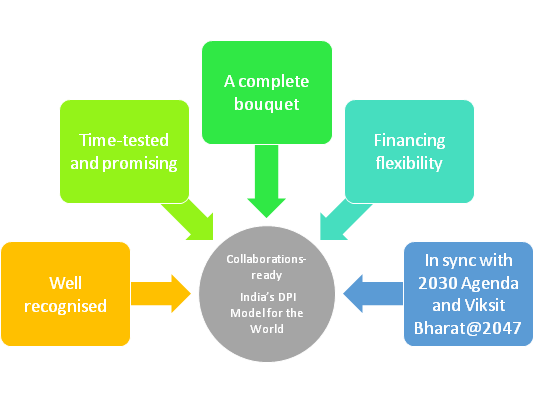
At the closing ceremony of UNCTAD-16 on 23rd October 2025, the Secretary-General aptly remarked on the digital economy, the technological advances creating new opportunities and new divides at the same time, necessitating member States to build digital infrastructure. This augurs well with India’s DPI rendering a collaborative pathway.
In today’s super-fast-changing world, the two features of a public good that stand apart and remain unchanged are its being non-rivalrous and non-excludable. For the Global South, seeking zero-fine-print non-exploitative collaborations, these remain the buzzwords appealing to the ears of policymakers and consumers alike. Its building blocks, Digital PublicGoods (DPGs), a segment of public goods, avert the free rider problem, and include open-source software packagesoperated by governments.
India’s deeper policy quest for access, equity, affordability, inclusion, and empowerment (AEAIE). As an instance, India’s financial inclusion is equality plus, as it doesn’t stop at merely giving everyone equal opportunity to open a bank account but takes it toward equity by permitting zero initial deposit and zero balance requirement. Access and affordability are taken care of by its public goods nature, leading to inclusion. On empowerment, a vegetable vendor can run her small shop without any constraint to keep physical currency in multiple denominations or face any digital hiccups.
Further on inclusion, DPGs of JAM trinity (Jan-Dhan accounts, Aadhaar and Mobile telephony), as a robust framework, have helped India, financial inclusion and eliminate leakages, eliminating direct benefit transfer (DBT), facilitating social assistance and safety nets, drastically reducing both financial and multidimensional poverty levels.
To share with the Global South, India’s unique identification number Aadhaar has 12 digits, which, on leaving out the last (meant for the correctness-check algorithm), generates the highest possible 99,999.999999 million Aadhaar numbers. This is over 69 times India’s 2023 population and over 58 times its peak population estimated for 2062 (ensuring non-repetition of any numbers assigned to the people no more).[1]
Furthermore, India’s Aadhaar is not merely a digital card; its non-transferability is in-built by virtue of finger and iris identification, besides a photograph. Moreover, it entails no need to carry it physically or digitally, as the database throws up true identity- a feature its very backbone. Even a newborn can get an Aadhaar using her birth certificate, and the Aadhaar number of either parent, with mandatory biometrics at ages 5 and 15.
Financing for Collaborations
On the financing of DPI, first India, with over 17 per cent of the world population, the marginal cost of any additional expenditure is minimal, especially when fixed costs are already taken care of. Second, emerging apps are also scalable enough to have negligible marginal costs. Third, India ensures non-withdrawal of the collaborations, including for the subsequent versions. Fourth, fintech systems, harnessing synergy between finance and technology, ensure efficiency, quality and timely delivery, for which costs are falling asymptotically.
Fifth, however, out of a large number ‘N’ of investments for innovations, as many as ‘(N-1)’ may not fructify, the cost of which can’t be directly passed on to the successful one. This aspect is endorsed in the citation for the 2025 Nobel Prize for Economics to recipients Mokyr, Aghion and Howitt, for having explained innovation-driven economic growth. Notably, Aghion and Howitt, in their pioneering Paper published in 1992, had argued the effect of research as the Poisson distribution-based arrival rate of innovations; a distribution known to catch rare events[2]. Sixth, similarly, another uncertain cost, brought to prominence by recent major outages like ‘Amazon Web Services’ and ‘Microsoft Azure’, necessitates an extra cushion of investments.
Way Forward
[1] UN World Population Prospects 2024.
[2] Aghion, Philippe and Howitt, Peter. 1992. A Model of Growth Through Creative Destruction. Econometrica Vol. 60, No. 2 (Mar., 1992), pp 323.
[3] G20 New Delhi Leaders’ Declaration 9-10 September, 2023.



Leave a Reply