

One of the first nations to acknowledge Cyprus after its independence in 1960 was India. Both countries set the stage for a supportive and cooperative partnership as soon as diplomatic connections were formed. India’s wider adherence to the principles of self-determination and non-interference in the domestic affairs of other nations was demonstrated by its recognition and support of Cyprus’s independence.
Additionally, establishing diplomatic ties lays the groundwork for more extensive political and economic collaboration. The establishment of Cypriot representatives in India and Indian embassies and diplomatic posts in Cyprus marked the start of a strong and long-lasting collaboration.
With India as a permanent member of a larger UNSC, Cyprus reaffirmed its support for strengthening the representational nature of the UNSC’s growth. Additionally, the two countries decided to work closely together and support one another at the UN.
Cyprus exported items worth 11.1 million to India and bought 64.5 million. Iron and steel were exchanged between the two nations. Cyprus is the eighth-largest foreign direct investment (FDI) investor in India, having invested a total of $8.328 billion between April 2000 and September 2015.
As a strategic message between the growing Turkey-Pakistan ties, Prime Minister Modi’s first visit to Cyprus since Operation Sindoor can be conveyed, as the application approach of India’s foreign policy towards the region with a subtle diplomatic sensitivity in which it can be identified with a broader strategic opening As it is known, Cyprus supported India after the April 22 terrorist incident and promised to raise the issue of cross-border terrorism at the EU level, indicating a growing harmony that now includes EU cooperation, trade and energy.
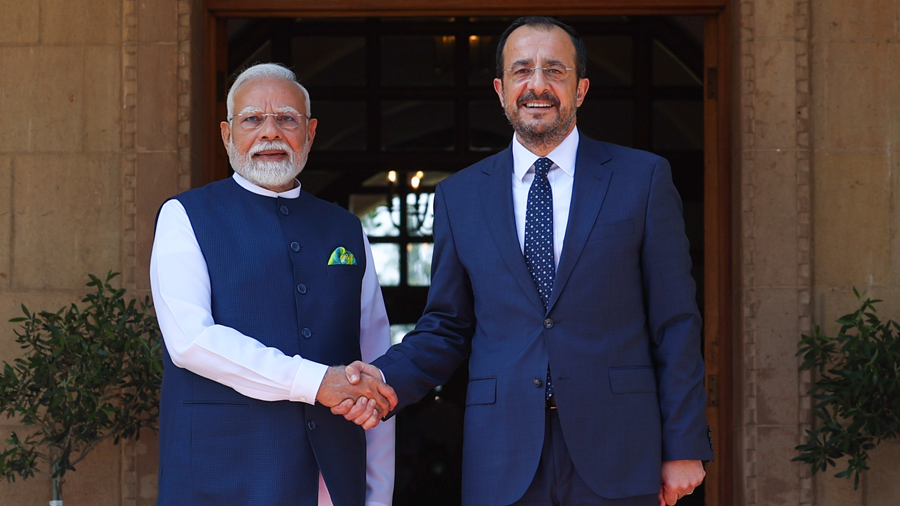
Following Operation Sindoor, Prime Minister Narendra Modi recently made his first international trip to Cyprus. He attended the G7 Summit in Croatia and Canada as part of a three-country visit. Geopolitical significance and likely an indication of Turkey’s ongoing support for Pakistan are demonstrated by his choice of Cyprus as his first destination. Prime Minister Modi was joined by a delegation of over 100 officials for the formal visit, which was made at the invitation of Cyprus President Nicos Christodoulides, adding to its significance.
Prime Minister Narendra Modi recently announced during a state visit to the island nation—the first by an Indian premier in more than 20 years—that India is strengthening its defence alliance with Cyprus by expanding coordination between their defence industries. While he did not go into detail, Modi said that bilateral cooperation in cyber security and marine security would be strengthened after meetings with Nikos Christodoulides, the president of the Republic of Cyprus.
In order to combat terrorism, the two countries also decided to create a framework for information exchange. However, Modi indicated that the effort may promote “peace and prosperity in the Middle East” while highlighting Cyprus’ strategic significance in the India-Middle East-Europe Economic Corridor (IMEC). Because of its close proximity to India and the Middle East, Cyprus is positioned as a vital centre for the corridor, which intends to improve trade, energy, and digital connectivity. Cyprus, according to Christodoulides, is India’s “gateway into Europe,” providing a foundation for Indian businesses wishing to go westward. He stated that strengthening India-EU relations, particularly advancing a free trade deal, would be a top goal during Cyprus’s EU presidency in the first half of 2026. He also pledged to support important infrastructure projects like IMEC. Modi reportedly heralded the visit as the start of a “new era” in India-Cyprus relations, based on shared principles and long-standing relationships.
Cooperation in energy became yet another pillar. Cyprus is at a crossroads in Eastern Mediterranean energy politics, with Greek, Israeli, Egyptian, and Turkish players, and it has new offshore natural gas opportunities. As worldwide prices continue to fluctuate, Indian businesses are beginning to consider purchasing stock in Cypriot blocks in an effort to diversify their fuel supplies. Modi’s promise to provide technical support for Cypriot gas-to-liquids research demonstrates Delhi’s determination to turn goodwill into real collaborations.
Cyprus has always supported India’s multilateral goals, going beyond trade and energy. The friendship has grown since Prime Minister Atal Bihari Vajpayee won Nicosia’s support for India’s application for permanent membership in the UNSC in 2002. In venues that are frequently opposed to growth, Cyprus’s support of India’s NSG entrance and civil nuclear agreement with the US strengthens New Delhi’s position. These alignments were confirmed during Modi’s visit, as both presidents stated their intention to coordinate their stances in international organisations.
The tour to Cyprus does, however, also draw attention to India’s constraints. First, the Middle East lacks adequate infrastructure, political instability in transit states endures, and IMEC is still a young concept. India’s ability to get funding, provide security along the route, and harmonise regulatory policies would determine if the ambitious and ambitious corridor plans are implemented as freight trains and shipping lines. Second, in the absence of substantial EU or third-party support, Cyprus’s dismal economic position—its non-performing loan (NPL) percentages remain among the highest in the EU—may make it more difficult for the country to bear the cost of large logistical investments.
Third, while the “Turkey factor” is useful for rhetoric, it also carries the risk of upsetting Ankara as India attempts to carefully manage the growing economic ties with the Turkish private sector, especially in the areas of textiles and automotive components. Both nations, India and Cyprus, which were formerly British colonies, have a history of collaboration through the Non-Aligned Movement, regardless of their allegiances during the Cold War.
Moreover, the market access promised by the free trade agreement is also attuned to potential local sensitivities in India’s agriculture and dairy sectors, where European competition could affect smallholder farmers, suggesting that the negotiations touch on subtle points. India may have to use calibrated negotiation strategies to protect sensitive lines while winning concessions for pharmaceuticals and IT services.
So, overall, we can observe that Prime Minister Modi’s visit to Cyprus has emerged as a masterful blend of symbolism and substance. This certainly illustrates the idea that India can further strengthen its position as a global balancer for sovereignty, and the fact that it has championed various linkages and reinforced full support for multilateral aspirations can be seen as a success that has been calculated in the finest detail. However, the real test will be the emergence of a more harmonious and efficient workforce by transforming diplomatic communications into fully functional corridors, energy projects and trade agreements. If New Delhi and Nicosia can chart a realistic roadmap based on incremental investments, strong risk mitigation mechanisms and transparent policy frameworks, Cyprus can indeed be a model for India’s wider engagement with Europe in all areas. As a result, Cyprus will serve as a test bed for the potential and pitfalls of the 21st-century geo-economy.
In the Eastern Mediterranean, a region tense politically because of Turkey’s insistent drilling, Cyprus is vital to the search for natural gas. Partnerships with Cyprus in LNG and exploration technology could develop into a competitive alternative to Middle Eastern oil as India looks to diversify its energy imports. Reducing reliance on unstable oil markets and adopting sustainable energy diplomacy may be facilitated by this energy cooperation.
Cooperation in the domains of professional services, culture, and education was the main area of emphasis during this period. Indian and Cypriot enterprises started looking into potential business opportunities in each other’s markets. Businesses from both nations were encouraged to invest and conduct business by the legal framework created by the signing of agreements for the promotion and protection of investments as well as to prevent double taxation.
Cyprus has also developed to become a point of entry for Indian companies wishing to reach European markets. Cyprus’s beneficial membership in the European Union (EU) and its strategic location in the Eastern Mediterranean drew in Indian businesses, especially in industries like financial services, IT, and pharmaceuticals. The basis for the stronger and more varied economic relationships that would develop over the ensuing decades was established by this move toward economic cooperation.
With both nations actively working to strengthen their trade and investment links, Cyprus and India’s economic relationship grew considerably in the twenty-first century. The Cyprus Investment Promotion Agency (CIPA) started aggressively marketing Cyprus as a desirable location for Indian investors, especially in the financial services, tourism, information technology, and professional services sectors.
With one of the fastest-growing economies in the world, India has grown to be a profitable destination for Cypriot investors. Through its favourable tax system, business-friendly atmosphere, and top-notch professional services sector, Cyprus in turn provided Indian companies with access to the EU’s sizable market. A varied commercial collaboration has been made possible by this reciprocal advantage. Cyprus has become a major destination for foreign direct investment (FDI) into India, and Indian businesses are progressively setting up shop there in order to take advantage of Cyprus’s access to European markets.
Conclusion
The India-Cyprus alliance is firmly based on shared democratic ideals and the rule of law, according to Prime Minister Narendra Modi. He says that the two nations’ friendship has endured over time and is not influenced by external factors or boundaries.
Prime Minister Modi’s visit to Cyprus marks a significant moment in India’s foreign policy, where strategic messaging, regional alliances and economic ambitions are intertwined. The first visit by an Indian Prime Minister in over two decades, the visit is not only symbolic but also a well-judged strategic move, especially as it comes in the wake of rising tensions with Pakistan and growing ties between Ankara and Islamabad.
India stands to gain the most from this diplomatic visit, even if it is widely perceived as a calculated signal to Türkiye that it is deepening its alliance with Pakistan. Ankara not only supported Islamabad during Operation Sindoor but also appears to have consistently supported Pakistan’s narrative on Kashmir. In return, Cyprus has been more vocal in condemning terrorism originating from Pakistan.
Prime Minister Modi’s Cyprus tour, which includes possible visits to the UN-controlled Green Line, also highlights diplomatic sensitivities in the context of India’s demonstration of its solidarity with Cyprus against the Turkish invasion and its commitment to a rules-based international order.
Modi, during his official visit to the eastern Mediterranean island, underlined the unlimited possibilities of expanding economic ties with Cyprus in a visit aimed at advancing India’s global trade agenda, underlining the importance of this diplomatic visit
Additionally, the prime minister conveyed common worries about the ongoing crises in Europe and West Asia, pointing out that their effects are felt much beyond those borders. Mr. Modi emphasised that this is not a time of conflict and urged discussion, compromise, and stability. All parties acknowledged the significance of the India-Middle East-Europe Economic Corridor in promoting regional peace and prosperity.
We can see that India’s Viksit Bharat 2047 and Cyprus’s Vision 2035 share many similarities, and it can be written off as a fruitful gain for India that they are working towards concluding a mutually beneficial India-EU trade deal by the end of this year. A roadmap will be developed to determine how the cooperation will develop over the following five years.”
An important turning point in their economic partnership was the 1994 ratification of the Double Taxation Avoidance Agreement (DTAA). By reducing tax-related concerns and uncertainties, this agreement gave companies a stable and favourable investment climate. To improve openness and conformity to international standards, the agreement was amended and altered in 2016.
The cooperation between Cyprus and India in the financial industry is one of the most notable features of their economic relations. Cyprus has developed into a significant hub for Indian businesses looking for banking, investment, and financial services. Cyprus’s EU membership has been used by Indian businesses to raise money and broaden their worldwide reach. Indian investors choose the nation because of its favourable tax laws, strong financial controls, and wide network of double taxation agreements with other nations. In order to help Indian enterprises with banking and investment services, Indian banks and financial organisations have also established operations in Cyprus.
Over time, India’s strategic interests in the Mediterranean region have expanded, particularly in light of its “Act West” policy, which supports its “Act East” strategy. Cyprus is strategically important due to its location at the intersection of Europe, Asia, and Africa. Given the significance of secure sea-lanes for international trade and energy supply, India has expressed interest in working with Cyprus on maritime security problems.
Concerns about the stability of the larger Middle East and North Africa (MENA) region are shared by both nations. Cyprus is essential to preserving regional stability because it is a member of the European Union and is located near the Middle East. Since both countries aim to further regional peace, stability, and collaboration, India’s strategic view in the Mediterranean is in line with Cyprus’s goals.
For Turkey, the rapprochement between India and Cyprus means that the diplomatic cards are being reshuffled in the Eastern Mediterranean. I think the feeling in Türkiye is that the purpose of the visit is not just “friendship”; I guess they believe that behind the scenes, there is a dangerous partnership seeking messages targeting Turkey.
While the Greek press devoted extensive coverage to Modi’s visit, the fact that Greek Leader Nikos Christodoulides’ welcoming Modi at the airport was described as a “historical privilege” by the Fileleftheros newspaper is undoubtedly an assessment that has been observed by Turkey. We think that such greetings, which are not normally included in the protocol, clearly show that Türkiye’s visit is not one of ordinary diplomatic contacts.
For Ankara, this traffic of visits and meetings can be read as a new move by the fronts trying to isolate Turkey in the Eastern Mediterranean. From Ankara’s perspective, this diplomatic visit creates the perception in Türkiye that India is ignoring the rights of the Turkish Cypriots and trying to establish a strategic partnership with the Greek Cypriot Administration, and in this sense, it is useful to emphasize that Germany is also trying to increase its weight in the region through developments in the Middle East.
Turkey undoubtedly holds the idea that it cannot be a passive observer in the Eastern Mediterranean, but can be a decisive actor The Indian publication Indian Express claims that Cyprus might significantly aid EU initiatives as well as New Delhi’s India-Middle East-Europe Economic Corridor project. This corridor, which was announced in 2023 and is a competitor to China’s Belt and Road Project, connects India to the Arabian Peninsula through the Arabian Sea. It then travels through Saudi Arabia, Jordan, and the United Arab Emirates (UAE) before opening to the Mediterranean through Israel.
When this plan was first announced, President Recep Tayyip Erdoğan, who was in India for the G20 Summit, opposed the project by saying, “There can be no corridor without Turkey. The most suitable line for traffic from east to west has to pass through Turkey.”
Turkey has declared its support for Pakistan during the conflict with India, while the Republic of Cyprus supports India’s position on the Kashmir issue. The Indian Express added that Cyprus is looking for defence cooperation partners against Turkey and would be open to assistance from India.
An analysis published in another Indian newspaper, the Hindu Post, reported that as a result of Türkiye’s support for Pakistan, India has also improved its relations with Türkiye’s regional rivals, Greece, Armenia, Egypt and Cyprus.
The written statement made by the Turkish Ministry of Foreign Affairs on May 7th also included the following statements: “The attack carried out by India has created the risk of an all-out war. We condemn such provocative steps and attacks targeting civilians and civilian infrastructure.”
Based on the view that the global economic weight is shifting from the West to the East, Turkey has recently increased its interest in this region, which also includes India, with an initiative it calls “Again Asia”
However, it is being commented that Ankara’s pro-Islamabad policies in geopolitical tensions, especially in Kashmir, make it difficult for relations with India to reach the targeted level.
Following the recent conflicts, many consumers and merchants in India have begun to boycott Turkish products.



Leave a Reply