

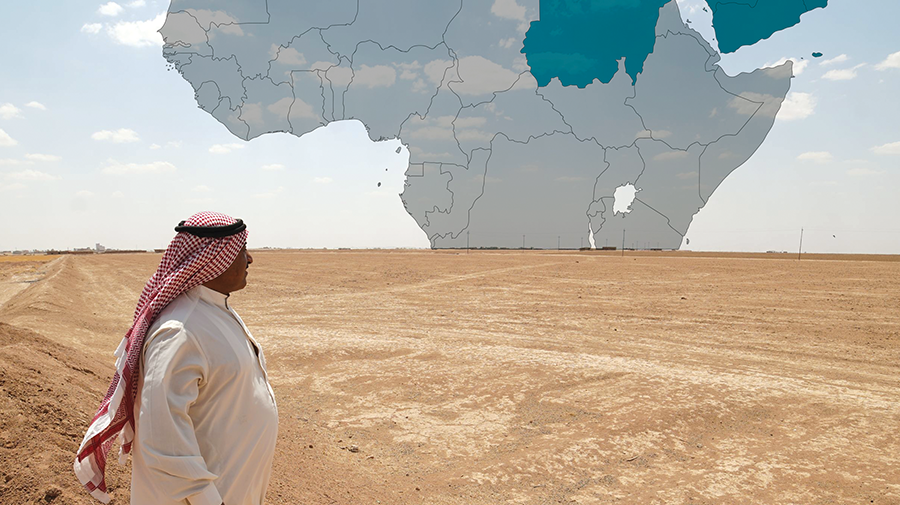
The Middle East and North Africa (MENA) region is one of the most vulnerable regions in the world to the effects of climate change, and its 500 million inhabitants are severely affected by its adverse effects, such as high temperatures, droughts, floods, severe water scarcity, and polluted air.
Temperatures in this region are warming twice the global average[1] and will have a direct impact on water scarcity, so according to 2019 data, sixteen of the twenty-five most water-stressed countries in the world are found in this region[2].
The fear of climatic effects and environmental disasters has caused countries to pursue and implement programs to deal with these effects and strengthen climate adaptation. However, what is important in implementing such programs is the degree of transparency in climate adaptation projects and the effectiveness of non-governmental sectors in implementing and following such programs, which is directly related to adaptive governance.
Adaptive governance and climate adaptation
National adaptation programs are opportunities through which governments can gradually address their future vulnerabilities and weaknesses, which means developing institutional and political capabilities to ensure climate adaptation and eliminate or mitigate the increasing challenges and disputes caused by the adverse effects of climate change[3].
Adaptive governance is one of the two ways of implementing adaptive programs by the government or with the support of people and social institutions. If the second method is chosen, this process includes using of internal and external capabilities, decentralization of power, and transparency in higher-level decisions from the bottom up[4]. This method is achieved by increasing institutional transparency and as a result strengthening non-governmental organizations, public awareness, institutional capacity building, transparency, fighting corruption and mismanagement, synergy with civil societies, and other methods of dealing with collective crises.
Transparency
Transparency is the key core of community involvement in climate change and one of the important tools of adaptive governance in this field. By creating a sense of trust between the government and the people, transparency allows them to understand each other and deepen the spirit of loyalty and productivity of the local and voluntary workforce in the implementation of adaptive adaptation.
Transparency in government means being honest and open, which leads to a better understanding of government operations and can reduce the possibility of corruption and mismanagement. A transparent government allows people to participate in the adaptive adaptation process and to be informed about government budgets, expenditures, and projects in this field.
The lack of transparency questions the efficiency of the government weakens accountability and sense of responsibility and disappoints society more than the climate change projects. Most of the people working in the MENA region are active in the agricultural sector, and more than the increase in temperature, lack of rainfall, and numerous droughts, the neglect of the government has offended them. Farmers in Tripoli, Libya are concerned about why the lack of accountability for frequent power outages would damage their irrigation systems when farmers are already dealing with climate impacts.
“Sandstorms affect my farm and also the electricity, but it’s not worse than the ministry and war. . . To me, the main factor is neglect . . . there is no oversight, no support,” A seven-year-old farmer living in the south of Tripoli said[5].
Probably, this survey among the Tunisian people, with a national average of 16.5% working in the agricultural sector, is due to this lack of transparency and inefficiency, because 64% of them believe that the government should do more to combat climate change, and 72% believe that the lack of government initiatives is largely contributing to climate change[6].
The lack of transparency in governance in MENA is not only limited to the government, and private and non-governmental companies are also not transparent in disclosing climate information. Based on the duties assigned in the climate conventions, companies must disclose their sustainability information and actions in order to pursue climate adaptation. Reports show that less than 1% of disclosing companies are in the MENA region[7].
According to research by Bain & Company, of the 200 largest companies in MENA, which account for nearly 80% of the market value of their countries’ stock exchanges, it was found that only 40% disclosed their technical publications, almost 12 per cent have stated a net-zero ambition, and only 6 per cent have outlined their roadmap. Compare this statistic with the private sector in India, where with the same existing capacities and impact on the economy, it is found that more than 47% of the 70 largest Indian companies have net-zero ambition[8].
Transparency and mismanagement
Lack of transparency leads to corruption, mismanagement, and inefficiency. When data is not exposed to public opinion and any data is considered confidential, decisions are not exposed to public opinion and judges and leads to failure or lack of community support.
Former Libyan dictator Muammar Gaddafi has been blamed for Libya’s environmental disasters today because his property collectivization in the 1980s accelerated the deforestation of the so-called Green Belt around Tripoli, which had helped reduce desertification for decades. Now that he is gone, Libya is still not interested in transparency, as officials from the National Weather Service, which monitors and collects valuable data on sandstorms and droughts and their socio-economic impacts, are not aware of the new authority on climate change and the data available in the prime minister’s office, and they do not make unified decisions[9].
The lack of transparency has led to a lack of understanding of conflicting interests in governing bodies, and it is not clear what hands are behind the scenes or what interests they are pursuing. While landfills in Tunisia have become a serious crisis and have caused public protests, the municipality in the coastal town of Agareb came to the aid of the people and closed a waste management centre, but the municipality’s decision was overturned by the state government, arguing that the municipality does not have this authority[10].
The Gotvand Dam in Iran caused water salinity in Khuzestan province due to its wrong location on the Karun River near the salt domes. Despite the criticism of the few people who knew about it, the officials of the Ministry of Water continued to build it and created this disaster[11], while if the information had been disclosed at the time under the pressure of public opinion, the residents near the dam would not have faced water salinity today.
Similarly, the lack of transparency in climate adaptation creates corruption in a parallel wave. Solving climate and environmental problems depends to a large extent on the quality and strength of institutions and the capacity of civil society for supervision because, in the absence of transparency, the quality of inspections, design, and implementation of policies and supervision is limited.
The Minister of Environment of Tunisia was dismissed and arrested due to the scandal of the illegal importation of waste, including 200 containers of household and medical waste, from Italy[12]. In Iran, The Islamic Revolutionary Guard Corps (IRGC) engineers participated in infrastructure development and water resource management to increase the IRGC’s income and economic influence in the country. They were used as contractors for the construction of dams and were called the “water mafia”[13]. The methods they used to build dams included increasing the cost of dams while providing shoddy work in the absence of monitoring and evaluation[14].
In the last few years, the adaptive governance in MENA has made efforts to deal in dealing with the follow-up of climate adaptation programs, but the problem of lack of transparency has become the main element in neutralizing these efforts, which in turn has caused a decrease in public support of the government’s climate change plans and corruption and inefficiency. This problem can be solved by increasing the supervision of the civil society, but it has to be seen to what extent the governments will tolerate the sharing of power with the society.
[1]. Isabel Bolle, “In the Middle East, temperatures are soaring. Will the region remain habitable?,” Fanack Water, June 15, 2024, https://water.fanack.com/in-the-middle-east-temperatures-are-soaring-will-the-region-remain-habitable/.
[2]. Mohammed Mahmoud, “The Looming Climate and Water Crisis in the Middle East and North Africa,” The Carnegie Endowment for International Peace, April 19, 2024, https://carnegieendowment.org/research/2024/04/the-looming-climate-and-water-crisis-in-the-middle-east-and-north-africa?lang=en.
[3]. Leah Sherwood, “Climate Change & Water Resources in the MENA Region Looking at Adaptive Governance,” Trends Research and Advisory, September 25, 2017, https://trendsresearch.org/insight/climate-change-water-resources-in-the-mena-region-looking-at-adaptive-governance/.
[4]. Marijn Janssen and Haiko van der Voort, “Adaptive governance: Towards a stable, accountable and responsive government,” Government Information Quarterly, Volume 33, Issue 1, January 2016, Pages 1-5, https://www.sciencedirect.com/science/article/abs/pii/S0740624X16300156.
[5]. Frederic Wehrey, “Libya’s Climate Fragility: Adaptation Through Decentralization,” in Climate Change and Vulnerability in the Middle East, The Carnegie Endowment for International Peace, July 6, 2023, https://carnegieendowment.org/posts/2023/07/climate-change-and-vulnerability-in-the-middle-east?lang=en.
[6]. Sarah Yerkes and Haley Clasen, “Federal Barriers to Tunisia’s Climate Momentum,” in Climate Change and Vulnerability in the Middle East, The Carnegie Endowment for International Peace, July 6, 2023, https://carnegieendowment.org/posts/2023/07/climate-change-and-vulnerability-in-the-middle-east?lang=en.
[7]. Mahmoud Abouelnaga, “MENA corporate sustainability and the climate disclosure gap,” Nature Middle East, December 2, 2021, https://www.natureasia.com/en/nmiddleeast/article/10.1038/nmiddleeast.2021.99.
[8]. Kelsey Goodman and et.al, “The Middle East is gearing up to combat climate change — its private sector can lead the way,” World Economic Forum, Nov 7, 2022, https://www.weforum.org/agenda/2022/11/middle-east-climate-change-private-sector/.
[9]. Frederic Wehrey, “Libya’s Climate Fragility: Adaptation Through Decentralization,” in Climate Change and Vulnerability in the Middle East, The Carnegie Endowment for International Peace, July 6, 2023, https://carnegieendowment.org/posts/2023/07/climate-change-and-vulnerability-in-the-middle-east?lang=en.
[10]. Lana Salman, “Environmentalism After Decentralization: The Local Politics of Solid Waste Management in Tunisia,” Arab Reform Initiative, April 29, 2021, https://www.arab-reform.net/publication/environmentalism-after-decentralization-the-local-politics-of-solid-waste-management-in-tunisia/.
[11]. Rahim Hamid, “Gotvand dam environmental catastrophe and human tragedy in ahwaz region,” Dialogue Institute, May 19, 2023, https://astudies.org/2023/05/gotvand-dam-environmental-catastrophe-and-human-tragedy-in-ahwaz-region/.
[12]. Simon Speakman Cordall, “Tunisia minister sacked and arrested in scandal over illegal waste from Italy,” The Guardian, December 24, 2020, https://www.theguardian.com/global-development/2020/dec/24/tunisia-minister-sacked-and-arrested-in-scandal-over-waste-from-italy-mustapha-aroui.
[13]. Nik Kowsar, “The IRGC and Iran’s “Water Mafia”,” Middle East Institute, February 5, 2021, https://www.mei.edu/publications/irgc-and-irans-water-mafia.
[14]. Eleanor Greenbaum, “Water, Corruption, and Security in Iran,” New Security Beat, January 23, 2024, https://www.newsecuritybeat.org/2024/01/water-corruption-and-security-in-iran/.



Leave a Reply