

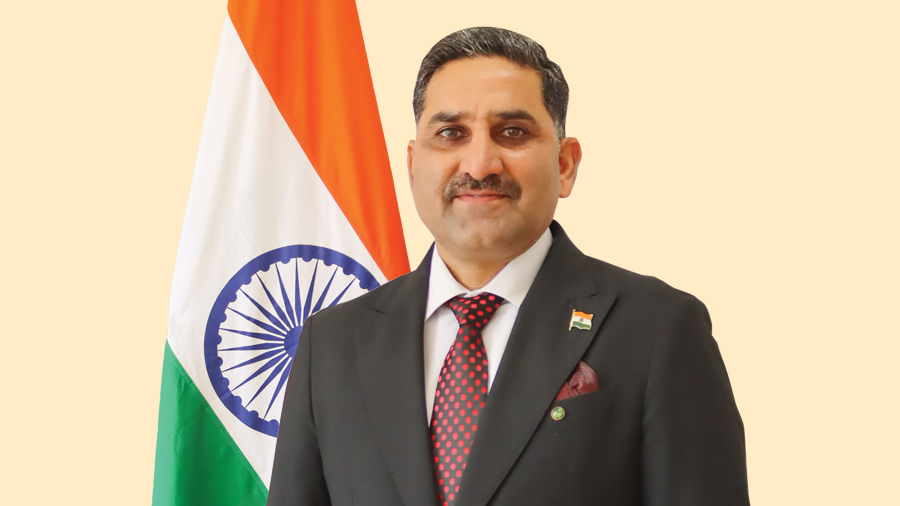
H.E. Amararam Gujar
High Commissioner of India to Malawi
In an exclusive conversation with Diplomatist, H.E. Amararam Gujar, High Commissioner of India to Malawi, reflects on the evolving India–Malawi partnership and the opportunities shaping its next phase. He discusses agriculture, critical minerals, healthcare, education, trade and investment, while highlighting how India’s development experience can complement Malawi’s long-term vision. From strengthening value chains to expanding institutional and people-to-people ties, the High Commissioner outlines a partnership increasingly focused on shared growth, capacity building and sustainable development.
Since assuming charge as High Commissioner, what has stood out to you most about the India–Malawi relationship, and where do you see the biggest opportunity to take it to the next level?
I joined as High Commissioner of India to Malawi in August 2025. Since then, the High Commission has made concerted efforts to reach out to the Indian business community and the vibrant Indian diaspora to further strengthen bilateral trade, economic engagement and people-to-people ties.
India–Malawi relations are cordial and deeply rooted in historical connections, mutual trust, respect and excellent cultural understanding. Indians have been living in what is known as the “Warm Heart of Africa” for more than a century, dating back to the period of British Nyasaland, and have made positive contributions to Malawi’s growth and development.
Following Malawi’s presidential elections in September 2025, the new government led by President Mutharika has expressed its desire to take bilateral relations with India to the next level. It is encouraging that, within a short span, more than half a dozen ministerial visits from Malawi to India have taken place, reflecting the present government’s interest in elevating the partnership.
The proposed fourth India–Africa Forum Summit would provide an excellent opportunity for African leadership, including Malawi, to engage with Indian policymakers and the business community and further strengthen the development partnership between India and Africa.
India has extended significant Lines of Credit to Malawi, but the next phase of the relationship appears to be moving towards value addition, manufacturing and private-sector investment. What is the one area where you believe India can help Malawi move from importing solutions to building local capacity?
The Government of India has offered USD 395.68 million in concessional Lines of Credit to Malawi since 2009. These have supported projects including the Salima Sugar Factory, the Likhubula Drinking Water Supply System for Blantyre, fuel storage facilities in Blantyre, Lilongwe and Mzuzu, cotton ginneries, pigeon-pea processing plants and agricultural machinery. India has also established Business Incubation Centres in Mponela and Phalombe for processing farm products.
As Malawi focuses increasingly on value addition and manufacturing, I believe agriculture and food processing offer enormous potential for Indian private investment. Malawi has the potential to move from food shortages to becoming a food-surplus country.
Indian investors could develop integrated agricultural value chains, combining farm mechanisation, sustainable and solar-powered irrigation, modern farming techniques and agro-processing. This would not only enhance productivity but also create local employment and build domestic processing capacity.
You recently visited Malawi’s pigeon-pea value chain and its non-operational dal-processing plants. What specific Indian expertise or technology could help Malawi turn pigeon peas from an agricultural commodity into a higher-value processed export?
I recently visited the Government of India-funded dal-processing plants in Liwonde and Luchenza to assess their socio-economic impact. India extended Lines of Credit in 2015–16 for the construction of these plants to add value to Malawi’s pigeon-pea production.
India also signed an agreement in 2021 for importing pigeon peas from Malawi. The crop generated USD 74 million in export earnings in FY 2024–25, making it Malawi’s second-largest revenue earner after tobacco.
India can support Malawi by helping the Agricultural Development and Marketing Corporation build the capacity required to operate these facilities efficiently. Sharing Indian expertise, best practices and technical know-how, along with training local personnel, could help transform pigeon peas from a raw agricultural commodity into a higher-value processed product.
Malawi’s Agriculture, Tourism, Mining and Manufacturing (ATMM) strategy identifies four sectors for economic transformation. Which offers the strongest immediate opportunity for Indian companies?
All four sectors under the ATMM strategy offer significant opportunities, but agriculture and mining appear particularly promising in the current environment.
Malawi faces challenges relating to what I would describe as the “4Fs”—Fuel, Forex, Fertiliser and Food, along with connectivity and infrastructure constraints. Addressing these challenges will be essential for unlocking the country’s economic potential and creating an environment conducive to greater private-sector investment.
Malawi is seeking to strengthen its natural-resource sector, while India is increasingly concerned with securing reliable critical-mineral supply chains. Can India–Malawi cooperation move beyond mining investment towards processing and value addition?
Malawi possesses significant deposits of rare earth elements and critical minerals that are important for the clean-energy transition and high-technology industries. Its deposits of graphite, uranium, kyanite, rutile and lithium could contribute to India’s growing energy and technology requirements.
Malawi can potentially become a reliable source of critical minerals and rare earth elements for India. The two countries are negotiating a comprehensive Memorandum of Understanding on exploration, extraction and mining, and I have been advocating for its early conclusion so that concrete cooperation can begin.
India’s health partnership with Malawi now includes the Bhabhatron-II cancer treatment unit, artificial limbs and medicines. What should be the next priority?
India’s healthcare cooperation with Malawi has focused on strengthening institutions and building local capacity. Since 2010, India has provided more than USD 10 million in support, including medicines, medical equipment, diagnostic machines, ambulances, COVID-related supplies and vaccines under the Vaccine Maitri initiative.
India donated a state-of-the-art cancer treatment machine to Kamuzu Central Hospital in July 2025 and established a permanent Artificial Limbs Fitment Centre at Zomba Central Hospital in February 2026. Technical staff from four major Malawian public hospitals are also undergoing training in Jaipur Foot prosthetic technology.
Food security is equally important to a healthy society. Over the last five years, India has donated 3,000 metric tonnes of rice to support Malawi’s efforts to address hunger and food insecurity.
Looking ahead, Malawi needs more super-speciality and tertiary healthcare institutions. Indian investors could consider establishing hospitals in Malawi, an area where the Malawian government is keen to attract investment. Malawi also sources more than 50 percent of its pharmaceutical requirements from India. Indian pharmaceutical companies could consider establishing manufacturing facilities in Malawi that could serve the wider Southern African Development Community market.
The 2024 India–Malawi Memorandum of Understanding on pharmacopoeia cooperation provides a framework for such ventures.
India has increased Malawi’s India–Africa Maitri Scholarship slots from 20 to 30 for 2026–27, while the ICCR has established the first Chair of Indian Studies at the University of Malawi. How can these initiatives create deeper institutional partnerships?
India’s relations with Malawi rest on four pillars: demand-driven development partnership, capacity building, trade and investment, and cultural ties through strong people-to-people connections.
India offers around 150 short- and medium-term training courses at premier Indian institutions to Malawian professionals under ITEC, along with 30 fully funded scholarships under the ICCR Africa Maitri Scholarship programme.
More than 1,700 Malawian professionals have been trained in India under ITEC, while more than 200 Malawian students have benefited from ICCR scholarships. Notable alumni include former President Bingu wa Mutharika and current Foreign Minister Dr George Chaponda, who studied at the University of Delhi.
The ICCR’s agreement with the University of Malawi to establish an India Chair for Indian Studies will further strengthen institutional linkages, encourage cross-cultural studies and enable Indian universities to expand their global outreach.
India’s Viksit Bharat 2047 vision and Malawi’s Malawi 2063 agenda both look towards long-term national transformation. Where do you see the two development journeys intersecting most meaningfully?
India@2047 represents the country’s roadmap towards becoming a developed nation by the centenary of independence. Similarly, Malawi@2063 aspires to make Malawi an inclusively wealthy, self-reliant and industrialised upper-middle-income country.
There are strong complementarities in agriculture, food processing, mining, renewable energy, pharmaceuticals and manufacturing. These sectors align with Malawi’s ATMM strategy and India’s priorities in areas such as artificial intelligence, semiconductors and clean-energy transition.
India’s strengths in digital public infrastructure, ICT, manufacturing, clean energy, pharmaceuticals and agri-tech can support Malawi’s development, particularly in commercial agriculture and youth skills development.
At the same time, Malawi’s abundant agricultural land, freshwater resources and deposits of rare earth elements and critical minerals offer opportunities for Indian investment and technology partnerships. Leveraging these complementary strengths could help build resilient value and supply chains while advancing the ambitions of Malawi 2063 and Viksit Bharat 2047.


Leave a Reply