

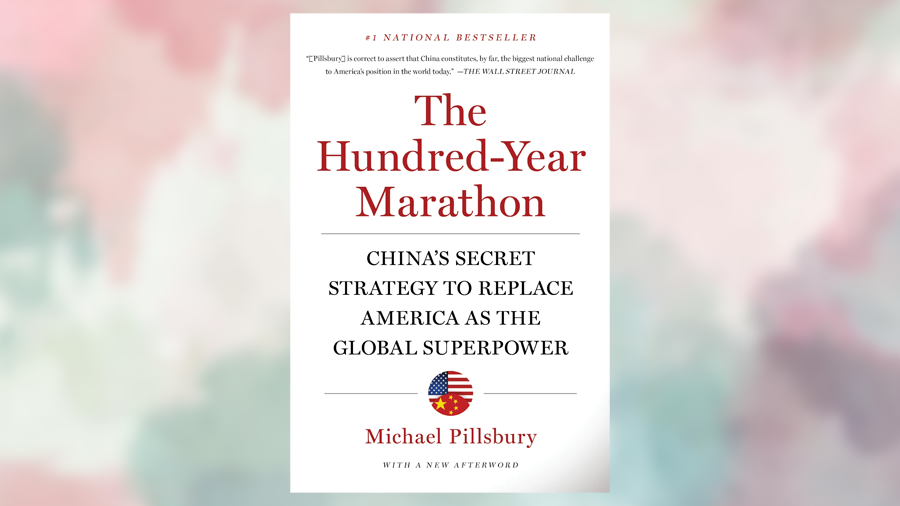
This book looks at China’s plan to outpace the United States as the superpower in the world. Based on his years of work in U.S.-China ties, Pillsbury says that China’s rise is not only about money or deals but is part of a secret planbased on old Chinese beliefs and tactics. It acts as a warning for Western leaders, saying that the U.S. has helped China rise due to mistakes and not knowing what Beijing wants.
“A Marathon, Not a Sprint” Pillsbury’s argument hinges on what he calls the “Hundred-Year Marathon” -a long-term, incremental plan rooted in China’s historical texts and strategies, largely unnoticed by U.S. policymakers and scholars. He weaves this idea into the broader framework of international relations, particularly realism, a theory that emphasises states’ pursuit of power and security in an anarchic international system. According to Pillsbury, China’s strategic ambition is a textbook example of realist behaviour, driven by self-interest and the desire to ensure its dominance on the global stage. Drawing upon his decades of experience in Washington, Pillsbury uses insider knowledge to illuminate how American political miscalculations and China’s adept diplomacy have allowed this ambitious strategy to unfold under the radar. He argues that the U.S., operating under a more liberal, cooperation-focused worldview, has been complicit in enabling China’s rise, often underestimating its geopolitical ambitions.
The core of pompous Dreymf Nechama’s writing is what he calls the idea of the ‘Hundred-Year Marathon.’ This has been an unnoticed, long-term, stepwise approach to reaching the centre that is largely based on Chinese historical texts and strategies ignored by, or beyond the grasp of, U.S. policymakers and scholars alike. Most of those attempts failed until China broke the surface, and looking back at US history, he draws on a great American insider understanding of how American blunders and clever Chinese diplomacy have brought this low-key but fairly ambitious strategy into motion. He sees that the United States has helped the other superpower, China, grow, where the American purpose of enlarging global cooperation has been consistent with military overreach and expansionism, at the same time undermining most of China’s ambitions for what is presently called international order.
This book also excels in the coherent description of so-called China’s political strategies, which include the useful strategies of war as presented by Sun Tzu in his “Art of War”. Pillsbury uncovers the fact that even now, Chinese decision-makers remain faithful to these strategies characterised by patience, misleading, and planning ways and means of outdoing the U.S. over a prolonged period. This likely provides a historical aspect that is pleasant to the Chinese and international relations scholars in equal measure.
The Hundred-Year Marathon politely criticises rather than avoids the stereotypical worries about when everything goes wrong. Reviewers might argue that the work belongs disproportionately to Pillsbury, who attempts to put China in a single narrative, as this country is ruled completely without dissent, although internal politics and various factions are never mentioned. Applying this narrow focus is dangerous as it rather oversimplifies the nature of rivalry as far as international power relations are concerned.
Pillsbury’s writing style is simple. This makes the book appealing not only to Chinese experts but also to geopolitical experts. Some chapters touch upon complicated world affairs, which speaks a lot about the policy approval style of magnesium, since this book does not plunge into the depths of academic style too much. The book is readable, the language is lucid, and the arguments can flow in sequential form, though sometimes, the shifts from historical facts to contemporary policies are a little abrupt, such that the reader is left wanting more substantiated linkages.
Still, given these minor structural built-in weaknesses, Pillsbury does come good in giving background information on why and how China is implementing its strategy, which pillared on thousands of years of political ideas. In terms of relevance, The Hundred-Year Marathon is timely, considering that more and more people have become concerned with relations between the United States and China in the twenty-first century. So, Pillsbury warns, this is an alarm, not a message for the weak heart; the book calls upon American decision-makers to change views about China while there is still time.
This book seems to appeal to those who have an interest in the politics of international relations, the concept of diplomatic strategies and relations between the US and China. To be specific, it is particularly helpful for the decision-makers and researchers who want to advance their knowledge regarding the historical background and ideological reasons behind the present aggressive foreign policy of China.
However, those who seek a more multifaceted or dispassionate viewpoint are likely to be disappointed. Some of Pillsbury’s assertions will be standard for sinologists and seasoned China watchers, which is logical and would appear in parts much too aggressive to his average reader. Relative to other nations’ warming rhetoric toward China, The Hundred-Year Marathon does not break the editorial silence on new patterns; rather, it makes an effort to reposition and name the US versus China conflict.
To summarise, it can be said without the fear of mistakes that The Hundred-Year Marathon is a cool-headed yet provocative book. For those interested in the politics of the United States and China, this book is certainly valuable in understanding the great power competition and strategic intentions of both countries. However, it is wise to approach it with a discerning mind. The writing is straightforward and engaging, making it suitable for a broad audience. However, its speculative nature might not resonate with everyone, especially those looking for a more balanced or nuanced examination of U.S.-China relations. It’s an enlightening but somewhat biased perspective on an important geopolitical matter. I can give this book a rating of 3.5/5.
Aryan Gupta is a postgraduate student at the Jindal School of International Affairs, O.P. Jindal Global University, where he is pursuing a Master’s in Diplomacy, Law, and Business. His research spans international relations, diplomacy, conflict resolution, and the Global South. He has written on global governance, peacebuilding, artificial intelligence, and emerging technologies, while also contributing to studies on identity, nationalism, and reconciliation in post-conflict societies. Actively engaged in academia and research, he focuses on policy-oriented analysis and the dissemination of knowledge across global and regional issues.



Leave a Reply