

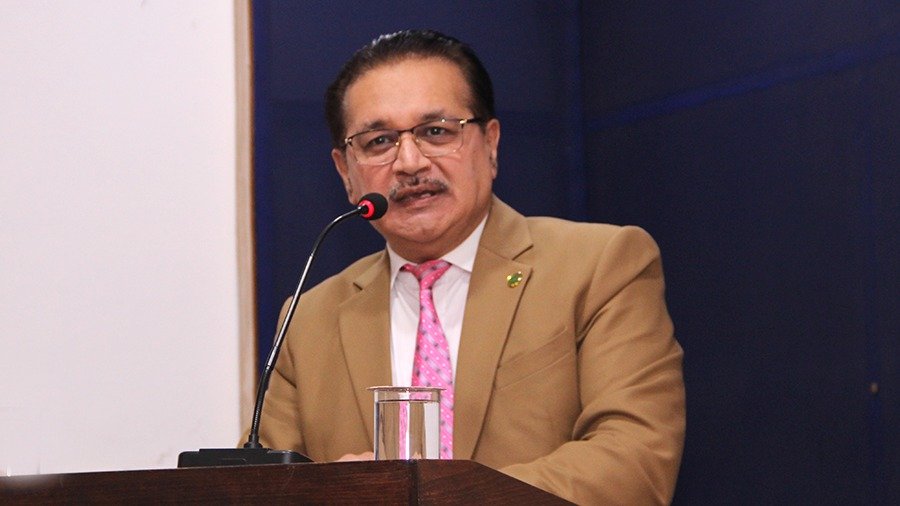
Against the backdrop of rising global uncertainty and mounting pressures on food systems, H.E. Dr. Manoj Nardeosingh, Secreatry General, AARDO, highlighted the urgency of reimagining agricultural cooperation through stronger partnerships, inclusive growth, and technology-led transformation at the 7th Agri Business Conclave & Awards, organised by Diplomatist Magazine in association with the TERI School of Advanced Studies on March 24.
Addressing a gathering of policymakers, diplomats, innovators, and development practitioners, Dr. Nardeosingh began by acknowledging the importance of collaborative platforms such as the conclave. Representing 32 member governments across Asia and Africa, he emphasised the collective responsibility of stakeholders in shaping the future of agriculture and rural development.
Situating his remarks within the broader geopolitical context, he highlighted India’s growing stature as a leader of the Global South, particularly in the post-pandemic world. “India today is increasingly being recognised as a leading voice of the Global South… this leadership role has become even more pronounced in the post-COVID era.”
He also underlined the significance of India’s guiding philosophy of Vasudhaiva Kutumbakam—the world is one family—which continues to inform its development partnerships across regions. From AARDO’s perspective, India has emerged as a critical partner in areas such as capacity building, technology dissemination, agricultural innovation, and livelihood generation.
While the conclave’s focus on innovation, inclusivity, and sustainability resonated strongly, Dr. Nardeosingh expanded the framework by introducing two additional pillars—investment and institutions. “We must explore how to mobilise greater investments—both within and across countries—and how to strengthen institutional linkages that can sustain long-term collaboration.”
His remarks came against the backdrop of rising global uncertainty. Ongoing geopolitical tensions, particularly in West Asia, have triggered economic disruptions with far-reaching consequences for agriculture and food systems.
“There are growing concerns about an impending energy crisis, which could lead to fertiliser shortages and, ultimately, a global food crisis. In such a scenario, the global food system is under increasing strain.”
In this context, he stressed the urgency of building resilient and self-reliant agricultural systems, supported by enhanced regional and global cooperation. Governments, institutions, businesses, cooperatives, and civil society must work in tandem to co-create solutions that are both sustainable and inclusive.
At the same time, Dr. Nardeosingh pointed to the vast opportunities emerging from technological advancements in agriculture. However, he cautioned that innovation must be accessible and scalable to make a real impact. “The real challenge lies in ensuring that these innovations are accessible, scalable, and inclusive.”
He advocated for what he termed “technology diplomacy”—a collaborative approach to sharing agricultural knowledge and solutions across borders. Strengthening trust, facilitating knowledge exchange, and leveraging technology were identified as key enablers of long-term progress.
Placing agriculture at the centre of the global development agenda, he highlighted its foundational role in achieving the Sustainable Development Goals, particularly SDG 2 on Zero Hunger. Yet, he acknowledged that progress remains uneven and insufficient.
“We must acknowledge that we are currently off track in achieving many of these goals.”
Challenges such as high cost of living, debt burdens, unequal value chains, and gaps in technology access continue to disproportionately affect farmers—especially women and youth—across developing countries.
In response, AARDO has been actively promoting capacity building, human resource development, and institutional collaboration. Working with centres of excellence, including those in India, the organisation is advancing initiatives in smart agriculture, agri-informatics, and innovation-led development.
Looking ahead, Dr. Nardeosingh emphasised the immense potential of deeper cooperation between Asia and Africa. Strengthening connectivity between the two regions could unlock new opportunities for startups, agri-tech enterprises, and young entrepreneurs. India’s success in areas such as policy innovation, digital governance, and agricultural programmes, he noted, offers valuable models that can be adapted across AARDO member countries.
He also highlighted key initiatives—including the promotion of millets, support for cooperatives and SMEs, and advancements in rural development—as examples of scalable and impactful approaches.
Concluding his address, he delivered a clear and forward-looking message: “Sustainable agriculture requires strong, trusted partnerships—at global, regional, and national levels. We must mobilise knowledge, technology, and finance, while creating an enabling environment that encourages innovation and investment.”
He further emphasised the importance of inclusivity, calling for a concerted effort to empower farmers, particularly women and youth, while bridging existing inequalities. “Let us work together to build a world where food security is assured, where agricultural systems are resilient, and where development is both equitable and sustainable.”


Leave a Reply