

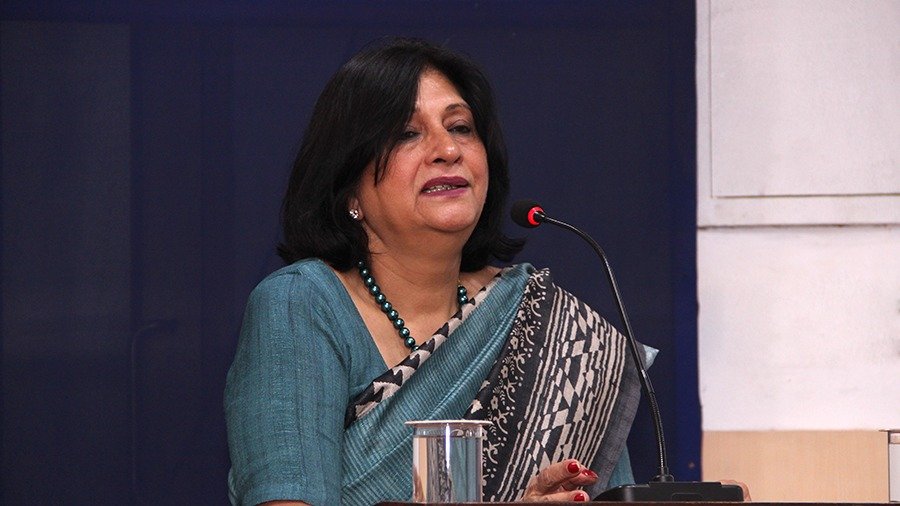
As global uncertainties continue to reshape economies and ecosystems alike, agriculture finds itself at the centre of multiple converging crises. Addressing this complexity, Dr. Vibha Dhawan, Director General, TERI & Chancellor, TERI School of Advanced Studies, presented a nuanced and forward-looking perspective on the sector’s transformation at the 7th Agri Business Conclave & Awards, emphasising its deep links with climate change, energy transitions, and global supply chains.
“Food production today is no longer just about cultivation—it is influenced by climate change, energy availability, and access to critical inputs such as fertilisers.”
Highlighting the complexity often overlooked in traditional understandings of agriculture, she challenged the notion of farming as a purely natural and benign activity. “We are taught that agriculture is a simple process… however, the reality is far more complex.”
In fact, agriculture today contributes nearly 16% to global greenhouse gas emissions while consuming close to 80% of freshwater resources—figures that underscore the scale of its environmental footprint.
At the same time, agriculture remains a deeply sensitive sector, particularly for developing economies. It must balance the need for affordability, nutritional security, and sustainability, even as it grapples with structural challenges such as excessive fertiliser use, pesticide dependency, and climate-induced uncertainties.
Drawing attention to recent weather anomalies, she noted how even short-term climate variations can significantly disrupt agricultural cycles. “We are already witnessing these impacts… unusual temperatures and unseasonal rains directly affect crop cycles and yields.”
A key concern, she pointed out, lies in the policy and subsidy structures that often distort agricultural practices. While crop diversification is widely advocated, existing incentives continue to favour water-intensive crops in unsuitable regions.
Similarly, fertiliser subsidies—particularly on urea—have led to systemic inefficiencies. “More fertiliser does not necessarily mean higher yield.”
The consequences are far-reaching: increased emissions of nitrous oxide, groundwater contamination, and long-term soil degradation. Inefficient irrigation practices further exacerbate the problem, leading to resource depletion and even desertification.
Yet, Dr. Dhawan’s address was not merely diagnostic—it was equally forward-looking.
Emphasising the role of science and innovation, she highlighted how advances in genetic research and biotechnology can help identify resilient crop varieties suited to changing climatic conditions.
She also pointed to emerging solutions at the intersection of agriculture and energy. “Innovations such as agri-photovoltaics enable the simultaneous use of land for both agriculture and solar energy generation.”
Beyond production, she stressed the urgent need to address inefficiencies across the agricultural value chain. Farmers, particularly smallholders, often lack storage capacity and financial resilience, forcing them to sell produce immediately—frequently at unfavourable prices.
In this context, decentralised processing emerged as a critical solution. “With access to reliable energy… farmers can process their produce locally, reduce waste, and access better markets.”
The scale of the challenge is stark—nearly 35% of agricultural produce is lost or wasted. Addressing this inefficiency alone could significantly enhance productivity and farmer incomes.
Dr. Dhawan also highlighted cutting-edge innovations such as nano-fertilisers, which promise to revolutionise input efficiency. “Unlike conventional fertilisers… nano-fertilisers can be absorbed directly by plant leaves, achieving near-total efficiency.”
Complementing technological solutions, she emphasised the importance of nature-based approaches. The use of beneficial microorganisms, such as mycorrhizae, can improve soil health and reduce chemical fertiliser dependency without compromising yields.
At its core, her message was clear: agriculture must be reimagined as an integrated system. “Agriculture must be viewed as an integrated system—one that encompasses water, energy, soil, and livelihoods.”
Empowering farmers lies at the heart of this transformation. By providing access to technology, renewable energy, and market linkages, farmers can make informed decisions that enhance both productivity and sustainability. “The goal is to create an ecosystem where agriculture is not only productive, but also sustainable, resilient, and economically viable.”


Leave a Reply