

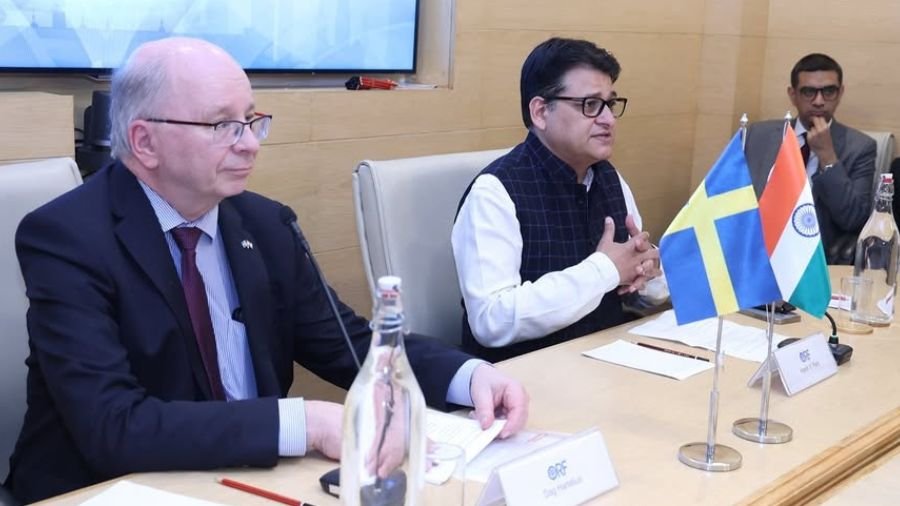
At a time when the global order is under unprecedented strain, the conversation between Harsh V. Pant, President of the Observer Research Foundation, and H.E. Dag Hartelius, State Secretary for Foreign Affairs, Sweden, who is visiting India, offered a timely and nuanced reflection on shifting geopolitical realities, Europe’s security recalibrations, and the expanding horizon of India–Sweden cooperation.
Held at the Observer Research Foundation on April 9, 2026, the dialogue brought into sharp focus the anxieties and opportunities defining today’s international system.
In his opening address, H.E. Hartelius highlighted the enduring strength of India, Sweden relations, rooted in shared democratic values and a commitment to multilateralism. Invoking Rabindranath Tagore, he recalled the idea of “bringing the distant near and making the stranger a brother” a sentiment he said continues to define bilateral ties.
He emphasised that in an era marked by volatility and geopolitical contestation, partnerships such as that between India and Sweden are more vital than ever.
“At this critical moment in history, such friendship matters. Sweden’s vision is to build a truly strategic partnership with India, one that helps us navigate the challenges of a more unpredictable world.”
Hartelius pointed to the erosion of the rules-based order, warning that “a world increasingly shaped by power, and at times brute force, is taking form.” He cited Russia’s war in Ukraine and instability in the Middle East as key drivers of systemic disruption, impacting everything from energy markets to global supply chains.
At the same time, he highlighted a structural shift in global power toward the Indo-Pacific, noting that the choices of countries like India would be decisive: “We need India not just at the table, but in many instances, in the driver’s seat.”
Framing his remarks around five key observations, he stressed the urgency of safeguarding multilateralism, adapting to geoeconomic competition, strengthening Europe’s security posture, fostering flexible international partnerships, and advancing India–Europe economic integration.
A World in Transition: Crisis or Opportunity?
Opening the discussion, Harsh Pant situated the debate within the broader transformation of global politics. He pointed to the weakening of multilateral institutions, the erosion of normative frameworks, and the unpredictability arising from shifting power balances.
Pant posed a central question: What kind of global order is emerging and is the current moment defined more by pessimism or possibility?
In response, Hartelius acknowledged the pervasive uncertainty but resisted outright pessimism. Drawing from his diplomatic engagements across regions, he noted that there is still a broad recognition of the need for a functioning rules-based system.
“Predictability has become a rare commodity. Yet governments and businesses alike need stability, rules, and institutions to invest in the future.”
He reaffirmed the continued relevance of institutions such as the United Nations and the World Trade Organization, even as they face mounting challenges.
Crucially, he argued that the present moment offers an opening for like-minded countries to step up: “There is both a necessity and an opportunity for countries that share values like Sweden and India to help shape a rules-based order for peace, stability, and free trade.”
Europe’s Security Reset and the Future of NATO
The conversation then turned to European security, with Pant raising questions about the future of NATO amid internal and external pressures.
Hartelius was unequivocal in his response: NATO remains indispensable. “NATO has always been a defence alliance, and the rationale for it is stronger than ever.”
He described Russia as the defining security threat to Europe, characterizing its actions, not only in Ukraine but across the region, as existential in nature. The 2022 invasion marked a turning point, prompting a fundamental reassessment of European defence priorities.
Europe, he noted, is now stepping up: “We are seeing a shift where European allies are taking greater responsibility for their own defence. This has long been expected and now it is happening.”
Middle East Turbulence and Global Spillovers
Addressing the crisis in the Middle East, Pant probed whether the conflict could indirectly strengthen Russia by diverting global attention and resources away from Ukraine.
Hartelius acknowledged the interconnected nature of contemporary conflicts. Instability in the Middle East, particularly involving Iran and key energy routes like the Strait of Hormuz, has far-reaching consequences.
“Conflicts today do not remain regional.
They affect energy markets, migration flows, and security dynamics globally.” He admitted concerns that shifting geopolitical focus could dilute support for Ukraine, particularly in terms of military assistance. However, he cautioned against overstating Russia’s gains.
While rising oil prices may offer temporary relief to Moscow, structural weaknesses in the Russian economy, including inflation, high interest rates, and logistical constraints, limit its ability to capitalise fully.
Interestingly, he also pointed to a less-discussed dimension: the erosion of Russia’s credibility as a reliable partner. “Russia’s reputation as an ally has suffered. Its ability to project itself as a dependable strategic partner is increasingly in question.”
India–Sweden Ties: From Partnership to Strategy
In the final segment, Pant turned to bilateral relations, asking about priority areas of cooperation between India and Sweden.
Hartelius highlighted the ambition to elevate ties into a full-fledged strategic partnership, driven by complementarities across sectors.
Key areas include: Innovation and emerging technologies, green transition, defence and security, and trade and investment.
“We see a near-perfect complementarity between our economies between innovation, talent, and industrial capabilities.”
He also underscored the importance of trust in deepening defence cooperation, noting that long-term industrial partnerships reflect growing strategic confidence.


Leave a Reply