

The India-Middle East Food Corridorsarea strategic partnership, initially between India and the United Arab Emirates(UAE), and Israel. They are designed to enhance food security, promote agricultural trade, and create integrated supply chains across the region. Backed by investments from the partnering countries, the focus is on agro-processing, logistics, and technology to meet the UAE’s high food import demand; and other needy countries in view. TheIndia-UAE Food Corridor, as a core component of the India-Middle East food security partnership, was initiated in September 2019. The initiative was further reinforced by the $7 billion food security agreement signed on February 18, 2022, in collaboration with the Comprehensive Economic Partnership Agreement (CEPA) (Invest India, July 27, 2023). The initiative was driven by the I2U2 group, composed of India, Israel, UAE, and the United States of America (USA); and the India-Middle East-Europe Economic Corridor (IMEC) framework(Shamim, 2026). Comparative advantage theory (FreshBooks, June 5, 2024) is adopted as a framework of analysis.
Theoretically, an agri-trade partnership aims to leverage comparative advantages to enhance regional and global food security. Crucially, India,Israel and the UAE have put this into practice in their strategic food security partnerships. The partnership is to protect and preserve their ‘food sovereignty’ and peoples’ wellbeing in this strategic region. It is strategic because the Middle East is a geopolitical location connecting Africa, Asia, and Europe, potentially to reduce hunger and alleviate poverty in many countries.The mediascape provides a significant current data collection method. The paper is examined by looking at: what India and the Middle East represent geopolitically; India-Middle East (UAE, Israel) Strategic and Food Security Partnerships; Food Security Outcomes and Challenges,and the conclusion.
India and the Middle East (UAE and Israel)
India and the Middle East are both geographically located in the Asian continent; while India is located in South Asia, the Middle East itself is situated in the Southwest Asia (teachmideast.org/…, November 24, 2023). While India is a country of 1,472,378,487 people (as of Sunday, March 1, 2026; 9:45AM GMT) (worldometers.info/…, 2026), the Middle East is a sub-region, comprising 17 countries with a population of 515,210,840 people (March 1, 2026 estimate) (worldpopulationreview.com/… , 2026). Given this purview of the region, India is certainly not dealing with all 17 countries at the moment, but with the UAE and Israel, first and foremost, as strategic partners for food security. It is expected that the food security corridors will expand to other countries.Indeed, India’s intent is to serve as the food basket to the Middle East and beyond (Middle East Institute, July 27, 2022).
Geographically, UAE is in Western Asia on the Arabian Peninsula, in the Middle East, and India is located in South Asia. Contiguously, India and the United Arab Emirates (UAE) are not contiguous, having no shared land border. Likewise, India and Israel are notcontiguous, but separated by thousands of kilometers of land and sea. Also, Israel and the UAE are not contiguous and do not sharea land border.While these three countries do not share physical contiguity, however, the partnership is a strategic, diplomatic, and economic one, based on common interest of food security imperative.
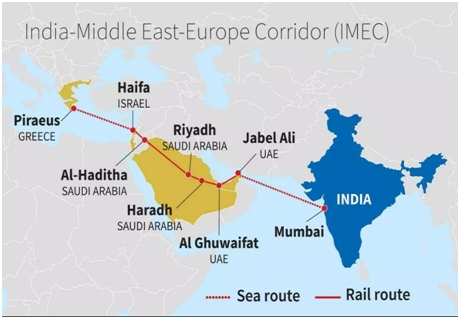 Source: Copyrights 2014-2026 – India Foundation
India-Middle East (UAE, Israel)Strategic and Food Security Partnerships
The India-UAE-Israel Food Corridorsconstitute the India-Middle East food security partnership,conceived in September 2019, when the Dubai-based Emaar Group and DP World agreed to invest up to $7 billion to establish mega-food parks, logistics, and warehousing in India(Invest India, July 27, 2023). Comparatively, India provides vast, arable land, diverse climatic conditions, and highfood production capabilities, while the UAE offers capital, sophisticatedlogistics, and advanced food-processing technology (IMARC Services Private Limited , 2026). In this strategic food security corridor, Israel has brought in its agri-tech and clean-tech partnerships with India, providing pivotal support for the South Asian country to achieve the two objectives. Israelestablished 29 agricultural centres of excellence across India,between 2012 and 2015,for the rapid transfer of technology and best practices(Middle East Institute, July 27, 2022).Despite no direct land contiguity, they maintain a “comprehensive strategic partnership” with massive trade in agricultural produce and other commodities and people-to-people ties.
The most recent two-dayvisit (February 25-26, 2026)by India’s Prime Minister Narendra Modi to Israel, in recognition of the critical role of water and agriculture in sustainable development, Prime Minister Modi and Prime Minister Netanyahu “affirmed the importance
of efforts to strengthen the partnership in water and agriculture” (PMINDIA, 26 Feb, 2026). In his public diplomatic affirmation, PM Modi said India and Israel are “trusted partners” and this “contributes to global stability and prosperity” (Shamim, 2026). This also underscored the strong partnership between Israel and the UAEunder the Abraham Accord brokered in 2020 (Embassy of the United Arab Emirates, 2025).TheAbraham Accordestablished formal diplomatic, economic, and security ties between Israel and the UAE, which has shifted Middle East geopolitics. This partnership has thrived on trade, tech-collaboration, tourism, and shared strategic interests in the region.
Food Security Outcomes and Challenges
Significantly,the UAE has committed $2 billion to build integrated food parks in India, which will utilise advanced technology for agriculture, clean and renewable energies. This will enhance food security for the UAE that hasrelied on imports for its enormous food needs. Also, this corridor will provide a stable, efficient, and direct supply of staple foods from India.Between India and Israel,the former is benefiting from the latter’s expertise in horticulture mechanisation,drip irrigation,dairy farming, and post-harvest management,elements being incorporated into these food security corridors.The partnership also, enables job creation and farmer benefits, expected to directly engageabout 2 million Indian farmers and create about 200,000 jobs through the development of food parks, cold chain projects, and processing facilities(Gulf News, December 12, 2020 ).
While there are significant outcomes in the strategic food security partnerships, challenges exist that need to be addressed. These challengesinclude the need fora high cost ofdeveloping physical infrastructure, andnavigating regional geopolitical instability.The Israel-Palestine and Iran-Israel conflicts are unsettling examples. Nevertheless, with resolve and sustained investment by the partner countries, the food corridors are expected to become a cornerstone not only of the Middle East but of a global food security landscape.
Conclusion
The India-Middle East Food Corridors, primarily driven by the I2U2 group,created a secure, tech-enabled food supply chain from India to the Middle East, extending to Europe. These corridors connect major Indian ports (for example,Mumbai)to the UAE and Israel, to enhance food security through agricultural investments and logistics. The India-UAE-Israel food security partnerships leverage a complementary, “land-and-labor-for-capital-and-logistics” model, thereby creating a robust, sustainable food corridor, to reduce the UAE’s huge import dependence while boosting India’s agricultural export value chain. The trilateral relations between the UAE, Israel, and India have become the natural and logical positioning in the advancement of the food corridor project, which can be replicated across Asia, Africa and Europe.




Leave a Reply