Gujarat’s Dairy Revolution and Cooperative Model: The Global Relevance of the White Revolution
In both emerging economies and developed countries, dairy farming is a key livelihood affecting animal welfare, environmental sustainability, and social justice. The programme adopted to increase milk production is called the ‘White Revolution in India’, also referred to as ‘Operation Flood’. This revolution in India occurred in 1970 when the National Dairy Development Board (NDDB) was established to organise dairy development through cooperative societies. This revolution transformed India from a milk-deficient nation into the world’s largest producer, greatly enhancing the livelihood of dairy farmers and contributing to rural development (Gulati & Juneja, 2023). Dr. Verghese Kurien was the father of the White Revolution in India. It empowered millions of smallholder farmers through cooperatives, doubling per capita milk availability and establishing a sustainable economic model.
Need for White Revolution
In the first two decades post-independence, India’s dairy landscape faced significant challenges. The compounded annual growth rate (CAGR) in milk production during 1950-60 stood at a meagre 1.6%, and it fell further to 1.15% during 1960-1970. In 1950-51, the per capita consumption of milk stood at a mere 124 grams per day, and it declined to 107 grams per day by 1970, a level considerably below the globally recommended nutritional standards (Scholten, 2015). During this period, India was a milk-deficient country relying on imports to fulfil its domestic demand. India’s dairy industry faced formidable challenges, producing less than ~22 million tons of milk annually despite boasting the world’s largest cattle population.
Purpose
To enhance dairy farming and augment rural incomes, increase milk production to ensure a steady supply of milk and fair prices for consumers.
Objectives
- Procurement, transportation, and storage of milk at the chilling plants, thereby eliminating the middlemen
- Provide cattle feed and superior cattle breeds (cows and buffaloes), health services, veterinary and artificial insemination facilities
- Manage the marketing of societies and also produce various milk products
Execution
This initiative was executed through a three-phase process:
- 1970-1980): Funding acquired by means of the sale of skimmed milk powder and butter oil, which were contributed by the European Economic Community (EEC) through the World Food Program (WFP).
- 1981-85: Establishment of a self-sustaining system of 43,000 village cooperatives covering 4.25 million milk producers, resulting in making India self-reliant. The production of domestic milk powder surged from 22,000 tons in the pre-project year to 140,000 tons by the 1990s.
- 1985-1996: Facilitated Operation Flood to expand and fortify dairy co-operatives, strengthening the necessary infrastructure for procuring and marketing growing volumes of milk. Comprehensive veterinary first-aid healthcare services, feed provisions, and artificial insemination services are extended to co-operative members, accompanied by intensified member education.
Importance
- The revolution significantly boosted India’s milk production, making the country one of the largest milk producers globally. This ensured the availability of milk and dairy products to a vast population.
- The revolution provided a sustainable source of income for millions of small-scale dairy farmers, leading to rural economic development and creating employment opportunities in the dairy sector.
- India transitioned from a milk-deficient nation to becoming self-sufficient, reducing dependency on imports and ensuring food security, leading to self-sufficiency in dairy products.
- The increased availability of milk and dairy products contributed to better nutrition, particularly in rural areas, helping combat malnutrition and improving public health.
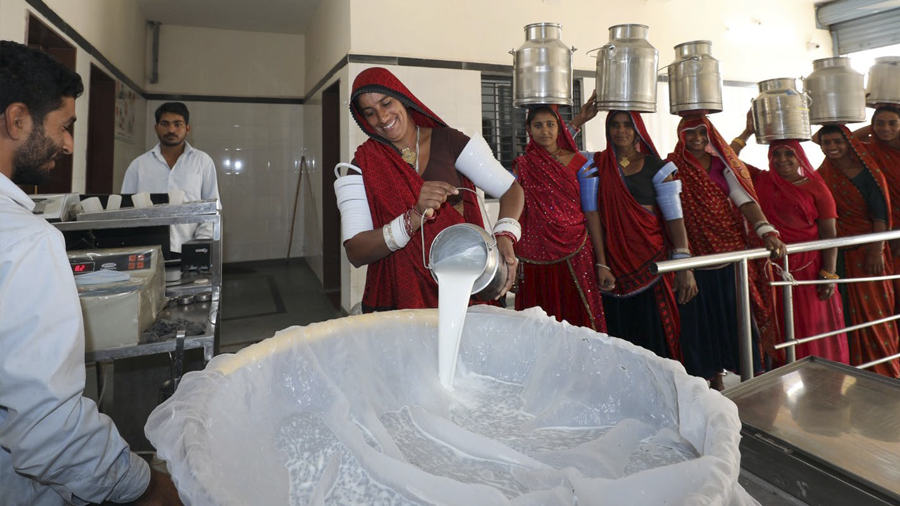
- Many women were actively involved in dairy farming, and this revolution empowered them economically, enhancing their role in household decision-making and community life.
Achievements
- Profound impact on rural communities, motivating many to pursue dairying as an additional source of income.
- Emerged as the world’s top milk producer, with milk production soaring from approximately 17 million tonnes in 1950-51 to over 198 million tonnes by 2020, ten times compared to the pre-independence situation.
- Current daily per capita availability of milk is about 263 grams, compared to 125 grams before the White Revolution in India, which also led to a substantial reduction in the import of milk and milk products.
- Advancements in cattle breeding, extensive cross-breeding programs and the implementation of modern technologies, establishment of research centres and regional centres nationwide to enhance livestock quality.
- Health schemes implementation and livestock insurance initiation to ensure disease-free status.
Global Relevance and Impact
- Food Security and Nutrition: The program significantly increased milk availability, helping to bridge the nutritional gap in developing nations.
- Infrastructure Development: It built robust milk procurement, chilling, processing, and transportation networks.
- Model for Rural Development: The “Amul model” of dairy cooperatives is globally recognised as a blueprint for empowering small-scale farmers, providing direct market access, reducing middleman exploitation, and ensuring stable income.
- Model for Developing Nations: The cooperative structure provides a scalable, replicable model for developing economies to increase rural income and dairy production
- Employment and Empowerment: It shifted dairy farming from a subsistence activity to a significant source of self-sustainable income for 14 million+ farmers, specifically focusing on empowering women.
- Sustainability: As a cooperative-driven model, it promotes self-sufficiency and strengthens rural infrastructure (cold chains, processing facilities).
- Technological Innovation: The success of converting buffalo milk into skim milk powder, pioneered during this period, provided a replicable technological solution for developing nations to boost dairy production.
Significance
White Revolution in India led to the remarkable transformation and growth of the dairy industry. The significance of this revolution lies in its contribution to rural empowerment, poverty alleviation, and economic development. By boosting milk production and creating a cooperative framework, it not only elevated the socio-economic status of farmers but also made India one of the largest milk producers globally, fostering self-sufficiency and economic growth in the agricultural sector (Duncan, 2013). Over the years, it effectively doubled the per capita availability of milk in India, establishing dairy farming as the nation’s foremost self-sustainable rural employment generator.
Conclusion
White Revolution in India stands as a testament to the power of cooperative movements and visionary leadership in transforming a nation’s agricultural landscape (Gulati & Juneja, 2023). As India continues to build on the legacy of the revolution, it must address challenges to sustain and enhance the dairy sector. The most notable feature of a developing country is that it witnesses the birth of a number of organisations geared to meet the demands of, and opportunities presented by, that development. Success of the development process, indeed, hinges on how well these new organisations grow, mature and serve the needs of society at large. Cooperative is one such organisation. These cooperatives led initiative, continues to be a landmark in agricultural development, showcasing how organised, localised efforts can lead to massive, sustainable economic transformation. Today, dairy development projects in Africa, Asia and elsewhere emulate India’s white revolution model for gains in child nutrition, education, health, and social mobility.
References
Duncan, J. (2013). The White Revolution and reordering of relations among the pastoralists of Gujarat: a case for pastoralist policies. Food Chain (2046-1887), 3.
Gulati, A., & Juneja, R. (2023). White Revolution in India: What smallholders can do given the right ecosystem (No. 224). ZEF Working Paper Series.
Scholten, B. A. (2015). The ‘White Revolution’and dual dairy economy structures. In Handbook on the Globalization of Agriculture (pp. 461-482). Edward Elgar Publishing.
Neeta Baporikar
Author is a Research Focused Professor, Namibia University of Science and Technology, Namibia.




Leave a Reply