

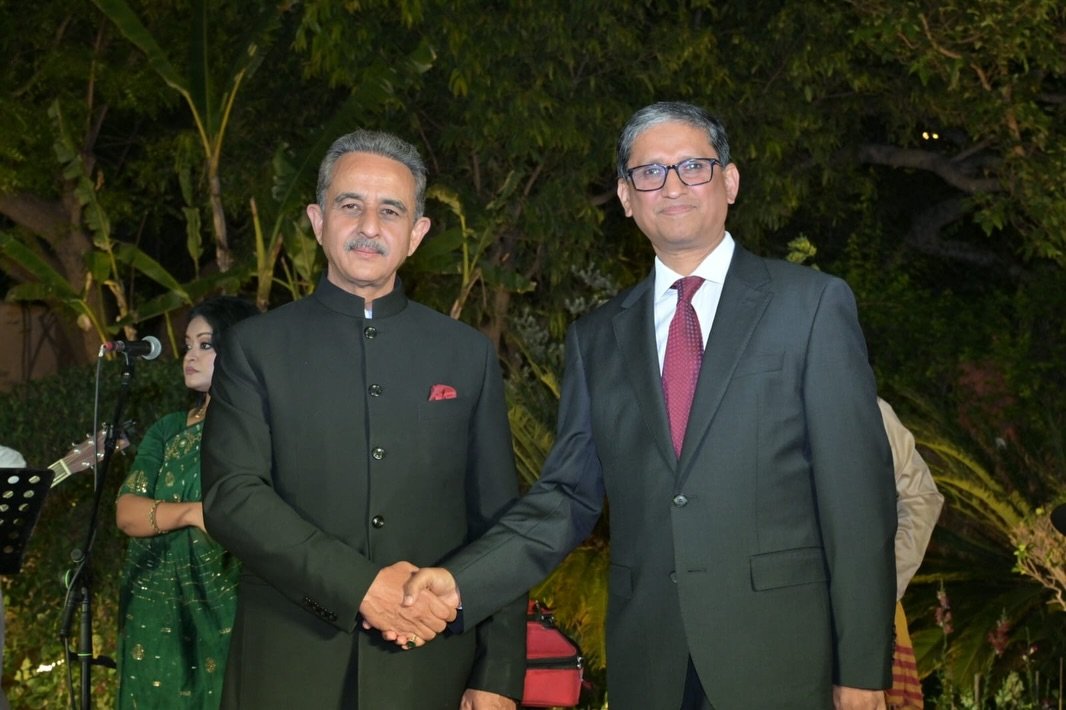
In a significant diplomatic moment highlighting both continuity and renewal in India–Bangladesh relations, H.E. M. Riaz Hamidullah, High Commissioner of Bangladesh to India, hosted a high-profile reception in New Delhi on March 26, 2026, to commemorate the 56th Independence and National Day of Bangladesh.
The evening brought together a distinguished gathering, including Shri Kirti Vardhan Singh and Shri Vikram Misri, alongside diplomats, policymakers, business leaders, and members of the strategic community. The evening included musical performances and a prominent “Golgappa” stall celebrating “shared heritage”. More than a ceremonial occasion, the reception subtly signalled a renewed emphasis on partnership, people-to-people ties, and what many described as a refreshing touch of “Golgappa diplomacy”—a light yet meaningful nod to shared cultural experiences that bind the two nations.
Honouring Shared History and Sacrifice
At the heart of the evening was a solemn tribute to the sacrifices that shaped Bangladesh’s birth. Recalling the Liberation War of 1971, the High Commissioner noted, “We pay tribute to our freedom fighters—the brave men and women whose courage and ultimate sacrifice… secured our independence.”
Importantly, he acknowledged India’s pivotal role during that defining period, emphasising, “We also recall with deep gratitude the immense support extended by the people and Government of India… We honour the 1,668 Indian soldiers who laid down their lives for our freedom—an enduring symbol of shared sacrifice and solidarity.”
This acknowledgement reinforced a foundational truth: that India–Bangladesh relations are rooted not merely in diplomacy, but in shared history and collective memory.
A Civilisational Bond Beyond Borders
Moving beyond history, the High Commissioner highlighted the rich cultural connections that continue to define bilateral ties. Invoking iconic figures such as Rabindranath Tagore, Kazi Nazrul Islam, Satyajit Ray, and Pandit Ravi Shankar, he remarked that these shared legacies reflect “a shared civilizational ethos.”
He also recalled the global impact of the historic 1971 Concert for Bangladesh, noting how it helped draw international attention to the liberation struggle—an early example of cultural diplomacy shaping global narratives.
Democracy, Development, and a Shared Future
Highlighting Bangladesh’s internal growth, High Commissioner Hamidullah emphasised the country’s commitment to pluralism and democratic values: “Bangladesh takes pride in its inclusive and pluralistic society, where harmony and coexistence remain fundamental values.”
Positioning bilateral ties within a broader geopolitical context, he noted that both nations are navigating an increasingly complex global order, adding, “Our partnership is anchored not only in shared history but also in a shared vision for the future.”
Notably, the address underscored Dhaka’s continued commitment to a pragmatic and mutually beneficial relationship with New Delhi, grounded in mutual respect, trust, and shared prosperity—without delving into specific political leadership references.
Beyond Trade: The Human Dimension
While acknowledging the expanding economic engagement between the two countries, the High Commissioner was clear that the relationship transcends trade figures.
“Beyond numbers and statistics, it is the human dimension that remains central,” he stated, drawing attention to the youthful demographics of both nations. With Bangladesh’s median age at around 27 and parts of India even younger, he highlighted the immense potential for collaboration driven by aspiration and innovation.
He articulated a shared developmental vision rooted in inclusivity: “Our shared vision must therefore be one of inclusive growth—where prosperity is collective, opportunities are equitable, and no one is left behind.”
A Moment of Reflection and Cultural Tribute
The evening also carried a poignant note as High Commissioner Hamidullah remembered the late Assamese musical icon, Zubeen Garg. “His absence is deeply felt, but his music and spirit continue to resonate across borders,” he said, underscoring once again the enduring power of cultural connections in diplomacy.
Towards a Renewed Partnership
As the reception drew to a close, the High Commissioner’s message was clear: India and Bangladesh stand at a moment of opportunity. His call to action was both simple and forward-looking: “Let us continue to build bridges, across rivers, cultures, and communities.”
In many ways, the evening encapsulated the evolving grammar of India–Bangladesh relations, where strategic cooperation meets cultural familiarity, and where even something as simple as shared street food can symbolise deeper bonds.
The symbolism of serving Golgappas may have added a light-hearted touch, but the underlying message was serious: a renewed commitment to partnership, mutual respect, and a shared regional future.


Leave a Reply