

Africa has often been called “The Continent of the Future,” a phrase that reflects both its demographic dynamism and its expanding economic and strategic relevance in global affairs. For India, engagement with Africa is rooted in a shared history of anti-colonial struggle, South–South solidarity and was inspired by the principles articulated at the 1955 Bandung Conference. These historical affinities today intersect with pressing geopolitical and developmental imperatives, as both sides navigate a rapidly transforming international order.
Intensifying great-power competition across Africa through China’s infrastructure outreach, along with renewed European and American engagement, has reshaped the continent’s external partnerships. Simultaneously, Africa too has strengthened its internal collaboration through continental initiatives such as the African Continental Free Trade Area, which seeks to harmonise trade regimes, foster regional value chains, and accelerate industrialisation. As global power structures undergo structural realignment, India–Africa engagement is increasingly positioned not merely as historical solidarity, but as a forward-looking partnership shaping a more equitable and multipolar global order.
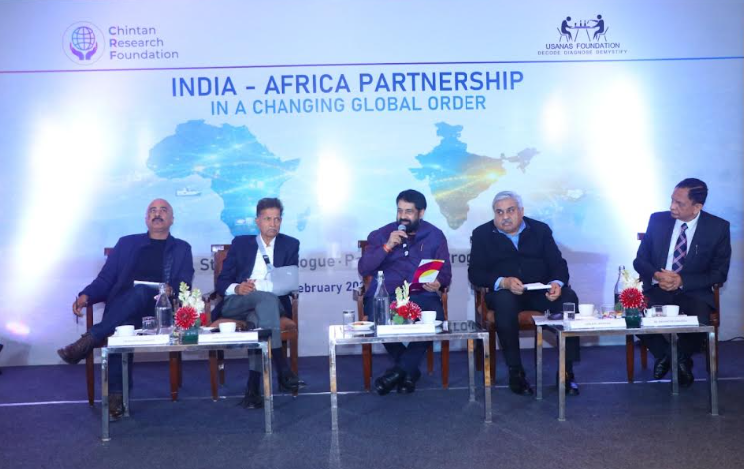
Under this backdrop, the Chintan Research Foundation (CRF), Delhi, in collaboration with the USANAS Foundation, Udaipur, convened a conference, “India–Africa Partnership in a Changing Global Order” on February 23, 2026, in New Delhi. The day-long conference brought together ambassadors, senior diplomats, policymakers, scholars, and strategic analysts to deliberate on the evolving contours of India–Africa engagement amid a rapidly transforming global landscape.
“The turbulent times we are living in, accompanied by disruption of supply chains, ask for south-south cooperation in energy transition and climate action,” stated Shri Sudhakar Dalela, Secretary (Economic Relations), Ministry of External Affairs, Government of India, while delivering his keynote address. He further underscored Africa’s centrality in India’s economic diplomacy and South–South cooperation framework. His address encompassed the increasing Indian diplomatic footprint in Africa, and specified that India-Africa solidarity is characterised by India’s principle of “Vasudhaiva Kutumbakam”
(the world is one family).
Earlier, welcoming the delegates, Mr Shishir Priyadarshi, President, CRF, and Dr Abhinav Pandya, Founder & CEO, USANAS Foundation, emphasised that India-Africa must strengthen its relationship, especially in the aspect of trade. The current fragmentation within the global order is marred by trade unpredictability that will hurt the growth in the India-Africa partnership. They stressed the historical aspects of India-Africa partnership and emphasised the need for robust global institutions and security structures with an aim of South-South cooperation.
During the discussions, the panellists highlighted that the strengthening of India-Africa partnership in trade, technology and transnational connectivity creates various opportunities and challenges. Various delegates highlighted that India needs to articulate a cohesive blueprint while engaging with the continent. As India and Africa have already surpassed US$ 100 billion in 2024–25, with both sides targeting US$ 200 billion by 2030, it was emphasised that India should engage with the regional cooperations in Africa more cohesively in order to further enhance trade.
H.E. Mr Anil Sooklal, High Commissioner of South Africa to India and former G20 and BRICS Sherpa, highlighted three key aspects of technological cooperation: sharing innovations in the agriculture sector towards food security; and assistance in capacity building and skill development, to be considered in the fourth India-Africa Forum Summit (IAFS). While exploring the transformative potential of the African Continental Free Trade Area (AfCFTA), he underlined that India needs to have a concrete blueprint in terms of engagement with the larger Africa, especially through AfCFTA.
While discussing the evolution of India–Africa industrial cooperation, it was pointed out that India’s role in Africa’s industrialisation is significant as India offers a combination of finance, know-how, and skills. India–Africa cooperation in technology, ports, and infrastructure is not just about building assets; it is about co-architecting futures in a changing global order, flagged Ambassador Anil Wadhawa. With an inference towards the prospects of India–Africa cooperation with Africa’s development at heart, it was signified that co-sharing the experience of digitisation by India is key for the continent.
The conference also explored ways to strengthen and navigate the India–Africa partnership within the contemporary global landscape. H.E. Dr Desire Boniface Some, Ambassador of Burkina Faso to India, stated that with President Trump coming to power, there is an emergence of a new structure in the world order. Within the emerging global order, it is essential to focus on how India–Africa cooperation can deliver mutually beneficial, win-win outcomes. He also emphasised that the spirit of the Bandung conference should be redefined and reinstated.
The day-long deliberations also ventured into the possibilities of how the India–Africa partnership can be strengthened within the great power engagement in Africa. The speakers insisted the inclusion of the African Union into G20 was a big success in India–Africa partnership, while addressing the strategic convergence between India and Africa, especially under the dynamic global order.
With climate change being one of the central aspects to contemporary geopolitical scenario, India should engage with Africa on various aspects like renewable energies, critical minerals, climate action, and other similar avenues.
Overall, the conference underlined that India–Africa relations have matured into a multidimensional partnership that encompasses various sectors. Although important gaps remain to be addressed, conducting regular India–Africa Forum Summit (IAFS) is one of them. Along with it, the partnership needs to expand into newer arenas like digitisation and climate action, while strengthening the partnership in aspects like trade, people-to-people linkages and security challenges.


Leave a Reply