

Geopolitical conflicts have historically reshaped global energy systems. The 1973 oil embargo triggered a wave of energy diversification across industrial economies. The Russia-Ukraine war pushed Europe to rapidly expand renewable energy and reduce its dependence on Russian gas. The ongoing conflict in West Asia may have a similar effect. While wars in the region have long influenced oil markets, the current crisis highlights a deeper structural reality: fossil fuel systems are inherently vulnerable to geopolitical shocks. In contrast, nuclear and renewable energy systems rely on domestic resources that are widely distributed across geographies. For countries heavily dependent on imported fossil fuels, this distinction is becoming increasingly important.
West Asia sits at the heart of the global oil economy. Nearly one-fifth of the world’s oil supply passes through the Strait of Hormuz, a narrow maritime corridor connecting Gulf producers to global markets. Any disruption in this region has immediate ripple effects on energy prices and economic stability. Even the threat of conflict can trigger volatility, translating into inflationary pressures and fiscal strain for large energy-importing countries.
India’s energy system illustrates this vulnerability clearly. The country imports close to 88 percent of its crude oil requirement and roughly half of its natural gas demand. Despite being one of the world’s largest coal producers, India also imports significant volumes of coal to meet industrial and power sector demand. This dependence exposes the Indian economy to external shocks whenever global energy markets are disrupted, often translating into higher subsidy burdens, pressure on foreign exchange reserves and broader macroeconomic instability. It is in this context that renewable energy takes on strategic significance.
Unlike fossil fuels, renewable energy sources such as solar and wind are geographically widespread. They are not controlled by a handful of nations or transported through vulnerable supply routes, but are locally available and can be harnessed domestically. This fundamentally reshapes energy security, reducing both emissions and dependence on volatile global fuel markets.
India has already begun moving in this direction. The country’s renewable energy capacity has expanded rapidly over the past decade, crossing roughly 260 Gigawatts (GW) of installed capacity. Solar energy in particular has emerged as a key pillar of this transition, accounting for a growing share of new power installations. With abundant solar irradiation and nearly 300 sunny days each year, India possesses one of the world’s largest solar energy potentials. Government targets aim to push non-fossil electricity capacity to 500 GW by 2030, reflecting a significant policy commitment to clean energy expansion.
The economics of renewables further strengthen this shift. The cost of solar power has declined sharply over the past decade, making it one of the cheapest sources of electricity. Analysts describe this phase as a “solar supercycle,” driven by falling costs and policy support. For India, this aligns climate goals with energy security. However, renewables cannot operate in isolation. Their intermittency, combined with rising base load demand, makes it essential to complement them with stable, low-carbon sources; this is where nuclear energy becomes critical.
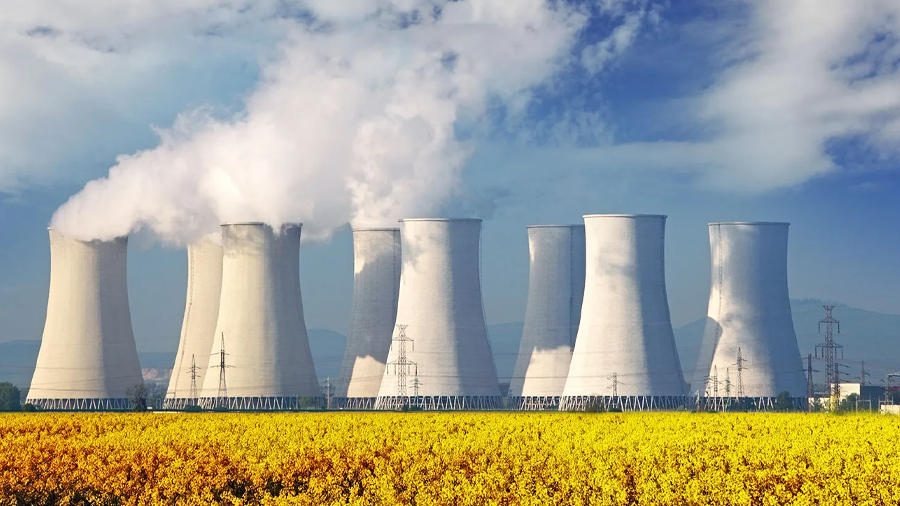
Unlike fossil fuels, nuclear power provides reliable, round-the-clock electricity with minimal emissions and without exposure to volatile global fuel markets. India’s current nuclear capacity stands at around 8.8 GW, constituting about 3% of the country’s total electricity generation, but this is set to expand significantly. Around 6.6 GW of nuclear capacity is already under construction, with additional reactors in the pipeline. Government plans indicate that total nuclear capacity could reach 22 GW by 2031–32, effectively tripling current levels. Looking further ahead, India has articulated an ambitious vision of scaling nuclear power to 100 GW by 2047, positioning it as a central pillar of long-term energy security.
Encouragingly, the policy ecosystem is beginning to align with this ambition. Recent developments, including the passage of the SHANTI Bill, signal a structural shift toward enabling greater private and international participation in India’s nuclear sector. This marks a significant departure from the historically state-dominated model and could unlock capital, technology, and innovation at scale.
The relationship between geopolitical conflict and the energy transition, however, remains complex. Wars can disrupt supply chains for critical minerals, solar modules & batteries and may push short-term reliance on fossil fuels. Yet over time, such instability reinforces the need to diversify away from imported fuels. In this sense, the West Asia conflict may serve as an unintended catalyst for accelerating clean energy transitions worldwide. For India, the implications are particularly significant. Every surge in global oil prices underscores the risks of external dependence. Renewable energy reduces this exposure, while nuclear energy provides the reliability needed to sustain growth. Together, they form the backbone of a more secure and resilient energy system.
The challenge now lies in sustaining momentum. Scaling clean energy requires continued investment in grid infrastructure, storage technologies and domestic manufacturing. Strengthening transmission networks, advancing battery storage and supporting decentralised renewable systems will be essential to ensure that capacity additions translate into real energy resilience. What this moment also highlights is a larger structural opportunity. India’s energy transition cannot rely solely on imported technologies. If energy security is the goal, technological self-reliance must be central. This requires a shift from being a technology adopter to an innovation hub, through stronger industry & academia collaboration, investment in indigenous R&D and strategic use of public procurement. When firms are incentivised to innovate, the gains extend beyond energy security to economic competitiveness.
Policy frameworks such as the Production Linked Incentive scheme can evolve to reward innovation and domestic value creation. The ongoing crisis in West Asia, therefore, offers a moment of strategic clarity. If leveraged well, today’s geopolitical uncertainty could become the foundation for a more secure, self-reliant and resilient energy future.


Leave a Reply