

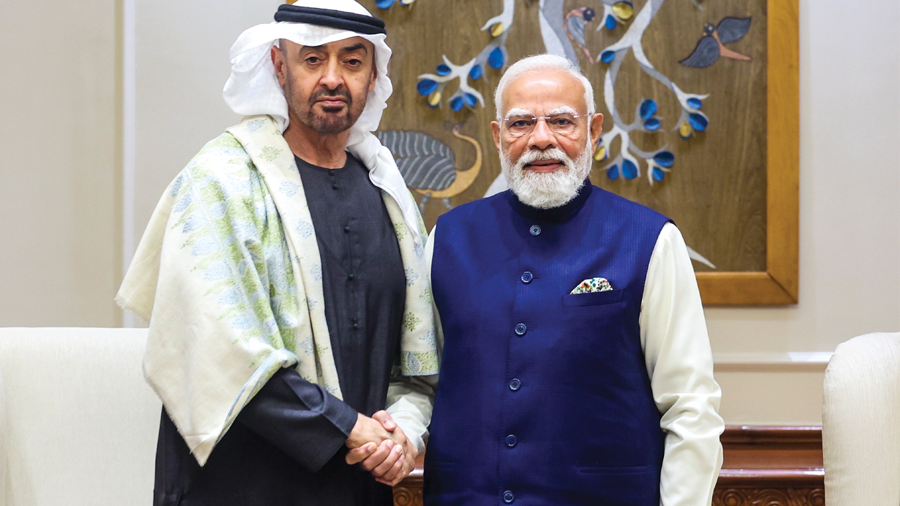
The January 2026 visit of UAE President Sheikh Mohamed bin Zayed Al Nahyan to India underscored that India–UAE relations have entered a phase of institutional depth, economic interdependence, and policy continuity. High-level exchanges now function as coordination platforms across energy security, geo-economics, defence, and technology. The visit was therefore not about resetting ties, but about consolidating a partnership that both sides increasingly treat as strategically consequential and structurally embedded in their long-term planning.
The timing of the visit carried notable geopolitical weight. Today, West Asia remains unsettled by the Gaza conflict, Red Sea disruptions, US–Iran tensions, and visible diversification of Gulf alignments. Saudi–UAE divergences on Yemen and oil policy, alongside renewed Saudi–Pakistan–Turkey security coordination, point to a region in flux. At the same time, evolving U.S. trade and tariff policies and tightening scrutiny on sanctions-linked energy flows have added new layers of uncertainty to global energy markets. For India—whose energy basket expanded toward discounted Russian crude after 2022—long-term hedging has become a strategic necessity rather than a choice. Stable Gulf suppliers such as the UAE, therefore, acquire renewed importance in India’s risk-hedging strategy. This aligns with India’s preference for strategic autonomy and geo-economics-led engagement rather than bloc politics.
Energy cooperation remains the most material pillar of the relationship and featured prominently in the visit’s outcomes. The $3-billion, 10-year LNG agreement between Hindustan Petroleum and ADNOC Gas for 0.5 MMTPA from 2028, alongside an additional 1.2 MMTPA contract involving Indian firms, strengthens long-term supply predictability and reduces India’s exposure to volatile spot markets. The UAE is now India’s second-largest LNG supplier after Qatar, while India has become ADNOC Gas’s largest customer. These contracts directly support India’s target of raising natural gas to 15 percent of its energy mix by 2030.
At the same time, both sides are managing the transition imperative. As India and the UAE pursue net-zero targets for 2070 and 2050, respectively, cooperation spans green hydrogen, biofuels under the Global Biofuels Alliance, grid connectivity, and critical minerals. Civil nuclear cooperation under India’s SHANTI framework—covering large reactors and SMRs—adds a clean base-load dimension. This is logical sequencing: energy security today, diversification tomorrow. For the UAE, India’s scale offers a stable demand anchor; for India, the UAE offers reliability in a tightening global energy market.
Economic integration has acquired a similar strategic logic. Since the 2022 Comprehensive Economic Partnership Agreement, bilateral trade has approached $100 billion, with both sides reiterating a $200-billion target by 2032. UAE FDI stock exceeds $22 billion against pledged investments of up to $75 billion. During the visit, leaders emphasised accelerating implementation—an implicit recognition that credibility now hinges on delivery, not declarations.
Gujarat’s GIFT City illustrates this shift from intent to architecture. First Abu Dhabi Bank’s presence links Indian firms to GCC capital markets, while DP World’s ship-leasing and logistics investments deepen financial connectivity. Its broader $5-billion commitment to Indian ports reinforces the UAE’s role in India’s logistics modernisation and maritime trade competitiveness.
Trade facilitation is becoming more granular. Bharat Mart in Jebel Ali—a 2.7-million-sq-ft hub with about 1,500 showrooms—provides Indian MSMEs a physical gateway to West Asian, African, and European markets. Digital payment integration through UPI and RuPay with the UAE’s JAYWAN system reduces transaction costs and normalises cross-border retail trade. Yet both sides are aware of structural irritants: India’s roughly $26-billion goods trade deficit, rules-of-origin sensitivities, and delays in converting pledges into projects. The visit’s emphasis on regulatory coordination signals a maturation from headline diplomacy to problem-solving diplomacy.
Technology cooperation is fast emerging as a high-value domain. The C-DAC–G42 supercomputing partnership supporting India’s AI Mission, data-centre collaboration, and discussions on sovereign “digital embassies” indicate shared interest in trusted digital infrastructure and data jurisdiction. DigiLocker integration and digital credential recognition reduce mobility friction for students and professionals. These developments situate the partnership within global debates on digital sovereignty and technology standards—domains increasingly linked to geopolitical influence and regulatory power.
Space and defence technologies extend this trajectory. The 2026 IN-SPACe–UAE Space Agency Letter of Intent on joint missions and satellite manufacturing marks a shift toward co-development in the commercial space economy. Defence cooperation remains calibrated but steady. Institutional mechanisms such as the Defence Partnership Forum and the Joint Defence Cooperation Committee provide continuity, while exercises like Desert Cyclone, Gulf Waves, Desert Flag, and the India–UAE–France trilateral Desert Knight enhance interoperability. The planned Strategic Defence Partnership Framework prioritises defence-industrial collaboration and advanced technologies. As Foreign Secretary Vikram Misri noted, India and the UAE are moving toward a framework focused on industrial cooperation, advanced technologies, training, and interoperability. He underscored that the partnership is not directed at any third country and does not imply alliance commitments—an assurance that reflects both countries’ preference for capacity-building without entanglement.
People-to-people ties remain the most resilient layer. Indians constitute roughly 35 percent of the UAE’s population. Around 3.5–4 million PIOs are working across construction, healthcare, education, technology, and finance. Remittance flows from the UAE are among India’s largest from any single country. Educational partnerships are deepening through the IIT Delhi Abu Dhabi campus, the IIM Ahmedabad Dubai campus, the proposed IIFT presence at Expo City Dubai, and over 100 Indian-curriculum schools. Cultural diplomacy reinforces societal trust: the BAPS Hindu Mandir, inaugurated in 2024, and cooperation on the Lothal Maritime Heritage Complex acknowledge civilizational linkages. Emiratisation pressures, however, are pushing the partnership toward skill intensity rather than labour volume, gradually reconfiguring the character of migration.
Connectivity and minilateral frameworks add a wider strategic layer. The India–Middle East–Europe Economic Corridor seeks to link Indian ports to the Gulf and onward to Europe, potentially cutting transit times significantly. The I2U2 Group focuses on food security, renewables, and logistics, including integrated food parks in India. Both initiatives reflect a pragmatic response to supply-chain concentration risks and an attempt to build alternative corridors without overt geopolitical branding.
Even aviation supports this connectivity logic. With the UAE handling about 2.3 percent of global international passenger traffic and over 160 million passengers annually, dense India–UAE air links sustain business, tourism, and cargo flows, reinforcing the UAE’s role as India’s primary western gateway.
Taken together, the outcomes of the 2026 visit reveal a partnership moving from sectoral cooperation to systemic interdependence. What distinguishes India–UAE ties today is not merely volume of engagement, but the integration of capital, connectivity, and technology into a shared strategic ecosystem. This reduces volatility risks for both sides while expanding their regional leverage.
The real test now is implementation. If corridors are built, investments realised, and technology partnerships scaled, the outcomes of the 2026 visit will translate into durable influence over trade routes, energy transitions, and digital governance across one of the world’s most strategically vital regions.


Leave a Reply