

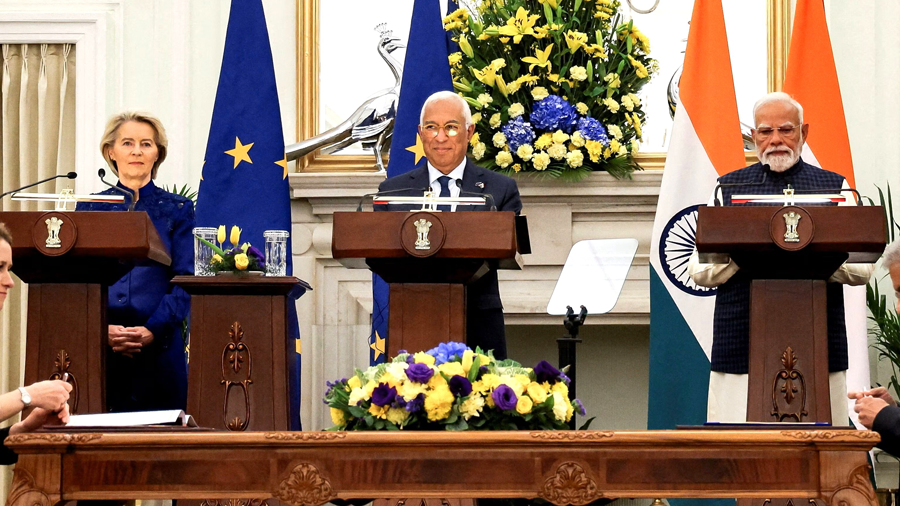
Announced at the 16th India-EU Summit, the long-awaited India-EU Free Trade Agreement goes beyond expanded market access and export potential to become a milestone in strengthening a resilient and forward-looking strategic partnership. As India and the European Union continue to redefine their partnership amid shifting global dynamics, much of the focus has centred on trade negotiations, connectivity initiatives, and shared geopolitical concerns. Yet beneath the “Mother of All Deals”, science and technology cooperation has emerged as the quiet engine shaping the partnership’s long-term trajectory, driving innovation, shaping norms and standards that underpin deeper strategic alignment.
In an era defined by rapid technological change, climate stress, and growing geopolitical fragmentation, science and technology sit at the core of strategic autonomy, shaping economic resilience, security, and global influence. For India and the EU, leadership in developing, governing and setting standards for emerging and critical technologies ranging from artificial intelligence and clean energy systems to digital infrastructure and advanced manufacturing now determines their capacity not only to shape norms and influence, but also enhances their capacity to address shared and pressing challenges. As technological competitiveness intensifies and techno-nationalism rises, the ability to cooperate on innovation and global standards has become a strategic necessity.
In this context, India-EU S&T cooperation goes beyond conventional research partnerships. In response to fragmentation and rising geopolitical pressures, including export controls, weaponisation of supply chains, and divergent regulatory frameworks, the India-EU strategic partnership stands out for its emphasis on openness, co-development, and trust-based cooperation between two like-minded partners.
India-EU science and technology cooperation, set to mark 25 years of formal engagement later this year, is anchored in the Agreement for Scientific and Technological Cooperation, first signed in 2001 and periodically renewed. The most recent renewal extended the agenda through 2030, reinforcing a long-term framework for joint research, reciprocal participation in programmes, co-investment mechanisms and shared intellectual property principles, innovation, and capacity-building across emerging and critical technologies.
Institutional oversight is provided through the India-EU Joint S&T Steering Committee, guided by mutual benefit and coordinated research priorities. Over time, this framework has enabled cooperation across a broad spectrum of domains, including clean energy, health, water technologies, information and communication technologies, space and nuclear research. Crucially, it links Europe’s research capacity with India’s rapidly expanding innovation ecosystem, creating a durable platform for long-term engagement. India-EU S&T cooperation forms an integral component of the partnership and will play a defining role in shaping its future trajectory.
The strategic weight of this cooperation is matched by measurable outcomes. An evaluation of the EU-India Science and Technology Agreement for 2020-2025 by the European Commission’s Directorate-General for Research and Innovation highlights collaboration across priority areas such as energy systems, health research, water technologies, and information and communication technology (ICT), underlining the depth and impact of bilateral research and innovation programmes. It is also reflected in the strong participation of Indian researchers in the Marie Skłodowska-Curie Actions and their position among the leading non-EU recipients of the European Research Council funding. India participated in collaborative projects under Horizon 2020 and Horizon Europe, which further illustrate the scale of these academic and research linkages, contributing to advancement across a range of S&T domains. Beyond scientific output, these initiatives reflect a robust architecture of co-funded and co-designed research aligned with shared priorities, including mobility and talent development, joint innovation, and deeper institutional cooperation.
The momentum in India-EU S&T cooperation is further reinforced by growing academic mobility, with Europe, particularly key member states such as Germany, France, Italy, Spain, the Netherlands, and Denmark, emerging as major destinations for Indian students and researchers who act as natural bridges between Indian and European innovation ecosystems, which brings in long-term sustenance of joint collaborative activities. This cooperation extends into mega research infrastructures where Indian scientists actively participate, including CERN in Switzerland, the FAIR accelerator and DESY in Germany, Elettra Sincotrone in Trieste, Italy and the European Synchrotron Radiation Facility in France, fostering joint innovation and knowledge creation. Institutions such as the International Centre for Genetic Engineering and Biotechnology (ICGEB) strengthen collaboration in biotechnology and molecular research, offering advanced labs and training that connect Indian and European science communities.
Mechanisms such as Marie Skłodowska-Curie Actions, Erasmus+, and Horizon programmes, bilateral scientific cooperation programs with several EU member countries, give engagements to several Indian researchers, students and early-career innovators with the European research ecosystems, gaining access to advanced infrastructure and collaborative networks. Initiatives such as VAIBHAV (VAIshwikBHArtiyaVagyanik fellowship) and SPARC (Scheme for Promotion of Academic and Research Collaboration) complement this trend by institutionalising researcher mobility and collaborative knowledge production with European partners. Beyond immediate research outcomes, these exchanges long-term professional networks, strengthen institutional linkages, and create innovation spillovers across academia and industry. Complementing these research collaborations, India-EU collaboration also spans global initiatives and alliances addressing climate, energy, and resilience, including International Solar Alliance, the Global Biofuel Alliance and the Coalition for Disaster Resilient Infrastructure, as well as the India-EU Clean Energy and Climate Partnership, the Global Gateway Strategy and joint research in fusion and renewable energy technologies.
The recent joint statement, Toward 2030: Joint India-EU Comprehensive Strategic Agenda,recognises science and technology not only as a vital supporting tool but also as a central driving force shaping the partnership’s future. S&T cooperation is embedded across all pillars such as trade, technology cooperation, sustainability, security, and connectivity, signalling a move beyond sectoral collaboration towards strategic integration.
The agenda identifies emerging and critical technologies, such as artificial intelligence, quantum computing, advanced semiconductors, biotechnology, high-performance computing and green hydrogen as priority areas, linking joint research to industrial deployment, supply chain resilience, and digital governance. Mechanisms including India-EU Innovation Hubs, cross-border startup partnerships and deeper integration with European research ecosystems, including exploratory steps towards Horizon Europe, further institutionalise cooperation. Beyond bilateral benefits, the framework positions India-EU S&T cooperation as a globally relevant collaboration, fostering joint standard-setting, regulatory dialogue, and innovation-driven solutions to shared challenges in climate, health, and security. By embedding scientific cooperation at the core of trade, competitiveness, and multilateral engagement, it shapes the trajectory of the partnership and contributes to emerging norms and governance frameworks in technology.
Described as the “mother of all deals”, the India-EU trade agreement brings together markets, regulations, and long-term economic engagement at a time when global trade is being reshaped by uncertainty and fragmentation, signalling commitment to openness and predictability. Alongside this evolving trade architecture, science, technology and innovation cooperation has provided a continuity in India-EU relations. Over the past 25 years, this partnership has steadily evolved, cementing the relationship through renewed frameworks, rising investments, expanding priority areas, and building natural bridges through mobility and talent development, providing a future-oriented anchor even amid rising technology competitiveness and techno-nationalism.
STI cooperation is now increasingly becoming a driver of change. As India and the EU confront shared challenges from climate transitions, public health, digital transformation and emerging technologies, scientific collaboration is moving beyond research funding towards technology co-development, innovation ecosystems and standards-setting. While the trade agreement provides the structure and scale, STI cooperation complements it by preserving continuity, and enables the India-EU partnership to adapt and transform in a rapidly changing global landscape through shared innovation, trust-based collaboration, and long-term, evidence-based problem solving.




Leave a Reply