

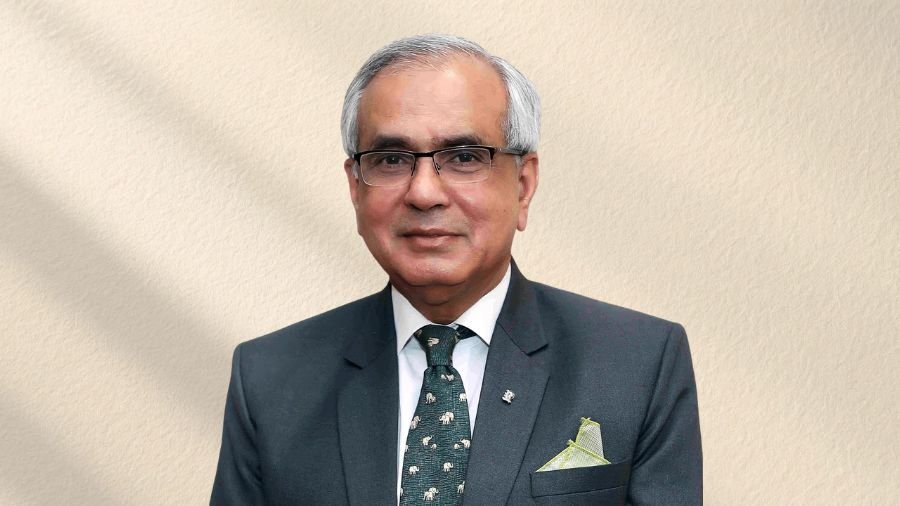
At the India–BRICS Dialogue 2026, held at The Habitat Centre in New Delhi, on 8th April 2026, Dr. Rajiv Kumar, Chairperson of the Pahlé India Foundation, spoke about the ethical dilemmas of emerging technologies, the shifting contours of global governance, and the transformative potential of BRICS in shaping a new world order.
He addressed a pressing concern: the unchecked rise of artificial intelligence and the urgent need for global ethical consensus. Drawing a parallel with a landmark moment in scientific history, he remarked, “When Dolly the sheep was cloned, the world came together to agree that human cloning would not be pursued. We must arrive at a similar global understanding for artificial intelligence.”
Raising fundamental questions, he asked, “Where do we draw the line? What are the limits within which AI must operate?” His intervention underscored that technological advancement without ethical guardrails could pose risks not just to economies, but to the very fabric of human society.
Moving beyond technology, Dr. Kumar framed the discussion within the broader context of global public goods. He highlighted the emerging demographic divide, with regions such as Africa experiencing a demographic surge, while countries such as India, China, and much of Europe are steadily ageing. This transition, he argued, demands a rethinking of public health systems and social frameworks. “We must build societies that are not only economically productive but also compassionate and responsive,” he emphasised, calling for dignity and inclusion for ageing populations.
Another transformative force, according to Dr. Kumar, is financial technology. As fintech disrupts traditional banking systems through innovations such as cryptocurrencies and central bank digital currencies, the very architecture of global finance is being reshaped. “The role of intermediaries is changing. The question is, who will regulate and safeguard these evolving systems?” he noted, pointing to the governance vacuum emerging in this domain.
Equally significant is the growing influence of non-state actors in international affairs. In an interconnected world, corporate and technological entities wield unprecedented power. Dr. Kumar cautioned that without a shared global framework, such actors could disproportionately influence or even destabilise the world order.
These challenges, he argued, must be understood against the backdrop of a changing geopolitical landscape. Referencing the gradual decline of Pax Americana, he observed that the world is entering a phase of uncertainty and fragmentation. Echoing Thomas Friedman, he noted that the world is no longer “flat” but increasingly defined by “crevices and fault lines.”
This evolving reality raises a fundamental question: who will shape the next global order? Institutions created in the aftermath of World War II, he argued, are no longer fully equipped to address contemporary challenges. They must be reimagined to respond to both the risks and opportunities of the 21st century.
It is within this context that Dr. Kumar positioned BRICS as a potential force for global transformation. “BRICS has the resources and the opportunity to play a defining role,” he asserted. Yet, he was equally candid about the bloc’s current limitations, particularly the lack of internal coherence.
To address this, he proposed a long-discussed but unrealised idea, the establishment of a formal BRICS Secretariat. Drawing a comparison with existing institutions, he argued that if the New Development Bank can function effectively, there is no reason why a dedicated secretariat cannot be created. Such an institution, he suggested, would enable sustained dialogue, policy coordination, and greater alignment among member states.
Another critical pillar of BRICS cohesion, according to Dr. Kumar, lies in the relationship between India and China. Recognising them as the two major emerging powers within the grouping, he stated, “For BRICS to function effectively, a greater degree of understanding between India and China is essential.” He further noted that leadership and political will, particularly from India, would be crucial in advancing this alignment.
Dr. Kumar offered a forward-looking vision for BRICS. He emphasised that the grouping must move beyond its current government-to-government framework and actively foster business-to-business and people-to-people linkages. “BRICS cannot remain confined to a G2G arrangement. It must deepen B2B and P2P engagement to truly realise its potential,” he stated.
“BRICS need not remain peripheral—it can become mainstream,” he concluded, urging member nations to seize the moment.
The event was hosted by The Secretariat in collaboration with Pahle India Foundation and supported by The Spark Forum.


Leave a Reply